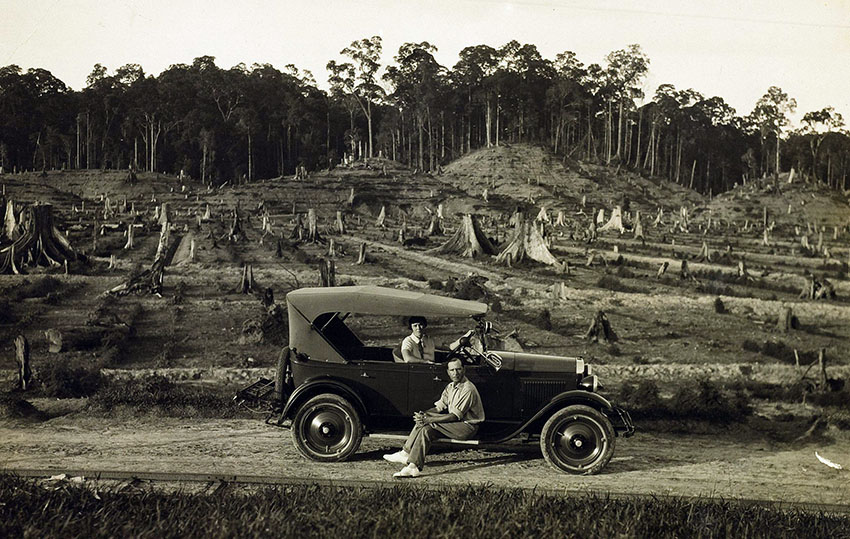
Lulofs, 1920s
At five o’clock, while it was still dark, the ton-tong roused the coolies from their deep sleep. They awakened moaning and yawning, stretched themselves and scratched. During the night they had been bitten by bugs and mosquitoes. Some of them washed, bending over tins of water in front of the huts. Others merely rinsed their mouths and changed from a sarong into a pair of shorts. Then, when the ton-tong sounded again and all the other ton-tongs sent back an echo, they took their spades on their shoulders and walked to work slowly, sleepily, reluctantly. They always marched in single file, dark silhouettes moving through the dark day break. Above their heads the stars paled on the greyish sky, and disappeared before the deepening glow coming up from the east. All around them on the distant horizon, encompassed by the virgin forest, half enveloped still in the milk-white morning mists, was land that would one day become the new estate. It was a colourless, dead plain where every thing that had once been alive had been uprooted, burned, destroyed. There had been the stately trees of the ancient forest, the thorny rattan, the creeping, stifling weeds, the ferns and the mosses, the snow white and dark purple orchids that had exhaled their perfume unseen. There had been animals too, serpents, scorpions, ants, and centipedes. They had crawled, wriggled, worked, and reproduced in the hot: putrefying weeds, decaying wood, and detritus of all kinds.
Continually a life just ended had risen again, pushing, murdering and throttling other life, striving upwards towards the glimpses of sunlight that filtered down between the high crowns of the trees like drops of melting copper. For centuries on end the secret struggle for life had gone on in the perennial dusk. Suddenly men had come, cutting, uprooting, destroying the majestic tree trunks, and the myriad suckers of the creepers. The blows of axes had resounded through the forest, and a thundering roar, magnified a thousandfold, had echoed through the dim depths like the sound of a dire disaster as these old giants of the forest fell dying. Still, under these colossal trunks with foliage lying criss-cross all over the ground, the black, soft, moist humus had continued to live. While the trunks and the branches of the trees were dying, the tough, juicy creepers and parasites had continued to grow and prosper. Ferns had shot up, orchids had flowered with a last magnificent efflorescence from the bark that was crumbling away. Deep under this chaos of leaves and fibres, creeping creatures still lived, unaware as yet that death was rioting above them.
Then in one morning at one stroke fire had put an end to all that remained. It had flared up, crackling, hissing, sizzling among the mighty tree trunks. It had greedily devoured and digested the things of the forest that had remained untouched for centuries. It had stretched its thousand contorted arms towards the blue sky where the brassy sun was less consuming than itself. There had been a raging era of fire, a furious flood of flames bellowing as it reached up heavenward.
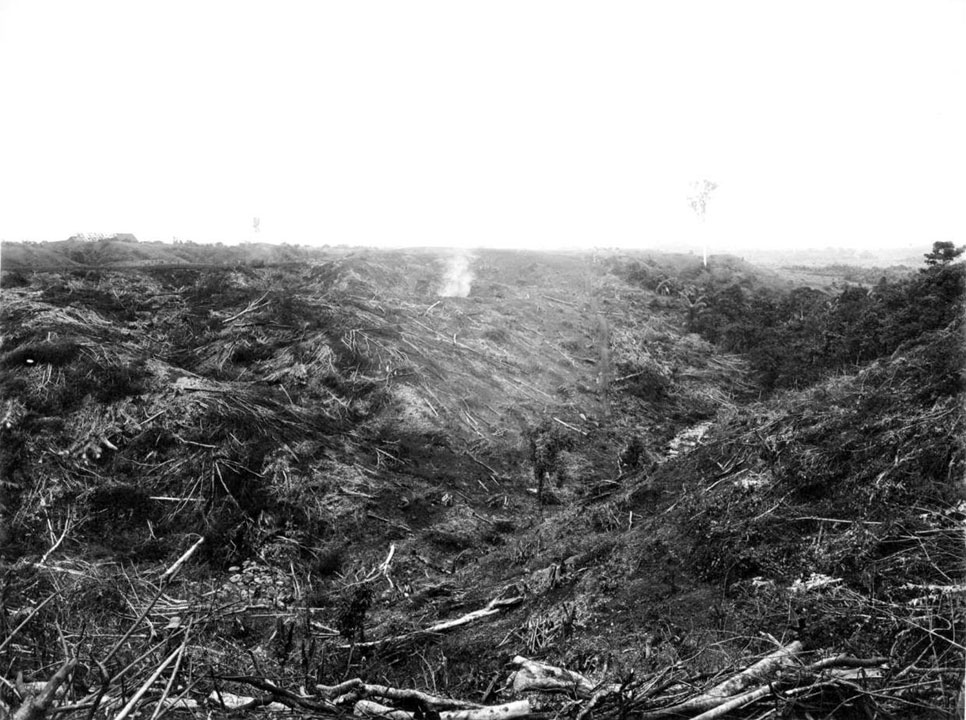
Before they had realised what was happening, plants and animals had been annihilated. For one second they had been checked in their accustomed ways. Then they had perished, destroyed utterly by the ruddy fire.
By night, nothing had been left but a smouldering, smoking mass of debris, a black, hot world of ashes and soot and mangled fragments. All that remained of the river of flames was a thin deposit of greyish dust. Tiny tongues of fire licked the corpses of the trees, and crept along bits of trunk that had escaped the full fury of the fire. The evening breeze carried away thin strips of calcinated grass and fern and dropped them in the form of a tenuous black dust. Then the wind freshened and blew on the smoulder in stumps until the fire blazed up again and, though satiated, began to feed once more, devouring the last remnants of its vast banquet.
Sometimes the smouldering heaps crumbled together with a dull, tragic thud or with a last tired sigh. Then a shower of sparks rose up into the air and dropped asunder, like red stars chased across a landscape by the wind. One tree remained standing isolated in the ill used plain, a mighty trunk whose crown had been merely singed. The axe spared it henceforth, as the fire had done. It was the most sacred of all sacred trees, the king tree. Its white stem, so many centuries old, alarmed the coolies. They dared not touch the tree that could be destroyed by Allah alone. Lofty and pure, it contemplated alike the destruction and the construction wrought by human hands-mighty in themselves, but puny in comparison with the strength of the sacred tree.
Barren, empty, desolate, overpowered and humbled, the land lay there, waiting patiently for the yoke of civilisation. Chinese were turning the earth with their spades, searching it deep with their cruel implements. With an endless repetition throughout the long scorching day, they lifted their arms and bent their bare yellow backs, down which the sweat ran in rivulets. The piercing rays of the sun tortured the naked parched land. It roasted to a darker brown the brown bodies of the Javanese coolies, and it burnt the white skins of the Europeans to a dull red hue. But from these uniformly yellow bodies it seemed to glide off powerless, as though they had been animated by a life more obstinate and ruthless than the gruelling heat that fell from the sky and rose again from the earth.
Along the edge of the forest, canals were being dug. There the Javanese coolies stood up to their thighs in the grey, putrid, evil-smelling water of the swamp. To each the mandur had allotted a task. Ruki looked straight ahead of him along the bed of the waterway which, almost choked with mud and vegetation, ran into the forest. Trees had fallen into it and across it, and lay there, together with decaying plants and dead animals, rotting into a black, slimy paste from which new plants were already shooting up vigorously.
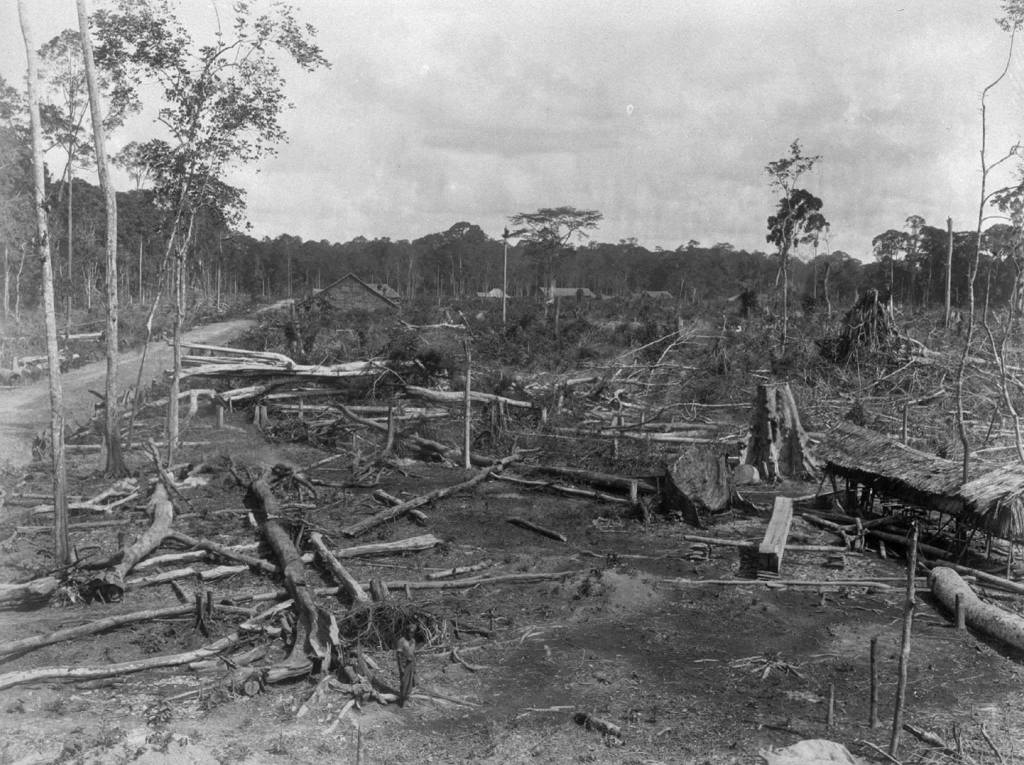
From Coolie (Madelon Lulofs-Szekely), describing large scale deforestation in North Sumatra committed by European planters.
 Stories from Deli
Leave a comment