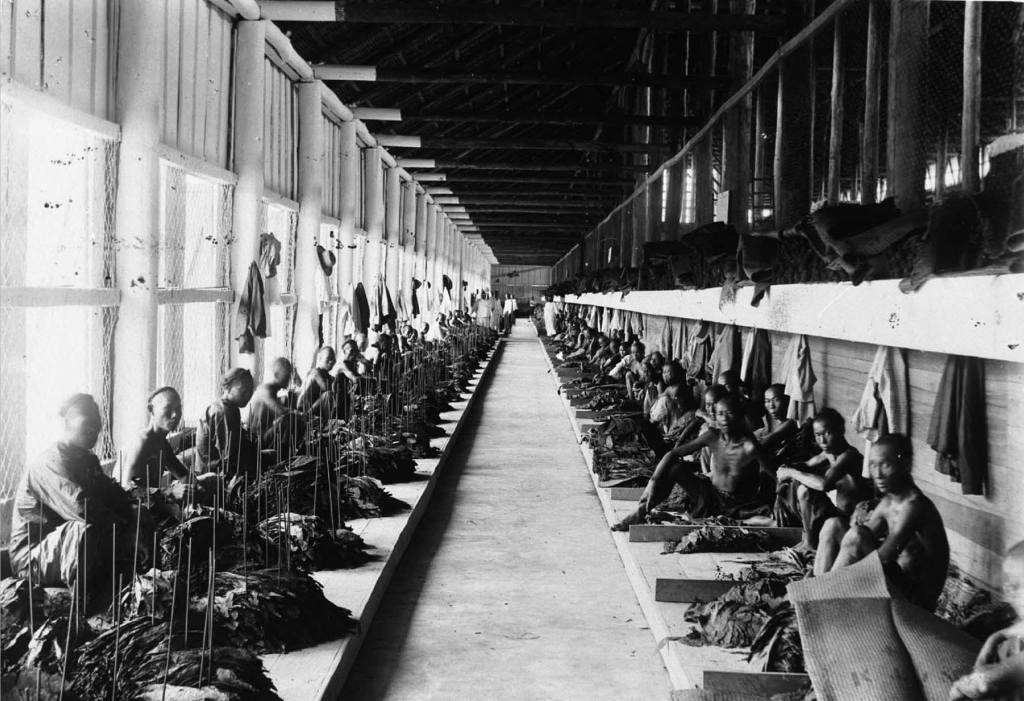
Dixon, 1913
Years ago, we saw how, during the tobacco sorting season several ringleaders threw the estate into total commotion.
It had been a bad year for the plantation in question. Due to all kinds of circumstances, the tobacco only grew moderately. Some poor soils had to be planted, rains came too late, finally, when it rained, it was too much, in short, it ended in a crop failure.
Already during the field time, there had been unpleasantness with the coolies, as they were dissatisfied that much of their planted tobacco had not grown or died so that they had not been able to make as much money as would otherwise.
As is customary in such cases, they would have been compensated for the damage incurred, but this was in proportion to what their tobacco would have yielded in other years if it had grown well.
However, the company also made large losses, as the harvest was far below expectations and the operating costs were not even recouped.
The tobacco was finally in; the coolies sat in the sorting sheds sorting them. The statements had been drawn up and published, so that every coolie could see for himself how much money he had made this year.
The clerk had made it known through the chief tandil that anyone who had any further remarks to make on his statement would be given the opportunity to do so.
Most of the coolies took advantage of this leave, but it turned out that there were no actual advertisements, but that they boiled down to this, that the coolies asked the clerk to pay them even more for the dead or unharvested tobacco.
When it was reckoned to them that they had been treated justly and fairly, that most had already received much more than they were actually entitled to, they went back to work, but the true satisfaction was not there.
They continued to sulk. When all had had their turn, the date was fixed when the annual payment of the profit balances would take place.
The day before this was to be done, the chief tandil reported that the coolies had decided that none of them would take the money, but intended to go to the inspector to complain to him that they had so little deserved.
He, informed by telephone of the intention, and not keen on receiving a visit from a few hundred disaffected Chinese coolies, promised to come immediately himself and make a personal inquiry.
When he arrived at the company a few hours later, accompanied by the Chinese lieutenant, there was a great uproar in the sorting shed, as all the coolies wanted to expose their grievances to the “tuan inspector.”
As no serious investigation could be envisaged in this way, the coolies were summoned one by one to the administrator’s office, where their accounts would be examined again. But it soon became apparent to the inspector, too, that there was no question of advertising in the real sense, that the coolies were only interested in getting more money.
The inspector, therefore, told them that they had been treated in accordance with all rights and fairness, the accounts were in order and that they had nothing more to claim. They were urged to return to work calmly and orderly.
The matter seemed to be over. Not for the coolies, however.
Being unsuccessful on all sides, they were not at all satisfied with the turn the matter had taken for them.
The clerk, seeing very well the danger of the situation, asked the inspector to leave some Native police guards at the company, so that in time of need, when a disturbance broke out, where there was every chance, he could scout out help.
However, the inspector thought he could not do this, as nothing had actually happened yet.
First one had to wait for the course of things, the magistrate thought. With the sincere advice not to get nervous and to keep him informed of all the events by telephone, the “tuan inspector” drove home again.
In the meantime, the situation at the company was far from pleasant.
There was a good chance that the coolies would not go to work the next morning, or make a riot in the sorting shed or at the payout.
The clerk decided to postpone the payment until complete calm and tranquility had thus returned. There was nothing else to do but wait. In this, one had to rely largely on the main tooth, in the hope that he would find out in time enough what was actually brewing among the coolies. The next morning the coolies went to work at the usual time. The sorting could continue as usual. Well-sorted bundles of tobacco were received and paid, others returned for review.
Yet it was felt that something was about to happen.
In the sorting sheds, where a few hundred Chinese coolies are together, one hears a buzz of voices, which is only stopped when the supervising assistant is nearby, to be resumed immediately behind his back, now nothing, no merry talk.
Dead silence everywhere.
It was like the calm before the storm that can break loose at the slightest moment at any moment.
The clerk himself was there all day long, to be at hand when something happened. They had to be there nevertheless remembered that at a given moment, the signal would be given for a disturbance.
In his opinion, could not yet say anything with certainty. He did not believe, however, that anything would happen this day; in the evening he could give more information.
He was again strongly urged to obtain accurate reports and report this. Even in the afternoon, when the coolies went home at five o’clock and the day’s work was over, nothing unusual happened. The coolies did not seem organised enough to act.
It was still dark in the morning, when the Bengalese night watchman came to tell the “tuan-besaar” that the head tandil was there, which the gentleman urgently needed to speak to.
He donned some clothes and stepped outside, where the head tandil was waiting at the stairs of the house. At last, he had succeeded in obtaining reliable information about the plans of the coolies. The plot had been betrayed.
He now knew the names of the main instigators. Six dangerous fellows, who were especially after the tuan-besar. It would happen this morning. At a signal from one of them, everyone in the sorting shed would get up at the same time to attack the manager.
Everyone had promised to participate, no one should be left behind. A chicken had been slaughtered at night to seal their pact. The coolies figured that in the commotion no one would see who actually made the assault and thus no one would be punished. It was now high time that action was taken. In the east, a light line heralded the approaching day.
The big bell at the administrator’s house was already ringing to call the coolies to work.
They were already slowly walking up the road from their houses to the barn.
It was important to take up the bells before this opportunity to enter the barn. Once they were there, it would certainly not be so easy to get them out unopposed.
The manager hurried to the shed with the head tandil and some Bengalese guards of the enterprise.
The Chinese arrived in groups of three and four, as usual; unaware that the main tandil had learned of their plans just in time. On his instructions, one by one the ringleaders were picked up (by the police) and taken to the administrator’s house without resistance, because you were completely taken by surprise by this action.
From here, they were immediately sent to the inspector with escort. Even before all the coolies knew what had happened, this scene had taken place. When all were well and truly inside, the ringleaders were already on their way to the magistrate.
It turned out that now that the ringleaders had been removed, the the rest of the coolies, deprived of their leaders, did not feel inclined to take any further action against the administrator.
Soon, then, all were back to their usual habits, to the inevitable. Calm and tranquility returned to the enterprise. The manager’s vigorous and resolute action had prevented an uproar here with all its unpleasant aftermath.
From: Dixon, C.J., 1913. De assistent in Deli: practische opmerkingen met betrekking tot den omgang met koelies. JH de Bussy.
 Stories from Deli
Leave a comment