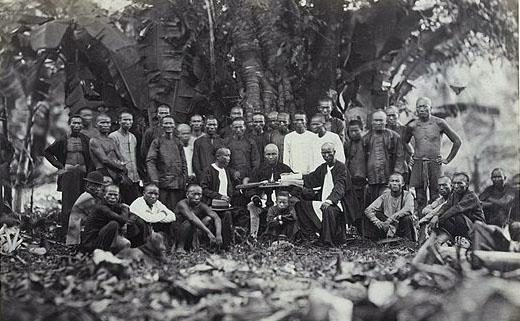
Wong, 1884
During the last four months of 1884, Deli witnessed a sequence of coolies’ riots across the tobacco estates. The coolies, belonging to two different secret societies, the Ho Seng and Ghee Heng, took up arms ranging from sticks and parangs to revolvers to fight against each other. Bindjey, Medan, and Laboehan were the hardest hit by these riots.
Mobs of coolies, especially the Ho Seng members, charged the towns and raided brothels and houses seeking members of the Ghi Heng to kill. By December 1884, the riots engulfed more estates and spread to Serdang.
In one estate, all three hundred coolies stoned the manager and three assistants. Many Chinese were killed or injured, along with members of other ethnic groups such as Batak, Malay, and Dutch officers.
By increasing their military forces and arresting the ringleaders, the Dutch eventually suppressed the riots. For the Dutch authorities, these estate riots were just criminal acts committed by coolies, who were, in turn, influenced by the secret societies.
However, the riots were rather more than that. They were a plot by some wealthy Chinese businessmen, who included a government officer and leaders of the secret societies, to weaken their rival for the revenue farming business in Deli, which was to open for tenders at the end of 1884. Gaining control of the revenue farms here was a highly profitable business since Deli was one of the most important tobacco-producing regions in the world, housing about 20,000 coolie customers by 1884.
Khoo Teng Ko, the Lieutenant of Chinese in Laboean, Lim Tek Swee, the Kapitan China of Deli, and Lim Tjing Keh, the Lieutenant of Chinese in Bindjey, were most probably the leaders of the Ho Seng and closely connected to the big five society in Penang.
Khoo Teng Ko, for example, was an active patron in Penang: from 1882 to 1890, he had donated 2000 yuan to most of the temples and public cemeteries managed by the big five. In addition, he had gone into partnership with Khoo Soo Ghee and Eow Chaw of Penang to establish a general trading store, Wong: The Big Five Families in Penang, Chop Ee Seng, on Beach Street in Penang. Through this intricate network of association with the leaders of Ho Seng in the east coast of Sumatra, it seems very likely that the big five’s Kian Teik Tong could have allied itself with the Ho Seng to play a part in organising the coolies’ riots as a form of economic leverage in intra-elite commercial competition.
From: http://chl-old.anu.edu.au/publications/csds/csds2007/Wong.pdf
The Big Five Hokkien Families in Penang, 1830s–1890s by Yeetuan Wong
 Stories from Deli
Leave a comment