
Mulder, 1898
The Chinese coolie is an absolute necessity for the planter in Deli. It is doubtful if a labourer could be found that would serve all the purposes as well, taking into consideration the climatic conditions. He is admirably adapted to the work and understands what is expected of him. Europeans could not possibly stand what the Chinaman stands with impunity.
The coolie is usually imported direct from China and at a very great expense, so that usually a number of planters club together and send one or two men to China to engage and bring over the coolies for them all. These coolies are called “singkehs,” equivalent to our word “greenhorns.” They know nothing about the cultivation of tobacco, and have to learn it from the Chinamen who have already been in Deli for a year or more.
The Chinaman does not plant and cultivate the tobacco on regular wages, but at so much per l,000 plants grown. Later in the season, how ever, he does piecework in the fermenting shed. Each receives in the first place a few dollars down, usually $4, upon signing the contract. Then there is an advance of from $4 to $8 each, according to his appearance.
This is advanced before anything is done by the coolie, in order to give him some capital to live on. The money so advanced is charged to the account of each individual, and is paid back when the tobacco is brought in. All the rest of the expense of getting the coolie over to the island and any bonus he receives is not returned directly to the planter. The Chinese coolie is bound to sell the tobacco to the estate.
The manager gives him a field of land, about 1.5 acres, after it has been cleared of the larger trees. He then gives him the necessary implements for clearing and cultivating the land, the actual cost of which is charged up to his account.
Further, on every pay day, that is, on the 1st and 16th of the month, he gets from $1 to $1.60 advance, according to his standing. This is charged to his account. There is no Sunday in Deli. These pay days are called by the coolies -‘hari besar,’ or great day. On these days they are not expected to work in the field, but are paid off about 11 o’clock in the morning and have the day to themselves.
The Europeans are paid by the month. The Chinamen from Singapore or Penang, who have been one or more years away from China, and those who have worked one or more years on the tobacco plantations and have been able to pay their debts and reengage themselves for another year, are, of course, considered the most desirable coolies to have.
They speak a little of the native language — Malay — and often a little English. It is almost necessary to have a few of them on an estate to teach those who come from China direct. They know exactly what is to be done and how to do it, and they understand, moreover, that it is to their own interest to work well.
There is one serious drawback, however, that they are inclined to be a rowdy set. They are inclined to think that they know more than they do and that they have more rights than others, and they very often cause great trouble on some of the estates.
House
The establishment includes a house for the manager, which, in the beginning, is a plain cottage, lifted from 6 to 9 feet above the ground, for the manager and one assistant. Later a better house is built. Chinese coolies, with the exception of the tandil, or foreman, are always single men. Sheds are usually built for them about 18 by 36 feet, one shed being intended for ten men. There is a small separate building of about 25 feet square for the head tandil.
There is a general kitchen, consisting of a shed about 13 or 18 feet wide and 100 feet long, where every coolie cooks for himself, excepting in sorting time. Their food is then prepared for them in bulk by the storekeeper.
The Javanese coolie has a somewhat different house, as a great many of these are married men. They have small houses, about 25 feet square for the married men, while for the single men the houses are similar to those of the Chinese coolies.
There is a store on the estate under the control of a Chinese merchant, who usually pays for the expense of the building and who sells to the coolies at prices subject to the approval of the administrator. As the estate grows, branch stores are established in the several divisions of the plantation under the control of this merchant.
When there are many Javanese coolies there is a separate store in the Javanese quarters, as the Javanese coolie is a Mohammedan and is not allowed to even touch anything coming from the pig, while this is the principal diet of the Chinese coolie.
SUPERINTENDENCE OF THE COOLIES
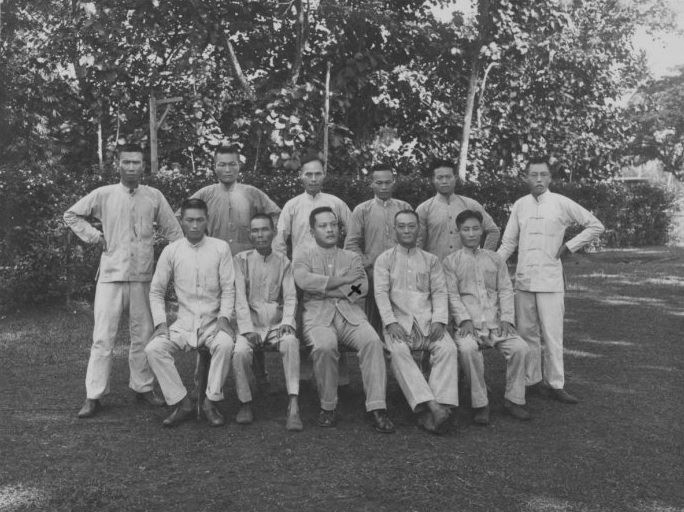
About every 40 men have a foreman, called ” tandil.” He is a Chinaman who has had a few years’ experience and has been promoted from the ranks of the coolies. This man receives usually 7 per cent of what his division of coolies gets and is entitled on pay day to $4, to be charged against his account.
The head tandil is the head foreman of all the Chinamen on the estate. He is usually a civilized Chinaman who has been a coolie, then a tandil, and who has consequently had all the experience which it is necessary to have. His position on the estate is one of great importance, and many a row and difficulty between the coolies and the European assistants could not be fixed up without his assistance.
His income depends upon circumstances, but is always more than any of the assistants, and is sometimes as much as the manager receives. He does not get as large a stated salary as the manager, but he has several perquisites, including the concession of the gambling tables on great days, which, altogether, means a large sum.
The working hours when the coolies are expected to be in the field are from 6 am to 11 am, then there is a rest from 11 am to 1 pm., then in the field again from 1 pm. to 6 pm., making ten hours a day.
In working in the fermenting sheds the hours are the same, excepting that the noon rest is shortened one hour and the day ends an hour earlier, as there would not be light enough after 5 o’clock to do the sorting.
A very complete system of espionage is maintained over the coolie by the planters. They frequently run away to escape payment of their debts, or for some crime that has been committed in the frequent affrays that take place.
There is an agreement between some of the planters that a coolie shall always be given a letter of discharge when he leaves a place honorably, and they will never engage a coolie outside of China or Singapore unless he is provided with a proper letter of discharge. This letter contains the name and a full description of the person.
Nevertheless, there is a large traffic in these letters, and they often sell for $10 or $15 apiece. If a person is caught using a discharge letter not intended for him, the letter is confiscated and the coolie is sent to jail.
No coolie is allowed to leave the estate during the year and visit another estate, or go to a neighbouring city without first getting a written pass. The color of the pass is pink, while the discharge letter is a light green. A pass is usually issued for from one to ten days. Whenever a coolie is met on the public highway by a police official his pass is demanded, and if it is not shown he is confined in jail until the police can find out from what estate he has come. A reward is offered of $2 or $3 to the guard who returns the person, and this amount is charged up to the coolie himself.
Notwithstanding the strictest pre- cautions, there are many who run away in Sumatra and are never brought back. Any manager belonging to the planters’ committee engaging a coolie without a proper discharge letter is liable to a heavy tine from the committee.
PUNISHMENT FOR CHEATING
The coolie often attempts to plant short, as it is called — that is, to plant less than 2 by 3 feet — in order to get a larger number of plants on the field. It is the duty of the European assistant to enforce the rule of planting very rigidly, and sometimes the coolie is compelled to pull out his plants and replant them the next day. Many disturbances arise over this question and serious quarrels are the consequence. When the short planting is discovered by the European assistant the next day after it is done it is a good lesson for the coolie, and he is not apt to plant short again: but after a few days have passed and the plants are growing it is rather hard to have to pull them out and reset the plants pulled out.
From: Emile Mulder. Cultivating Tobacco in Sumatra.
 Stories from Deli
Leave a comment