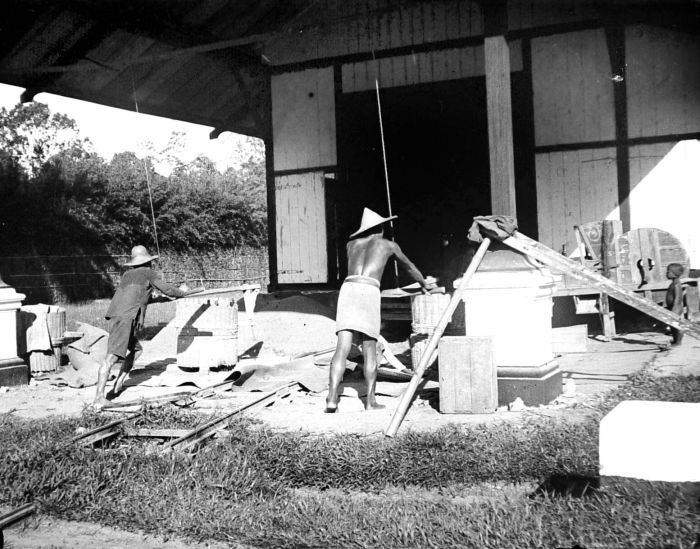
Ann Stoler, labor in 1930
Through 1930 labor unrest still showed no signs of subsiding. The total number of assaults and threats on supervisory personnel remained virtually the same as in 1929.
On the Bah Boetong estate and several neighboring plantations in the far western district of the cultuurgebied, 400 workers participated in a work stoppage, demanding full-time off for an Islamic holiday.
On a tobacco estate, 40 Chinese workers demanded the dismissal of an overseer.
In July, 35 Chinese workers refused to work because of a wage dispute. And on the following day, 200 workers rioted in protest against an abusive foreman; upon the arrival of a labor inspector and the police, most of the workers returned to their jobs, and eventually, the foreman was dismissed.
In early August, 65 workers staged a work stoppage, demanding the dismissal of an assistant who had mismanaged their rice rations and forced them to work on holidays; the assistant was transferred and the rationing was readjusted.
In August, a group of Chinese tobacco workers staged a work slowdown.
In September, 11 new Chinese recruits refused to work because of a wage dispute; they were immediately returned to China.
Elsewhere, a number of Chinese workers protested the way their cash advances were calculated but returned to work when police arrived to make arrests
Meanwhile, the right-wing European community was gaining ground. The Vaderlandsche Club, for one, had expanded to 400 members with branches in Kisaran, Siantar, and Binjei. As the severity of the depression became more apparent in mid-1930, other political and economic organizations were established to ensure that government priorities concentrated on safeguarding foreign capital-not the jobs of Asian workers.
In December the Colonial Workers’ Association was set up to countermand “difficult and costly social legislation … which would lead to complete economic disruption.”
But the depression was a worldwide “disruption” that local planters were powerless to avert. The only question was to what extent the companies could use it to their advantage, and the answer was found in a massive retrenchment of European and Asian labor.
In May 1930 the estate workforce totaled 336,000; by December, 40,000 workers had been dismissed, and by late 1931 another 62,000 were fired. This trend continued until 1934 when there were only 160,000 workers left (partially) employed on the East Sumatran estates. The industry was in dangerous economic straits, but its control over the labor situation remained clear-sighted and precise. As thousands of workers were repatriated to java each month, a careful selection process assured that only the most trusted, docile, and hardworking married men and women were retained.
In 1931 the number of assaults and threats on supervisory personnel dropped to 113 from 220 the preceding year. The number continued to decrease through the 1930s, reaching an all-time low of only 25 such incidents in 1936. Some of those who had long opposed the penal sanction were convinced (or so they argued) that the decline in assaults was directly related to its demise; others were under no such illusion and saw the reduction in assaults as an obvious result of employing a much smaller number of workers.
With a rigorous selection for “good elements” (of submissive character and healthy physique) there was less occasion for maltreatment and less impetus for resistance among those who were fortunate enough to have any work during the depression.
From: Ann Stoler. Capitalism and Confrontation in Sumatra’s Plantation Belt.
 Stories from Deli
Leave a comment