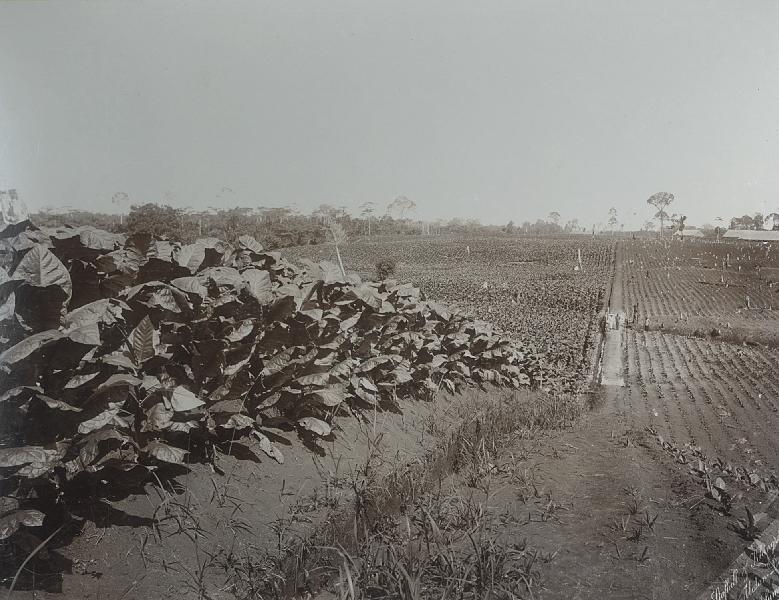
Boersma, Deli in 1870-1880
The rule was that the land used for tobacco was to be left for ten years, to be able to make an annual planting of 300 fields, the planter had to dispose of about 3,000 baoe. If he had less and still wants to plant his 300 fields, he had to return to the first-used fields within ten years.
The general finding was that the crop produced less when the soil had a shorter fallow than ten years.
If the plantation land was small after it was planted after a few years and then the field was closed. To give an example: Polonia had a concession from 1869, a few thousand baoe. In 1873, they worked with 228 Chinese and one assistant, obtained 88500 pounds of tobacco. In 1878 they had 250 coolies and yielded 175 thousand pounds. In 1879 the crop was 148 thousand pounds. In 1883 with 212 coolies 137600 pounds, and after that, the estate had to be closed because it had been “exhausted”.
A company that did two harvests in a row reported that the yields were disappointing twice in one year.
There were, alas, those who, with undue reliance on wealthy grounds, tilled the former tobacco fields, once they had supplied padi. Others thought they had to strengthen such fields before or under the cultivation and tried vigorous tillage by plowing and fertilizing. This was around 1878.
In addition to animal and green manures, artificial fertilizers were also used. The inferences were very different and of only significant value over short duration.
Since the gathering of natural fertilizers required more effort and was uncertain, the use of fertilizers gradually gained the upper hand, and before long, one could speak of guano-mania. It was a question of determining the correct method of fertilizer application and the right amount because the tobacco leaf was very sensitive to it, its color and later its “burn”; could suffer from too much fertilization.
And the Chinese planter, soon knowing the influence of manure on yield, gladly administered it generously, so that European supervision of it had to be tightened up. Replanting occurred after 2 to 4 years of fallow, without fertilization with satisfactory results. There were those who found useful in guano after using other fertilizers and there were also those who had terrible guano. The findings differed widely.
In 1883, the land in Maryland had been replanted with tobacco, which had been lain fallow for 15 years after the first tobacco plantation had been planted. With guano fertilization, the yield was satisfactory. On Kloempang, soils on which after the first planting had been planted padi by locals and had subsequently fallowed for 10 years, fertilized with guano and the yield was good. In Padang Boelan, after one padi cultivation and 10 years without guano, they obtained a harvest that was 15 percent less than the first. In 1885, at Mabar, after 6 years with guano fertilization yielded a satisfactory harvest. At Petersburg, land on which padi had been grown after the first tobacco harvest had been immediately replanted and had a yield of 9 picol per baoe, an average yield.
Variable results were obtained. The location and nature of the soils, in connection with rainfall, further tillage, type, quantity and time of the application of fertilizer were factors which the planters knew little or nothing. The best things were the planters, who each year had access to new forest land, for this was soon evident that the harvest of a second or third time with tobacco planted land in no way produced the quality and rarely in quantity compared to the first. This means the need to restore the productive power of the soil.
And in the minds of a few, the idea arose that the means might be regular irrigation of the grounds. It was linked to another so that a permanent population would be established in the tobacco region with padi cultivation. Colonization, irrigation, padi growing — that is the way along which the strength of the soil might be preserved so that after 2 or 3 years one could return with tobacco.
One would need only one-third of the expanse and the over-exploitation would be over. The idea might be alluring, but those who had to bear the care of colonization and the costs of flooding were less envious, as the future would teach. In these years, the promotion of forest growth on planted fields was important.
In 1885, the Deli company in Petersburg, did not plant wide strips with padi to leave the soil in fallow. As a result, the custom that the population was allowed to plant padi on the planted tobacco fields acquired special significance. Already, in the beginning, it was the custom for the planters to supply their planted fields to the Native population. Since such fields were handed over perfectly ready for planting, and the padi planter saw himself relieved of all preparation, and also obtained a perfect land, the native was very much made available. If he still had any objections to the behavior of European tobacco cultivation, the planted fields could ultimately reconcile him with that action.
Different customs prevailed about the padi harvest: one company left it entirely to the population, the other demanded one-tenth, a third demanded the sale of the padi to the company at a specified price. The one-tenth agreement was quite common. The fields yielded an average of 16 to 17 picol rice per baoe. However, the rice yield was insufficient for consumption. For example, in 1885 one had to import 240 thousand picol, for which on the coastal towns was paid 7 to 9 dollars the 100 gantang padi and 20 to 22 dollars the 100 gantang rice.
In the models of the land contract of 1877 and 1878, the land of planted fields was not mentioned, but in 1884 the resident prepared an amendment to the model, in which he made, among other things, the abandonment of the planted fields mandatory and also included the right of the population until the construction of ladang everywhere on the land permit where the land had not yet been used for tobacco. Moreover, the 1884 amendment entailed a preference for the residents over others, whereby the entrepreneur could no longer freely give up part of the fields to his workers as before.
In 1885 the Planters Committee repeated its complaint two years before about the damage caused to the young wood by the planting of the planted fields with padi. The population nevertheless left the padi field to its own devices after the harvest, so that the alang-alang easily progressed, even more so when the rice straw or alang-alang had been set on fire. As a result, the humus layer burned and the soil lost its good condition. In addition, the padi planters destroyed the storage of young woods during weeding and cleaning. The Planters Committee, therefore, proposed to keep wide strips open, not to have them planted with padi, so that forest could grow there, partly to supply construction wood. It further wished that only settlers whose kampongs lay in or near the planted fields should be entitled to padi fields.
In 1888, the disputed provisions were brought up again. Both the minister of colonies and the Indian government were mixed up, as the boards of eight large companies sent him a petition. As a result of the changes of thought, the 1892 model contained a modified provision, which made it possible to use part of the planted fields for remodeling.
In 1898, after negotiations of the Planters Committee with the princes and the administration, it was determined that anyone who was guilty of the destruction of planted bushes lost the right to planted fields and that carelessly causing lalang fire on someone else’s land would be punishable. With this, the re-preservation on planted tobacco grounds could be considered assured.
As written in a manual, compiled by a former inspector of the Deli Company published in 1889
We read there that planting padi after the tobacco harvest was detrimental to the soil, because the natives destroyed all the sprouts of the growing forest, and after the paddy harvest the stems, remaining in the field, hindered the plant growth for a long time. On well-tended land, where the burning of lalang was kept out and where not “the foolish tampering with padi by the mounts killed all the forest germs”, where healthy societies were also rehabilitating, the tobacco planter was able to settle down after eight years of fallow.
With the distribution of the planted fields, strips of 40 meters deep were planted, which had to remain unplanted for the sake of forest growth. If the fields that were to be planted with tobacco had grown long or had there been a tobacco plantation less than eight years before, sometimes guano had to be used either after planting.
From: Oostkust van Sumatra. R. Broersma (1919)
 Stories from Deli
Leave a comment