J.L. Vleming Jr. 1926

Bagan Si Api-Api is a subdivision of Bengkalis region, the most significant fishery in Sumatra’s East Coast. Besides the capital town of Bagan Si Api-Api, there are many smaller places in the estuary of the mighty Rokan river such as Panipahan, Kubu, Sinaboi, Sungai Siandam and Pulau Halang, where fishing and trading are the most important means of livelihood of the people. The hinterland of Bagan Si Api-Api is thinly populated. Upstream we find some minor logging (panglong), but on the whole its practical significance is slight.
Bagan Si Api-Api was established in 1875 by a party of pirates who, thanks to its rich resources of fish, gave up their dangerous adventures in exchange for becoming peaceful fishermen. Since then the place has developed quickly under the guidance of the Dutch administration and, despite economic catastrophies such as the fire of 1908 when the whole town was burnt, and the damage inflicted by ravaging fires and storms in 1920, Bagan has now become an important place. It has also become an almost purely Chinese city. Against the 12,000 or 13,000 Chinese, of whom about 1,600 are women and 3,200 are children, there are only few hundred natives, and a still much smaller number of other foreign Asians and Europeans.
The fisherman population (note also that many shopkeepers used to be fishermen) consists mainly of Hokkien Chinese. Teochews work there as bookkeepers and clerks, and there are a few Cantonese and Hakkas. Almost all Chinese are singkeh and many do not speak the Malay language at all. The fishery on the sea and in the river mouth is exclusively owned by Chinese. The natives do some fishing in the Rokan river, but it is of little importance compared to the large-scale trade. The place is not big.
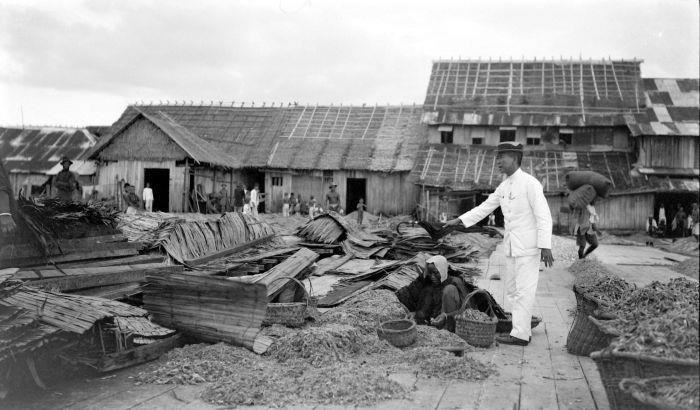
The main street stretches a few kilometres along the Rokan river, partly over planks which rest on poles, past typically Chinese shops, fish-drying godowns, and landing and mooring places. There is always a lively traffic of ships coming and departing with fishermen and traders. Add a few crossroads with their obligatory shops and eating places, and a few backstreet villages mostly populated by Chinese, and we have seen the capital town of Bagan and its surrounding area.
Bagan is mainly an export centre for fish products; and the imports, which consist mainly of manufactured goods, rice and food, are rarely distributed beyond Bagan and its peripheries. The country does not produce much. The Chinese breed pigs and chickens; rattan, areca nuts, copra and roofing material are produced, partly for export, but this is not important compared against the fish trade. The natural conditions for fishing are very favourable.
The estuary of the Rokan river and the adjacent stretches of inshore sea are shallow, and the strong river currents drive the fish into nets and traps. The fish are caught with jermal, ambai and, to a lesser extent, with nets from sea-going prahus. A jermal (or champi in Chinese) consists of two parallel rows of piles stuck in the ground and closed at one end by a third row of piles. At the other end the nets, which are attached to the piles, are left bound but directed against the current. The opening is widened by two other rows of piles (jajar) which diverge from each other in the shape of the letter V. Fish are caught only at low tide. The small fish especially are driven into the V-form rows of piles and run into the net. The big fish, which usually escape being trapped in this manner, are caught by sea fishermen further down. All the fish are sold directly to traders who bring their boats from Singapore.
The jermal is useful to catch the small fish which, after being salted and dried, yield the renowned ikan busuk. The small fish are not cut open but dried and salted, losing between 30 to 40% of their weight during drying. Around 80% of the total fish catch ends up as preserved fish. The ambai is a sort of basket attached to the poles standing in the sea and which serves primarily to catch shrimps. The big shrimps are dried and salted, while the smaller ones are pounded and salted to produce the renowned trasi (belacan in Malay).
During the last few years there has been a shift in emphasis from dried fish to dried shrimps. The main reason for this is that fishing with the jermal has become much more expensive than fishing with the ambai. Ajermal costs no less than f 7,000 or f 8,000 due to the large quantity of wood required. Besides, very large sums of money have to be spent on regular maintenance. The river mouth where the jermal is placed silts up and the jermal must be moved from time to time. In using the ambai, all these costs and risks are obviously less. The second reason is the gradual increase in the price of salt.
According to Dr J.H. Boeke’s entry under ‘Visscherij’ in the Gedenkboek voor Nederlandschlndiie 1898-1923:
The fisheries in Bagan Si Api-Api have flourished largely because salt used to be cheap. With the gradual increase in its price, less salt has been purchased, resulting in a change in the fishing industry whereby less fish are dried, much to the benefit of the business of drying shrimps where less salt is used.
Hence economic considerations explain why the people of Bagan Si Api-Api have applied themselves to producing more trasi than ikan busuk during the last few years. Previously the chief person in the fishing industry was the tauke bangelo, the owner of the fish-drying premises. This man paid money in advance to the fishermen and bought fish and shrimps for a fixed price. Thus he bore the risk of the fishermen running away, declining prices and increased costs. Most tauke bangelo were financially less than powerful and had to borrow money. Where there was no banking institution, and when in spite of the close relations with Singapore and (particularly) Penang the supply of capital from these places dried up, the tauke bangelo had to seek credit against high interest rates, most notably from the salt pawnbroker. (Participants in this kongsi include the late Major of the Chinese in Medan, Chong A Fee, and the present Major, Khu Chin Tek, together with other Chinese merchants).
Without the capital of the salt pawnbroker, the expansion of the enterprise might have been altogether impossible in the long run. When the price of poles and nets, coolie wages, and other costs rose during the war, and the Rokan estuary silted up forcing the fishermen to move their jermal, on top of all that the market price of trasi went into free fall. Hence many tauke bangelo could not keep their business going and went bankrupt. Meanwhile the fishermen, having borne much less risk and suffered no losses, were financially strong enough to form a small kongsi themselves to sell their fishery products directly to the merchants. The fishermen understood how to take advantage of the competition among the merchants. The results of fishing are of course uncertain, yet it can be assumed that a fisherman can earn f100 to f150 a month. The fishermen stay outdoors in their small boats for two weeks and spend the next two weeks on land. It is clear that the money they earned with such difficulty is quickly spent, as they have the opportunity to amuse themselves in the town with its many eating-houses, clubs and gambling dens, not to mention the occasional wayang performance. The merchants buy fishery products and ship them at their own risk. The sharp practices and price-cutting competition have led to the establishment of a fish merchants trading ‘trust’ called ‘Chin Ek’ which supervises the fish export. Anyone evading the ‘Chin Ek’ and exporting fish without its permission must pay a fine of f20 per basket. It is worth noting that this ‘trust’ applies only to the trade in dry fish. It does not apply to the trade in shrimps and trasi, even though Bagan Si Api-Api has a virtual monopoly in trasi for the Java market, which is not the case with fish where Bagan Si Api-Api must compete with Siam
Large quantities of salt are required for salting fish and shrimps. Earlier it was provided by a salt pawnbroker who sometimes sold it for a price higher than that fixed by the government. At present the state salt monopoly has an office which does not sell salt directly to the merchants but exclusively to a trading company called ‘Chin Thong’. This company is required to sell the salt at a fixed price, currently f3 per pikul, and to stock it in certain places. The ‘Chin Thong’ has a capital of flOO,OOO parcelled into f100 and f50 shares issued ‘to the bearer’. No one is allowed to accumulate shares worth more than f3,000, and indeed almost all the merchants are shareholders. Whoever leaves Bagan permanently must put his shares at the disposal of the board of managers who should sell them again at parity prices. Only people settled in Bagan or nearby places can be shareholders. In 1920 local officials established a district bank called ‘Bagan Maju’ [Bagan Forward]. According to the report for 1923, it lent approximately f422,000 by way of advance for:
nets, jermal, etc. f104,900
fish trade imports .. 15,050
retail trade .. 68,600
agriculture .. 44,500
pig breeding .. 9,450
shipbuilding .. 1,400
house building .. 9,300
miscellaneous 107,510
61,345
Of this, f390,000 were lent to Chinese. The bank has had good experiences with its Chinese customers who, generally speaking, repay faster than the natives do. Moreover the bank advanced up to f477 ,600 to its Chinese customers, against pawns, so they could pay their bills of lading.
The telegraph cable laid some years ago is very important for the trade. It has rapidly communicated the Java prices, so important for Bagan, and allowed the merchants to adjust their tactics accordingly. The Shrimp shells, mixed with fish waste, are much used as fertilizer in the cultivation of pepper in Riau, Bangka and the Lampung districts. The fertilizer is shipped mostly by steamers belonging either to the KPM [Royal Packet Navigation Company Ltd] or, until now, the state salt monopoly. The ikan busuk and trasi go mainly to Java, the shrimps to the Straits, while small amounts of all fishery products are forwarded to the plantation belt of Sumatra’s East Coast.
The merchants in Bagan Si Api-Api have had difficulties with the buyers in Java who lowered the prices and unethically rejected large quantities of fish as though it were decayed. This prompted the merchants to establish their own agency in Batavia under the name ‘Keng Lam Kongsi’, and it now holds a monopoly over Bagan fish and trasi. Elsewhere in Java such an institution does not exist. Indeed the buyers outside of Batavia dread the prospect of such an agency, so we have been informed, and have become more business-like in their dealings with the Bagan merchants. That Bagan Si Api-Api is a lively and prosperous place and hence an important source of tax revenue becomes clear from the custom-house receipts. In 1923 these amounted to f205,354 under the heading of import duties (the old export duties having been abolished), and f 1,264,328 under the heading of the State Opium Monopoly. Singapore is the major source of imports. There are good shipping links with Bengkalis, Singapore and Java, traversed by steamers belonging to KPM and by Chinese steamers. For local transport sampans and motor boats are used; sado [dog carts] and hongkong [rickshaws] are superfluous when it comes to travelling the streets of a place as small as Bagan.
.L. Vleming jnr, Het Chineesche Zakenleven in Nederlandsch-Indie, Dienst der Belastingen in Nederlandsch-Indie No. 730, Landsdrukkerij, Weltevreden, 1926

 Stories from Deli
Leave a comment