J.L. Vleming Jr. 1926
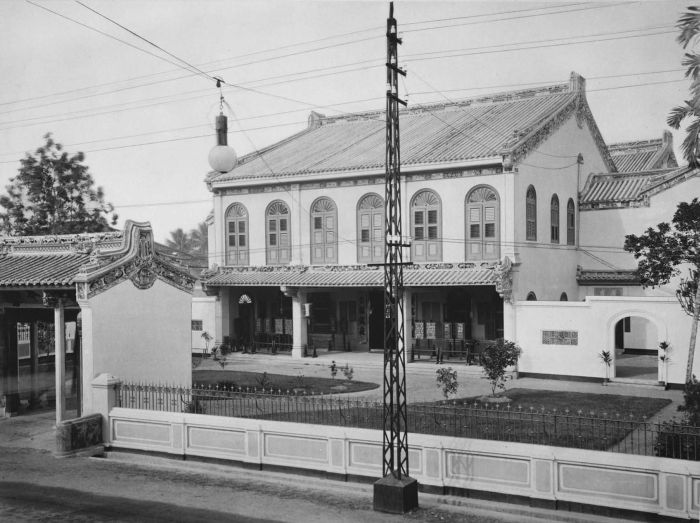
The government of the East Coast of Sumatra is divided into five afdeelingen: Deli and Serdang; Langkat; Asahan; Bengkalis; Simalungun and the Karo lands. We will return to the division of Bengkalis in our discussion of Riau and its surrounding area. In the 1860s this region was poor, thinly populated and almost unknown. Its economic upswing began in 1863 when J. Nienhuijs ‘discovered’ Deli as a place to grow tobacco. Since then the region has gradually improved and grown in importance, notwithstanding periodic slumps such as the general economic depression of 1921-22. Not surprisingly this region, magnificently suited to European plantations, has experienced the ups and downs of the plantation industry. To be sure it does not have a large population capable of supporting itself and blessed with strong buying power. If the plantations are forced to economize then commerce certainly suffers. Any improvement in the general economic conditions requires that efforts be made to reclaim new regions and to expand existing plantations. Then commerce grows again and the turnaround in the entire economic life of the region immediately becomes evident.
The Chinese play only a modest role as entrepreneurs in the plantations. To be sure, there are some rubber plantations, one tea plantation and some coconut plantations owned by Chinese, but in comparison with the European companies they are of very little importance and need not be discussed. The reason why Chinese settlements have been established in the plantation belt should therefore be sought elsewhere, specifically in the engagement of Chinese labourers to grow tobacco.
The Chinese coolies are mostly ‘Teochews’ and ‘Hailohongs’ who have their clans in the province of Kwangtung. Teochew, Hai Hong and Lo Hong are cities near Swatow. The coolies are recruited in China itself, either by the Bureau for Immigrants under direction from the Deli Planters Association, or by sending the field-coolies (the so-called ‘laukehs’) to China with the commission to attract new coolies to bring back to Deli. The majority of the labourers have to sign a contract with the enterprise concerned. They come under the jurisdiction of the Coolie Ordinance of 1915.
We refer to ‘new’ or ‘old’ coolies depending on whether the contract involves immigration or are-engagement. These contracts describe the work to be done (usually agricultural labour), payment, rest time, etc. Any arbitrary violation of this labour contract can be punished through penal sanction. To prevent these violations, the Ordinance requires the Labour Inspection Service for the Outer Islands to supervise the plantations on behalf of the Government, especially with regard to the conditions for labourers. After the contract expires the coolies are entitled to free transport back to their place of origin. Many people make use of the service, but others re-engage themselves or settle for ever in Deli as small merchants or free coolies.
With the expansion of the tobacco and other plantations (rubber, tea, fibre, oilpalms, etc.), and with the exploitation of the oilfields in Langkat, thousands of Chinese other than coolies have come to Sumatra’s East Coast over the years to find their living as merchants and technicians. More than one poor Chinese who started as a coolie in Deli has ended up a well-to-do merchant. In the plantation belt we find 92,985 Chinese men and only 18,731 women (Census of November 1920). The coolies on the plantations mostly leave their families behind in China; Chinese women are found mostly in the cities and much less on the plantations.
As the settlement of Chinese in the plantation belt is of recent date- their number was small before Nienhuijs began cultivating tobacco- the Chinese of Sumatra’s East Coast are almost exclusively sinkeh. Chinese families lacking contacts with their mother country are almost unknown here. It should not be surprising that the Chinese in Sumatra’s East Coast espouse the opinions and notions of their fellow clan members in the motherland. For most of them the motherland lies in the South China provinces. We find Amoy or Hokkien Chinese mostly in commerce or working as contractors. The biggest Chinese Bank, the Chinese Trading Company, is managed by Hokkien Chinese. Most Chinese merchants speak the Hokkien dialect, even if they do not belong to this clan. We find Cantonese as goldsmiths and silversmiths, furniture makers, tailors, silk merchants and the like.
Hakkas are generally found in more intellectual positions such as clerks, bookkeepers and publishers. Otherwise they are also found as merchants in provisions and drinks, tailors, shoemakers, makers of rattan furniture, tin workers and the like. The late Major of the Chinese, Chong A Fee, and his brother and predecessor Chong Yung Hian, both of whom had been prominent personalities in Deli, were Hakkas. As mentioned earlier the coolies on the plantations are mainly Teochews and Hailohongs. The Hailam Chinese are active as domestic servants, cooks and hotel servants, occupations which the Chinese in Java follow only in very exceptional circumstances. In general the Chinese of the East Coast of Sumatra are ethnic Chinese who speak only Chinese. Most of them know even less Malay than does the average European who has immigrated to the Indies. Knowledge of Dutch and other foreign languages (except, of course, Malay) is not widespread among them. The younger generation speaks a little English as a result of its close relations with the American missionary schools in Medan.
It speaks for itself that various organizational structures occur among the Chinese. The most widespread commercial form is the kongsi. Persons acting alone, and limited liability companies, would not constitute even one-tenth of all the Chinese trading companies. Chinese occupy the same place in the commerce of this part of the archipelago as they do in Java, so we need no further discussion. The connections with Singapore, Penang, the Chinese rice merchants in Rangoon, and China are important. In the export trade the European plantation products (tobacco, rubber, fibre, palm oil, etc.) are very important. Major exports produced by the natives are rubber, fish and trasi (from Bagan Si Api-Api), copra, areca nuts, potatoes, rattan, charcoal, black pepper and dammar.
After the liquidation of the Deli Bank Ltd in February 1921 there were still two Chinese banks left in Medan; the Chinese Trading Company mentioned above, and the Hwa Seng Kongsi. The first is under the management of the present Major of the Chinese, Khu Chin Tek, and is renowned as the ‘Hokkien Bank’. The second is managed by the Cantonese, while the ‘Deli Bank’ is remembered as the ‘Hakka Bank’. There are many Chinese kongsi engaged in money-lending. For the sake of completeness we should mention those British-Indian moneylenders of renown, the Chetties.
The transfer of money from the accounts of the Chinese (whether labourers or in other professions) to their families in China is also an important activity. These transfers are often called ‘letters’ by the Chinese. In numerous Chinese shops one sees small boards indicating the facilities to accept letters to be sent to China. We may safely assume that, barring those occasions when the dollar rate swings strongly and large profits can be made from the cross-rates, these transactions yield only a small profit. So they should be regarded mainly as an extension of facilities in order to attract prospective buyers. The number of transfers is hard to estimate precisely because so many shops are engaged in it. According to reliable sources, a prominent Chinese goldsmith once transferred remittances worth f200,000 within a single year.
As regards the goldsmiths, most of whom trade in watches, manufactured goods, silk (largely from China) and a range of other goods besides gold and gold ornaments, there is the following information to report. The natives and Chinese are desirous of buying gold articles and jewels, not just for the sake of their wives and children but also as an investment. If the owner needs money he can sell the ornaments or change them for something else. The goldsmiths take this into account; every buyer gets a certificate in which the quantity and value of the gold, and the calculated labour costs, must be mentioned separately. If the buyer wants to sell a piece of jewellery that still has the shop mark, the trader takes it back against the value of the gold after deducting three percent from the price which the client paid for the gold. According to custom he is obliged to do this only if the jewellery originated from his shop or from a friendly goldsmith, so an outlet mentions the ‘brands’ it deals with. The outlet owner need not buy jewellery associated with other brands; if he does, then he is entitled to pay a reduced price. The price of gold is fixed by the goldsmiths guild.
As house owners the Chinese of the East Coast of Sumatra hold an important place, mainly in the cities. It is difficult to trace the exact size of the Chinese share in real estate because, as a result of the administrative intricacies, when a houseowner obtains money by mortgaging his houses and lands at a bank, he sells out to the bank while retaining the right to buy back, so the bank appears as the registered rightful claimant. This is because ownership of property, while theoretically possible, does not exist in practice.
In the autonomous regions, i.e. regions governed by the native rulers and chiefs, the Netherlands Indies government exerts greater or lesser control depending on its relations with the autonomous region as stipulated by the socalled korte verklaring [brief declaration] or by political contract. Sumatra’s East Coast is an autonomous region, one where the ruler’s subjects can have only the usufruct right of land.
In the Opstalregeling [building regulations] supplement no. 8571, it was stipulated that granting ownership of land would be allowed only in special cases to be carefully considered by the Governor-General. But by virtue of the Staatsblad 1915 no. 474, Europeans can be granted commercial rights to lands within the autonomous regions. On top of that, the right of occupation can be granted for buildings and other premises in the residential centres.
The result is, then, that the concept hypotheek [mortgage] which is based on the ownership of immovable goods cannot be applied in practice. Loans can be obtained in which, as a further guarantee to the lender, the ‘grants’ (documents giving the right of use) can be made out in the name of the money-lender, while the right to buy back is reserved for the borrower. If the interest due is not paid on time, the money-lender receives the right to sell the ‘grant’. If this sale yields more than the amount for which the debtor is indebted, he will be paid the difference by the money-lender. While we cannot go into this matter further here, we can direct the interested reader to an interesting article by Mrs C. Frida Katz titled ‘Hypotheek- en Grantbank’, in the April 1919 edition of Neerlands Welvaart, from which the above discussion has been partly borrowed.
In Medan, Tanjung Balai and Siantar, large and important parts of the city, including some of the main shopping streets and marketplaces, are controlled by the Chinese. The house-building and timber-cutting trades (refer to Bengkalis’ extensive forest-felling) are almost entirely in Chinese hands. The Chinese also play a minor role in the shipping business. In transport they participate mainly as renters of motorcars, buses and, exclusively in Medan, the so-called hongkongs (rickshaws) or small wagons drawn by Chinese coolies. Of the few important industrial businesses owned by the Chinese, we should mention a coconut oil factory in Medan and another in Tanjung Balai, a tanning factory in Medan, a few small lemonade factories, a few factories making kecap or soy sauce, and a small ice factory in Tanjung Balai.
We should finish off with a discussion of the Chinese associations. The centre of all the Chinese associations is Medan which supplies the board members working as representatives in the smaller districts. There is a ‘General Trading Association’ (Tiong Hoa Siang U Chong Hwe) which is recognized as a corporation. Its office shares a building with a Chinese bank. Its aims are to support Chinese merchants who are in difficulties, to achieve acceptable solutions in disputes between members by playing the role of inter-mediator, to support inventors, and to assist the return of poor Chinese to China. As the statutes show, the association is in contact with the Peking government. The other Chinese associations can be grouped into guilds, societies of fellow countrymen, family societies and a range of other associations.
In Medan there are 16 guilds instituted for: goldsmiths; shoemakers; sailors; machine dealers and owners of shops repairing machines, bicycles and motorcars; barbers; manufacturers; labourers (plantation coolies); bicycle merchants; blacksmiths; furniture-makers; contractors; painters; butchers; rickshaw-drivers; pedlars (e.g. the tukang sayur or travelling green grocer who is often Chinese here, in contrast to Java); and timber merchants.
All these guilds have a purpose similar to that of the ‘General Trading Association’. Members include not only individual merchants or technicians, but also their wives and personnel as well. The masters are obliged to have people in their service join the appropriate association. When engaging an employee they are obliged to ask whether the employee is registered as a member, and if so, in which business he has been working. The employer must ensure that the employee was indeed dismissed by his former employer- a rule which has been promulgated in an attempt to prevent employers poaching good labourers. On top of a donation for being accepted as a member, every member pays a minimum monthly contribution stipulated by the statutes (usually 30 cents a month). In cases of extraordinary costs the board would ask the members for an additional contribution. When a member dies, the other members are required to attend the funeral, and whoever fails to do so without a satisfactory reason must pay a small fine.
Medan has 12 societies of fellow-countrymen from the same province or city. The most important unions are the Hokkien Club, the Kwangtung Club (a Cantonese society), and the Pat Sut Hwe Koan society which covers eight districts in K wangtung province populated by Hakkas. Moreover there are societies formed by Chinese from one or more cities, such as the Taipu Society or the society of people from Weichow and its ten districts. All these societies have a common purpose – the welfare of the members, assistance to needy members and interventions in disputes. Besides, there is always the desire to meet each other for fun and enjoyment, which has been made easier because these societies often have club premises for friendly gatherings.
The family societies are a remarkable phenomenon of authentically Chinese origins. The ‘brands’ or society names are the old (literary) names of the places or districts from where, according to tradition or legend, the ancestor of all the Tans, Oeis, etc., came. For instance the society of the Tans bears such a name; lnchoan is the historical name of a district in Fukien province (Hokkien). Only those who bear the related name can become members of these societies. Just as in the associations based around mundane affairs, the aims of the family societies are to support each other and, if possible, establish a club-house to meet together for fun and enjoyment. Of the various other associations we mention here the Su Toh Hwa Kiao Siong Giap Thoan, or Trading Association of Chinese Inhabitants of Sumatra, which can be regarded as a Hakka association in competition with the General Trading Association where the Hokkiens are dominant. Then there are the Sumatra Association for Education, music societies, sports clubs and a kindergarten.
Vleming, J.L., 1926. Het Chineesche Zakenleven in Nederlandsch-Indië . Dienst der belastingen in Nederlandsch-Indië.
 Stories from Deli
Leave a comment