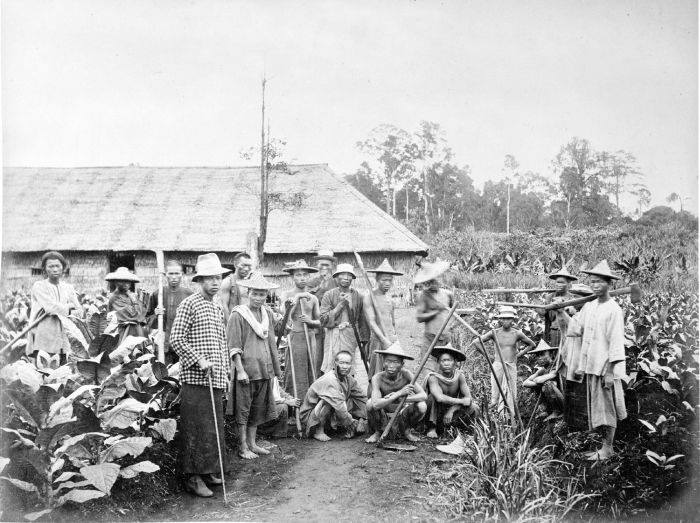
Jeremiah Jenks, 1902
EAST SUMATRA (DELI).
Agricultural conditions
The situation in East Sumatra (more frequently called Deli) as regards Chinese coolies is similar in many respects to that in the Federated Malay States, but the Dutch have followed quite different methods of procedure both in securing immigrants and in controlling them after their arrival, so that the subject needs a separate treatment. By far the most important industry in Deli is that of tobacco growing. Within the last thirty years the success of this work bas opened the country in a most remarkable way, and has resulted in mak!ng of what was formerly almost a trackless forest or waste of uncultivated lands a very prosperous colony, with well-made roads, flourishing plantations, progressive towns, and a civilized administration of the laws.
Character of worker
ln Deli, as in the Federated Malay States, it is found that the native population, Malays, can not be persuaded to do the regular drudgery of the plantations. At any rate, no rates of pay yet offered them have so persuaded them. The plantation work is practically all done by the Chinese coolies, and the more skillful carpenters and other trained craftsmen are also Chinese. For building the thatched sheds that are needed for drying tobacco, as well as for digging drains and the performance of other work requiring comparatively little skill Javanese laborers are to a considerable extent imported from overpopulated Java. The native Malays are, in some cases, used for clearing off the forests, although even here it is found that they can not be trusted fully to clean up the land and prepare it for cultivation. The Singalese and Boyanese are used as teamsters and for other work which is to their taste.
In Sumatra also, if one may accept the testimony of practically all persons, those without interest in plantations as well as those who have such interest. The Malays have no objection to the importation of the Chinese to do the labor which is ordinarily assigned to them. Doubtless, there is more or less race feeling here as elsewhere, hut the Malay gets the benefit of the increasing prosperity of the colony and of the better market for his fish and vegetables. Those Malays who object to the Chinese, as in the Federated Malay States, are said to be only those who prefer the uncivilized forest life to the development of the country the direction of the higher civilization.
Immigration methods
The Chinese are sometimes brought into the country from Singapore or Penang, or direct from China through brokers, in accordance with the system already explained in connection with the Straits Settlements. There seems, however, to be much more done in the way of direct importation by the planters themselves. Some of the plantations have sent their agents direct to Swatow or Hongkong to make arrangements with the Chinese coolies there. The larger part of the importation of labor, however, has been done through the Planters’ Association. This is an organization of companies owning different estates, and in 1899 it represented 7 4 separate estates. This association has an immigration bureau and keeps in China its own agents who make the bargains with the coolies. The contracts are formally signed, in most cases, in Sumatra under the supervision of the Chinese protector.
Nature of contract
While the usual form of contract provides for regular pay, ordinarily $6 silver a month to begin with, it is usual, especially after the first year, for the coolies to work by the job; that is to say, they are furnished a certain piece of land by the planter and raise their own tobacco, which they sell to the planter at a certain fixed price. Working in this way, the average annual earnings of the Chinese are probably as much as $125.
In order to protect the Chinese to a certain extent against the effects of their own vices by insuring that they shall have at least something to eat, it is the custom to furnish to the Chinese each month $2 worth of rice. On each payday, of which there are two each month, each coolie, whether working by the job or on contract, receives a ticket for $1 worth of rice. They are not allowed to receive cash for this, but must take rice-this to prevent their gambling away everything that they have.
*The money employed on the plantations, as well as elsewhere in Deli, except in connection with Government business, is regularly the Straits dollar, although the Dutch guilder is the legal standard. The Straits dollar and the so-called bank notes issued by the Netherlands Trading Company in terms of dollars form the currency ordinarily employed, and all the dealings with the Chinese are regularly expressed in terms of dollars.
So far as the rest of their income is concerned, it is paid in cash. The estates furnish regular lodging and medical attendance free; the coolie pays for his rice, his opium, clothing, tools, and whatever else he needs. Each estate keeps a store where he can purchase these things at a price fixed by the manager. As a rule, these prices are held at not much above cost, and in some cases, rice and opium are sold at a loss, especially when the price in the general market is high and it is feared that the Chinese would demand higher wages if they were compelled to pay the regular market rates.
Statistics.
ln 1900 there were on the 74 estates belonging to the Planters’ Association 62,468 coolies, classified as follows:
Contract Chinese coolies 36,509
Noncontract Chinese coolies 1,758
Singalese (Klings) 2,412
Boyanese 2,566
Javanese 14,139
Contract women (Javanese) 5,084
It is probable that much the same proportions of the different classes are used generally on the estates not belonging to the association, but the regular work of tobacco planting is practically all done by the Chinese.
Provisions for care of coolies
On the larger plantations there are hospitals for sick coolies. In most cases, these are good buildings, well appointed, and with every provision for the comfort and care of the coolies that is to be found m government hospitals in the Straits Settlements and elsewhere. If the estates are, relatively speaking, small, several may join together in providing a hospital, but under the terms of the contract it is the duty of the plantation to provide in some way suitable hospital accommodations.
The Planters’ Association is important enough so that it has its special depot for the reception of new coolies just coming from China in which they remain the two or three days necessary for their examination and distribution to the various estates. This depot is in the suburbs of Medan, the capital of East Sumatra. The houses are large one-story buildings, situated in an open space with wide lawns, which are kept in good order. Each house would easily accommodate two or three hundred. They are kept thoroughly clean.
The coolies sleep on mats placed on benches running along each side of the room, the usual form of bed provided for coolies on the estates and in the mines, and even in the hospitals. At one end of the house there is a bathroom, with toilet accommodations at one side and a large tank kept full of water, so that the men can bathe freely by dipping the water over themselves according to the usual custom followed in these countries. The accommodations are very comfortable and healthful.
This association has also provided a home for those coolies who are permanently disabled, and who, for whatever reason, can not conveniently be returned to China. In this home they are comfortably lodged, and suitably fed, and opportunities are given those who are able to do light work to busy themselves in weaving mats, sewing, and performing such other productive work as lies within their power and inclination.
Gambling.
It is usual for the larger plantations to provide a house for gambling and other entertainments for the coolies. In East Sumatra gambling is farmed out by the Government to a Chinaman of influence, and, other things equal, is sold to the highest bidder. This farmer regularly sublets his night to the Chinese headmen on the separate estates, who, in turn, supervise the gambling, receiving for their profit 10 percent of all the winnings. While the gambling farm is a very important source of revenue for the province, the farmer has also invariably become wealthy, and it is believed that the Chinese headmen on the estates receive large incomes from this method of controlling and using this vice of the coolie.
lt is argued by the Government officials as well as by the plantation owners that, in as much as the Chinese will gamble under any circumstances, it is much wiser to permit it by law and to put it under proper restriction. The gambling is nearly all done at the seasons of the year when the tobacco is being cured and sorted, so that the workers are brought together at the central part of the estate. Provision is also regularly made by the person who controls the gambling on the estate to supply each season one or two weeks of Chinese theater by hiring a regular troupe to give performances. For this purpose, in connection with the gambling houses, there is a room with a stage for theatrical representations. The European managers·of the estates, so far as can be learned, do not regularly take any active part in the control or share the profits from the gambling. They do, however, recognize that there are certain indirect advantages coming to them from gambling on the estates, and in consequence, do not object to providing gambling houses.
It is not uncommon for the European managers, during the gambling season, to go into the room once or twice with small sums, $10 or so, to gamble with, thus giving their approval to the custom. If they should be fortunate enough to win, their winnings are usually scattered among the coolies present. A very large percentage of the coolies, through their passion for gambling, lose practically all that they have earned during the year. The employer then finds them ready to enter into a contract for the succeeding year on favorable terms. It is perhaps this fact as much as any other that leads the plantation manager to incur the expense of building and keeping up gambling houses. They can keep the Chinaman good-natured, on the one hand, and will have the first opportunity, on the other, of getting the benefit of the loss of his money.
Striving to improve the morals of the Chinese coolies seems to form no part of the business of tobacco planting. It is considered sufficient to look fairly well after his physical needs.
Savings
In spite of the fact, however, that many of the coolies from year to year lose practically all of their earnings, a good many return to China, having succeeded in making savings. The figures for savings are naturally not available. The larger estates, however, and the Planters’ Association offer to give, free of charge, drafts on China to coolies who are returning and who prefer to take their earnings in that form instead of taking the risk of carrying the bulky silver with them. The figures for the drafts from separate estates are not available, but the Planters’ Association, representing 74 estates, gave drafts in 1899 to 1,934 Chinamen for sums amounting to $260,124.38. In 1900 from these estates 1,835 returned to China. Of these 1,539 took drafts with them amounting to $215,412.50. During the last twelve years, the association has given drafts to such returning coolies amounting to $1,912,945.88.
Doubtless in addition to these drafts, much money has been taken in the form of silver carried by the Chinamen themselves.
Treatment of coolies
There are doubtless on these estates, in spite of the provisions for the care of the coolies, many individual cases of harsh treatment. The number of these cases, however, it is believed, has been very much less of late years. The Government has passed rigid laws forbidding mistreatment of the coolies, and according to the statement of both Government officials and planters, these laws are enforced with considerable strictness. In fact, the planters do not hesitate to say that the Government seems to be prejudiced in favor of the coolie, and the planter is likely to get the worst of it provided any matter goes before the courts. It is also felt that the Government inspection as regards contracts and the enforcement of the contracts in detail on the estates has affected the profits of the planters materially. In spite of this fact, however, it is generally believed that the plantations could not succeed with any labor other than that of the Chinese.
The Chinese as settlers
The Government also in that locality seems to desire to encourage the Chinese, after their contracts with the planters have run out, to become permanent settlers. In the neighborhood of the towns, certain small pieces of land are given them on easy terms, and they are encouraged to become gardeners and by earning their living in this way to provide for the towns necessary vegetables and fruits. Some of the estate managers are of the opinion that in this way again, the Government is willing to sacrifice the interests of some of the planters whose estates are located near the towns for the sake of securing lands to be given into the hands of Chinamen, who are considered settlers of such excellent quality.
Control of the Chinese.
On the other hand, the Chinese are managed in the towns and, in general, in Dutch East India with a great deal of care. In the towns regularly, certain sections are set aside for them, and they are not allowed to purchase property or to live outside of these quarters. There is also appointed by the resident a “Chinese Captain”, who has general supervision of the policing of the Chinese quarters, of sanitation, and, m general, of the care of the welfare and discipline of the Chinese. He regularly receives no pay for this work, but in his position as a tax collector, is allowed a certain percentage for that work. He employs his own assistants and sees to giving them whatever they get for their work.
It has happened, at any rate in Deli, and this is doubtless the case elsewhere under Dutch administration, that the Captain China, in whose hands these powers rest, has also been the owner of the opium and gambling farms. So that his various relations with the Dutch Government have furnished him with the means to secure large profits. This system of control of the Chinese will be developed more fully in connection with the relations of the Chinese to the government of Java.
The currency
Under the discussion of the currency question, attention was called to the fact that in East Sumatra, although the legal currency is the Dutch guilder, the currency commonly in use is the Straits dollar. It may perhaps be repeated that it is practically the universal opinion of planters, bankers, and businessmen that this dollar, which has been for some years depreciating in value, has been a source of decided profit to the planters. Chinamen prefer the large dollar, and they can be hired with this cheap dollar at rates much more profitable to the planter than if they wished the smaller coins whose value is much more closely dependent on governmental action. Many of the businessmen do not hesitate to express the belief that if they were compelled to do business with their coolies on a gold basis ft would result in the financial failure of a very large proportion of all of the plantations in East Sumatra.
Report on Certain Economic Questions in the English and Dutch Colonies in the Orient, 1902 [bk]
 Stories from Deli
Leave a comment