Aeilko Jans Zijlker, born May 1830, of rich Groningen farmers’ stock, was one of those who tried their luck in tobacco in Deli. When Sumatra’s East coast was opened up, he moved from his first plantation in Eastern Java to the Lepan river area, where he managed plantations of the East Sumatra Tobacco Company.
In the fall of 1880:
“… on a tour of inspection of the tobacco fields, he was overtaken by a storm and sought refuge in an abandoned tobacco shed where a not too comfortable night was spent. The mandur who accompanied hirn, an inhabitant of the district, lit a torch to dispel the darkness. Zijlker’s attention was drawn to the peculiar bright flame and, convinced that he had to do with a particularly resinous kind of wood, he asked the guide how he had come by this toreh. The man explained that the torches were daubed over with a kind of mineral wax, which from time immemorial, had been used in the district for many purposes, such as the caulking of boats. They used to skim it off the surface of small pools to be found in the neighborhood. Zijlker’s curiosity was aroused, and the next morning he got the man to take hirn to one of these locations. He was quick to recognize the smell of kerosene, which had been introduced in the Archipelago a few years back. Zijlker collected a little of the muddy substance and sent it back to Batavia to be analyzed. This was in 1880. Examination and distillation of this already very evaporated oil yie1ded a 21.2% of first-rate illuminating oil at a temperature between 130 and 180 degrees centigrade; 28% between 180 and 225 degrees; and 10% between 225 and 240 degrees, or a total of 59.2%. A later specimen yielded even 62% excellent lamp oil (together with 15% gasoline).”
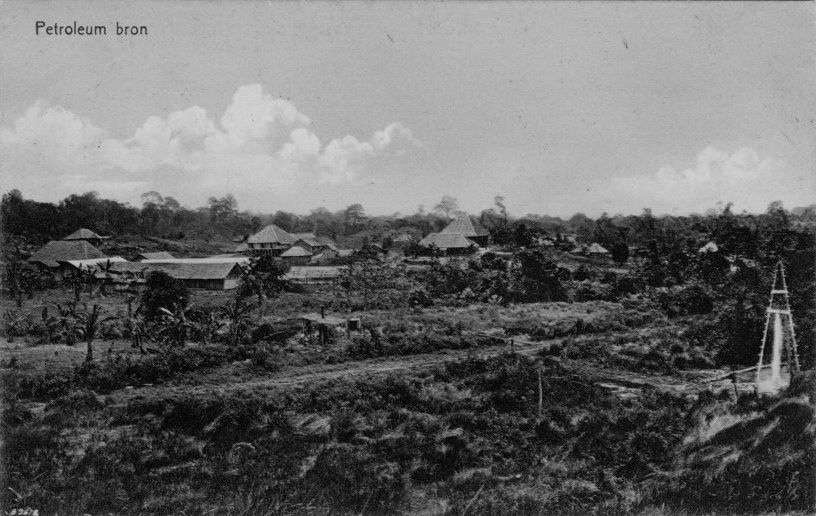
As we have seen, this was not the first time petroleum had been found in North Sumatra. One can, therefore, hardly speak of Zijlker’s “discovery”: (But he was one of the very first) … to have sufficient spirit of enterprise to stake his position, his peace of mind, his resources and his life on a still remote contingency. No sedate family man would have ventured his living on such an undertaking. But does not the great importance of the pioneer in economic development resides precisely in this, that he takes risks that nobody else would dare accept, and that, one time in a hundred, he may succeed in bringing about the impossible? Zijlker’s mind was immediately made up”?
Through a land swap, he managed to obtain a land area where oil seeps proliferated. The local ruler, the Pangeran Langkat, was favorably inclined towards Zijlker’s intentions and granted hirn a land concession in 1881. Hence the short statement in the “Annual Report” quoted above. To comply with Regulations, in order to obtain a proper petroleum mining concession, Zijlker had to show solvency for the mining enterprise. An informal consortium was formed in Batavia, and Zijlker went to the Netherlands to drum up further support, moral, financial but above all political. Although he had to overcome quite a bit of reservation, he managed to return to Batavia early in 1883, armed with the necessary back-up and recommendations. There the consortium was converted into the “Voorlopige Sumatra Petroleum Maatschappij”. Later in 1883, with the co-operation of the Sultan (against fairly high royalties), and with the Commissioner of NE Sumatra’s approval, Zijlker obtained the petroleum mining concession “Telaga Said”.
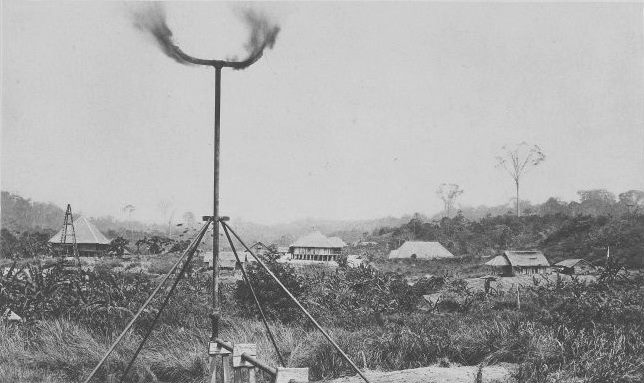
On July 11, 1884 began drilling at Telaga Tiga, the most accessible of the oil pools at the concession.
“The dense inaccessible underbrush was all over between the epiphyte covered smaller trees and the curtains of hanging entangled liana some giant trees stood towering above the jungle with their mighty tops. The racket of the monkeys from the branches of the trees was all around”
He had succeeded. His tenacity had paid off; he now had a mining contract that allowed hirn to exploit any discovery. His concession acreage measured some 500 bouws (3.5 km2)
“Thus came about the agreement between Zijlker and His Highness the Pangeran Indra di Radja, Emir ofLangkat, and his feudal chiefs. It was to be the foundation of the Royal Dutch”.
J. P. Poley, Eroïca, Springer (2000)
 Stories from Deli
Leave a comment