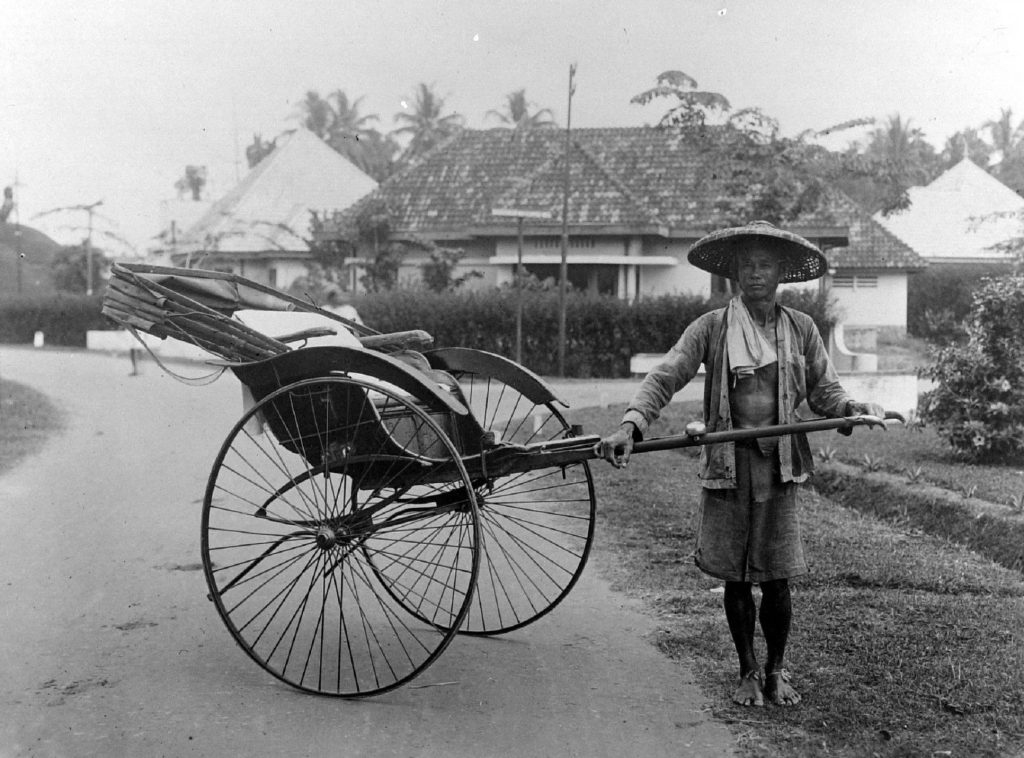
Madelon Lulofs, De andere wereld
It was a quiet evening, without a moon, but full of starlight. Perhaps it was even more pleasant to take a walk after the long boat trip … He left the hotel garden. At once he was assailed by a dozen rickshaw koelies, who showered him with a flood of wild, incomprehensible sounds. Frightened and unsure, he looked back. There was the terrace and among all the strange faces suddenly appeared strangely bright the face of Van der Steeg. He suddenly found himself standing in full light and full attention. Fleeing from this, he blindly stepped into one of the rickshaws.
The Chinese picked up the handles and started a slow trot. Noiseless and feather-light on its high, thin wheels, the cart drove on, where, Pieter did not know and worried he saw the square with the hotel disappear behind him. How would this end? Could he ever make it clear to the Chinese that he had to be back there? And where would this Chinese take him? And was it usual to go to a strange city like that? … He stared at the man moving up and down among the light trees. The red glow of the lanterns lit a fluttering bathing suit, ragged shorts, heavily muscled bare legs. Loose soles clattered to the feet, tied around the ankles with filthy strings and straps.
As if the Chinese felt his gaze, he looked back. And in a start, Pieter saw that yellow crooked tronie in the lantern glow. But then a confidential smile passed over that criminal face, and a monotonous nose voice repeated the same sound several times: ‘Tsa-fho (Ca bo)…? Tsa-fhoaaa ?! ‘ Peter’s fear inexplicably subsided. He had seen an almost childishly surprised look in the black slit eyes. He shrugged and smiled back. And yet he wished he had never started this.
The Chinese trotted on. Trotted along broad, asphalted streets, past shopping areas, lined with tall, massive buildings of shipping and commerce; past low bazaars that teem behind arched gate entrances pine of bright colors and bright people. Cars glided past him, honking at the little two-wheeled pony carts and rickshaws, which did not soak or soak in the wrong direction, or stopped suddenly without warning; they honked for dreamily strolling on, ignoring Natives.
Every now and then the Chinese looked back and muttered with a hint of joyful promise in his voice: Tsa-fho … Tsa-fhoaa ?! Unexpectedly, he made a sharp swing and turned into a cross street.
And then, suddenly, here is another world, full of human bodies, sounds, colors, smells. A narrow, dark alley cuts through grotesque chaos of houses. Sturdy stone houses under a sloping roof, decorated with blue and green porcelain dragons, but also dilapidated wooden houses, retail space downstairs, upstairs residence, staggering upwards and scaly and crookedly paneled with planks and flattened petroleum cans. Open shops spew their overcrowded commodities – spices, baskets, pottery, – to the brim of the stinking gutters. In others, right up to the street, showcases with shiny yellow gold work, bracelets, earrings, rings, pins of gold coins. Thoughtful brown women bend over these showcases, dressed in multi-flowered loincloths and transparent, multi-colored bathing suits. They hold the gold work in her small brown hands, and behind the counter stands a fat, half-naked Chinese, waiting and lurking — sure, like a predator, already taking hold of its prey. In the smoky, sweaty atmosphere of dimly lit, open workplaces, half-naked, yellow bodies bend over never-ending labor. There is knocking, hammering, sawing, chiselling, planing. Sewing machines rattle at breakneck speed. Chinese words fall over this work in a heavy and heavy way, are shouted through the teeming street with a nose sound. Children scream. Dogs howl and howl. Peddlers scream their hoarse shouts and clatter with an iron clapper. Rickshaw koelies shout their warning. From different sides at the same time whimper from bad gramophones the high, screeching, false tones of a Chinese song piece. Long rows of Chinese characters hang down black, red and gold, strangely and wonderfully beautiful in this environment of dirt and overload. In twilight porches dangle Chinese lanterns.
The rickshaw has to walk through everything that is rooting in those spots of light and shadow: crooked, carcass-like bodies destroyed by opium; women in trousers and flat jackets; women stumbling on her mutilated miniature feet; beggars, who grope blindly or crawl through the dust like flesh; broadly built, strong, pale yellow young man’s bodies and incomprehensible masses of children; little one, crawling around naked in dust and dirt, squatting above the gutters in sudden urgent need; larger ones, with bottoms and stiffly braided pigtails. Dogs sniffing along the gutters, scabby and the bald tail between the trembling hind legs. On chairs at the front of the street, lobe-fat Chinese, fleshy, yellow Buddhas with three layers of stomach protruding over the lacing of their trousers, doll-like Chinese babies in their tender hands. Here and there at the edge of the gutter are small offerings with smoking incense candles.
Somewhere on the side of the road is a portable kitchen. Chinese roast meat on sticks over a smoldering charcoal fire. Sharp air of fat dripping into the fire turns black rancid from the stench of oil, fish, spices, and garlic blowing from the open shops. Sweet and mysterious, all this hangs with the scent of incense and opium.
And then the Chinese grins at Pieter: “Tsa-fho … Tsa-fho …” And an absurd fear, the fear of his childhood rages in him. Swirling and flowing, shapes and colors tumble before his eyes. Hoarse, shrill voices and melodies blare madly in his ears. He gets the feeling that this must be a nightmare, this mad Chinese city around him and that Chinese, softly spinning in front of him, between the trees of the cart, in the appearance of the lanterns, which ghostly illuminate the bundles of tendons of the naked yellow legs. . He shouts, “No, no, no!” But his voice is lost in the noise. Two sados have collided in the crowd, and between the neighing of the ponies are the screams of the coachmen and bystanders. He feels disgust rise in his empty stomach. This stench …
He clings to the cart with both hands, he shouts: “Hey, hey, hey !!” And the Chinese man looks back, grins his crook’s grin and nods and Pieter no longer knows whether this devilish fun on this devilish yellow face is a murder threat or a criminal promise. What is this guy going to do to him? Where is he going to take him? Will he ever get out of this cursed Chinese city again? And he thinks about the street at home and does not understand how he could ever have been afraid of a drunken stoker swinging by, of you street girl, of the mere alcoholic smell, of the cold, shivering, silent Chinese people. He only knows that he suspected this, this, what now surrounds him, behind the dusty displays of those Chinese shops with their ginger jars and their characters. And the threat of the past turns into something,
Unexpectedly, the Chinese stops. He lets the trees down, wipes a rag from his neck over his dripping face and points to a house. It has a floor. It leans forward a bit and staggers between two shops. In the wrecked facade of timbered planks, there are two windows above. Dingy-white, transparent curtains hang in front and behind them a dimly lit chamber emerges, in which the intimate yet screamingly impudent rises the white square shape of a bed with mosquito net.
Downstairs is a small room, dimly lit by a kerosene lamp above a limping table. Three sailors sit in dirty rattan chairs. They are red and heated and grumbling and punching the table with their fists, which almost collapses underneath.
An old, thin Japanese woman dribbles out and babbles something with the Chinese, and they keep looking at Pieter. And then a young, gaudy brown woman emerges and stops giggling and noisily in the door. Her mouth is bright red. Her eyes turned black. Just above her eyes is a black pony. She has plump shapes in the loincloth and white bath.
Pieter looks at the shield on the facade. It says: Hotel Yamatori and suddenly, without knowing how, he understands where the Chinese has taken him. For a second an old and still unsatisfied desire flashes through him.
A woman. Now he can have a wife. What seemed so difficult at home is presented to him here. “Tuan …” says the Japanese and bows repeatedly and hisses with a smile at everything else that she says that he does not understand but understands. ‘Tuan …’ says the Chinese with a nose sound and grins. And the girl at the door puts her hands on her hips. With all her white teeth behind her red mouth, she smiles encouragingly at him. “Tuan …” Dizzy and hot it goes to his head. But then he suddenly hears the wailing sailor voices. A hand grips the maid around her waist, gripping brutally lower in the loincloth. Laughter roars over the woman’s hysterical screams and she disappears inside. In Pieter all desire subsides and aversion becomes. He pushes himself deeper into the cart, hides from a red sailor head, who peeks out and swears. ‘Goddamn it, Ma Boekusan, where are you …! Ajo, let that guy fuck off …! kemari, damn …! ‘ Pieter shakes his head at the Chinese. Shakes violently and signals him to leave. He points around. Away. Away. No. No. – ‘Tsafho …?’ says the Chinese, disappointed and still hopeful. But Pieter beckons again. No. No. No. The Japanese has disappeared. She had to get beer for the sailors. Those are better customers. New tuan are never good customers. But Pieter beckons again. No. No. No. The Japanese has disappeared. She had to get beer for the sailors. Those are better customers. New tuan are never good customers. But Pieter beckons again. No. No. No. The Japanese has disappeared. She had to get beer for the sailors. Those are better customers. New tuan are never good customers.
Resignedly, the Chinese picks up the handles, navigates through the circle. One turn. One more turn. And it is quiet and open. Behind the rickshaw, the Chinese quarter sinks into gaping darkness. The noise dies away. There is a wide, peaceful road. A gravel road. There are white houses of Europeans, small and large villas, in neat gardens. People sit on open porches, in a ruddy and yellowish twilight glow, reading or talking. White people. Piano music is playing. Or a little further a gramophone. Familiar sounds, which become melancholically beautiful in this quiet evening. Pieter leans back, breathing again. A coolie brushes his warm head. There has been a danger, but it has passed. Maybe there will be a loss, a disappointment, a question. Did I … ? He looks into the illuminated white houses and sees the brown woman behind them in his mind. Her red, laughing cheeky mouth, her black-lined, enticing eyes, the full curves of her belly and breasts. There is unrest that does not want to calm down completely. Then he sees again that coarse hand that the woman takes away from him.
 Stories from Deli
Leave a comment