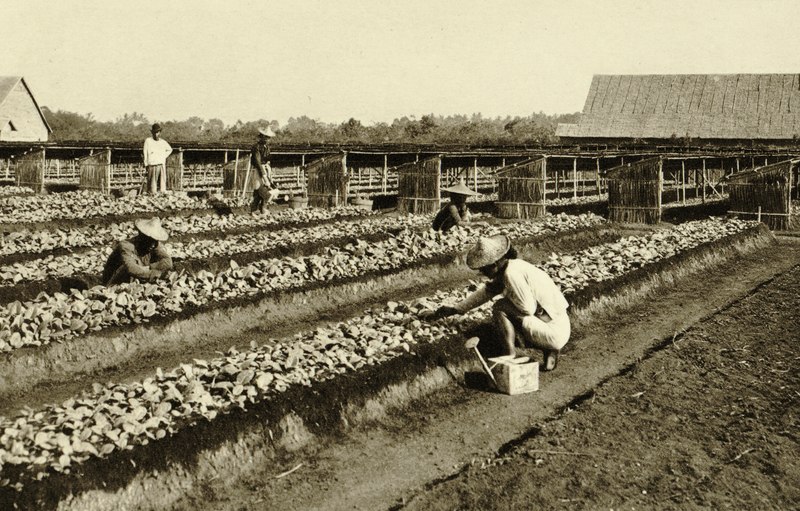
The busy work in planting had reached its peak. It is true that the Chinese field coolies had planted their fields and the young tobacco plants were standing in the ground on the last pett branch (field), but the entire planting still required a great deal of care and labor. Those young plants still had to be watered every morning until they were properly upright and grown. Searching for caterpillars on the tobacco in the previous fields could not be interrupted for a day, because each caterpillar that remained in the top of a plant ate several holes in it, resulting in ‘piece leaves’, so great damage.
Raising the rows of plants also took a lot of time. That work was not done roughly, but was done with the greatest precision and regularity, as well as all work in this culture. The main work in this period, however, was the plucking of the leaves – the actual harvesting of the precious product. Every day the assistant of the department determined from which package tax two leaves per plant should be picked, and this was done at the same time in all fields of the department, which was seventy to eighty acres. The plucked leaves were then placed as flat as possible in the picolans, the heavy baskets, which rested on two stakes almost man-sized.
The coolies could put their shoulders under it and take the heavy load to the drying sheds on the plant road. Here the leaves were placed in neat piles to be sprinkled on. The assistant made the rounds along the path that was several kilometers long, where the coolies were picking and he watched every single one of them doing that work with due care. As he walked there, he was once more astonished at the almost inexhaustible labor power of these Chinese field coolies, whose achievements far exceeded the work of the agricultural workers in the motherland, in any culture.
There, in Holland, people plow and harrow the land in a pleasant spring temperature and, after sowing, the work is finished until autumn. With some crops, weeding between the rows still needs to be done, or chopped and thinned, but people do not overwork themselves. Harvesting then follows, usually mechanically and then comes the long winter rest. But here, the stiff ground first has to be worked up with the heavy tjancol, the heel deep at a sometimes unbearable temperature.
Continuously the coolies then lift that heavy piece ready high above their heads, and then bring it down with great force, knocking off another narrow strip of earth from the furrow. That work takes many weeks of continuous labor, until each of them has reworked his three-quarters of a hectare field. The assistant and the tandils, the Chinese foremen, are constantly poking a thick stick into the reclaimed soil to check whether there is enough deep tjankol and the Chinese word: ‘koet chim’, deep ‘digging’, sounds incessantly. the fields.
In addition, digging wells several meters deep, raising the seed beds and making the canopies for them from lalang, the reed grass, which often has to be cut at a great distance. Then sow the seed on the beds at set times; the abundant watering of it, the thinning and penance of the young Io8 plants, the punching of the planting holes and the planting out field after field. Meanwhile, the rows of planted tobacco must be raised twice; spent several hours every day searching the caterpillars and finally picking the leaves. But then it is not over yet. When the leaves are placed in heaps in the drying sheds, they must be strung, forty leaves on a string, which is tied to a stick, anak kajoe, with which the whole drying shed is gradually covered. Since no more time is available during the day for this on, the coolies have to do this work at night, so that during that time they were in line for almost the entire 24-hour period.
And all this under strict discipline and the constant supervision of the assistant and the foremen, who do not condone anything and notice any negligence or breakdown and usually punish it severely. The assistant considered all this as he toured the pickers. He greatly appreciated the work performance of these guys, with whom he also got along. He knew that with the coolies he had the name of ‘patoet’, to be just, and only in extreme necessity would he intervene in the manner which was customary in Deli at the time. But it did not alter the fact that he also maintained strict discipline and did not hesitate to punish where this was inevitable. Because behind him stood the clerk and finally the head boss, who held him responsible for any abnormality found in his department. And he refused to be the victim of the negligence of his workforce.
Only a few of them bothered him and he kept an extra watch. One of them was the coolie of field, a tough Chinese, a tireless worker, yet incredibly stupid. Ray It seemed as if the orders did not reach the man’s dull brain, and his work had to be intervened. He plodded on like a stupid, strong ox, grumbling to himself and unaware of guilt. Now, with the threading in the drying sheds, it was all wrong with him again. Almost every night he sat in the midst of his comrades next to a smoky paraffin lamp, threading the tobacco leaves with a long awl, and often the tandil pointed out to him that exactly forty leaves had to be collected. For this work was paid extra according to the number of sticks of forty leaves that the coolies handed in in the morning.
On several occasions it had been found during inspections that, despite all the warnings, had insufficient, and the penalty for this was: pay nothing and simply bring all his sticks up in the drying shed. It had been that way that morning too, and on his tour the assistant deliberately walked again to that field where the man was picking. With the tandil as an interpreter, he informed him that all his sticks had been shortened that morning, so that he had again worked for nothing, because again not enough leaves were strung per stick. The tandil added a little extra during the translation, so that the air was shaken with the most exquisite collection of Chinese curses. The coolie narrowly escaped a treacherous cane blow from the angry tandil, who thought he had to give the necessary force to his demonstrations in the usual way. The man grumbled back that he was not aware of guilt; he had always counted the number of leaves in his own way, and he thought it was not fair that he should not get his wages.
In addition, such a threatening expression had appeared on his face that the assistant resolved to be a little wary… that all his sticks had been cut that morning for this strong bear, so that there would be no drama. Swearing in his mouth the man took his heavy picolan on his square shoulders to carry the load to the drying shed. The drama came, but in a different form than the assistant had suspected. In the twilight of the next morning, he enters the drying shed, which is directly opposite the assistant house. There had been no work in that shed that night, but he wanted to see if the tobacco hanging there was already dry enough to be bundled that day and sent to the fermentation shed at the yard.
Hesitantly, he enters where it is still completely dark and runs into something hanging above the aisle. He recoils far, opens a tin canopy, a light valve and, to his dismay, sees the naked body of a man in whom he recognizes the coolie of field, who hanged himself there … The assistant pauses for a moment to recover from the shock that this lurid discovery in the sober morning has caused him. Then he goes out to get help, because that man cannot linger there and maybe he can be saved if he is cut loose immediately. The tandil meets him on the planting road and reports eagerly that the coolie of field is nowhere to be found; the man had not pelted his picked tobacco either… “Come on,” the assistant interrupts and without a word they enter the drying shed. At the sight of the hanged man, the Chinese tandil startles even more than his tuan, runs out of the shed and immediately returns with a few coolies.
They lift up the unfortunate cut the rope and lay it down on a blanket. It is clear: nothing more can be done about this. The man has certainly been hanging there all night. A messenger is sent to the yard to warn the clerk and the chief who will arrive during the morning. It is remarkable that this incident has caused a great deal of unrest among the other coolies. Deaths occur repeatedly, of course, without anyone caring about it. Because the Chinese are also convinced that after their death they will have a much better life than during their life on earth, and the two Europeans at first do not understand why this suicide is causing such a stir. But when they are both together in the assistant’s house with the head tandil, and the latter is also looking around him very dubiously and shyly, the clerk asks him: ‘Tandil besar, has this man now taken his own life, because he had enough, or has he suddenly gone mad? ‘ “No, tuan besar,” was the answer, “that man would have liked to live on and he was certainly not crazy, but he thought he had been treated unjustly.” ‘Then why didn’t he complain to you. If that man couldn’t count to forty, then someone else could have come before him, because he was a good coolie by the way. ‘ ‘He was afraid that he would be thrown out of his field and assigned to the kongsikangs (field worker), and he was ashamed of that. And he doesn’t dare to drink the tuan here.
Now he has taken the worst revenge there is… ”The main toothed was silent, while the two Europeans looked at him quizzically. Revenge? By hanging himself? ‘What do you mean?’ ‘This is very bad, tuan besar,’ said the man with a sigh, ‘very bad for the tuan here. He did not dare to do anything about Tuan, but now that he is dead his spirit, his hantu (ghost) will keep wandering around here in and around the assistant house. That’s why he hanged himself in the barn, which is directly opposite… ”They look at each other in silence, not understanding.
For one to take his own life in order to free his mind in order to disturb the life of another in revenge for alleged injustice, that is another thing neither of Europeans can understand. And if the head tandil gives serious advice, that the tuan is doing the best to move into another house, they boldly tell him that there is no question of that. They do not step aside in front of a whole army of hantus of dead Chinese, and if the other coolies would object to working in this haunted drying shed, then the main tandil would be held liable. The clerk angrily makes him understand this; no trouble should arise from this! ‘Buy fireworks for ten bucks and shoot that guy’s angry hoe for good,’ is the wise advice that the chief finally receives when he goes to the kongsi to move the tandil to coolies straight to the shed in question. where the tobacco now needs to be bundled.
East is East, and West is West, and never the twain shall meet, ‘says the tuan besar as we drive off,’ but don’t worry about those farces, young man. There is work to be done and we have to deal with that person with nothing but lightning. Just be tough and when that handle comes, kick him out the door. from. Salute… ‘
Tabakkers, Gorter
 Stories from Deli
Leave a comment