Epperlein is a cafe and bakery owned by Mr. E, Epperlein. He first opened its shop as a pastry shop in Wilhelmina Street around 1919 offering good German bread and pastry.
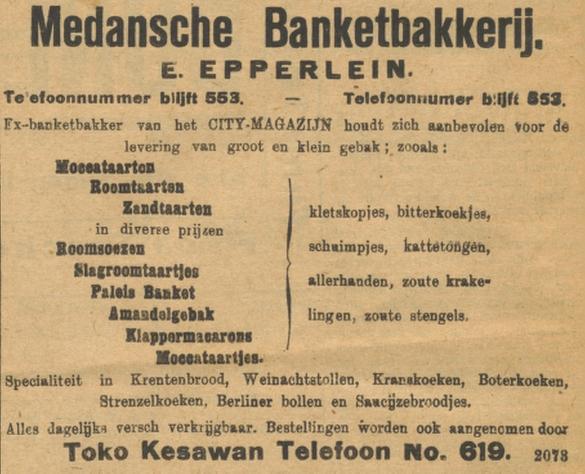
It advertised as the first electric machine made bread in Medan.
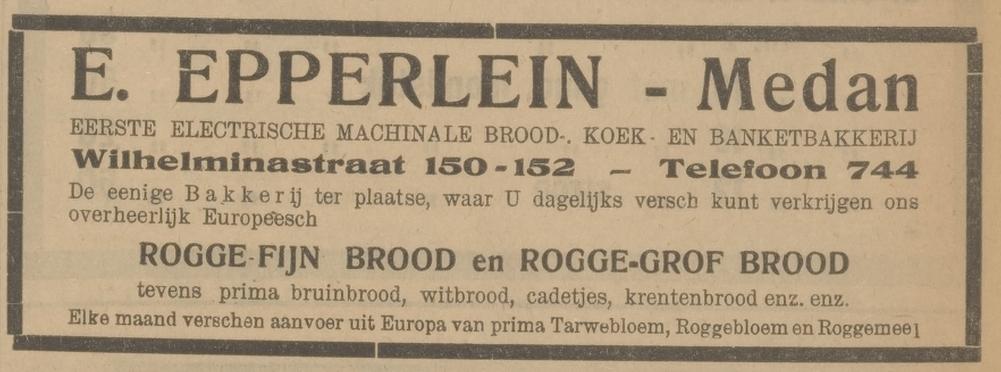
Epperlein opened its Lunch room in Kesawan in 1933, offering delicious European food, sausage, and famous ice cream, praline, and Likeurbonbon. The staff were Epperlein, Jacobi and Büllesbach
The Sumatra Post 28-08-1933 wrote:
EPPERLEIN’S LUNCH COOM. A godsend for the shopping ladies.
This morning we had the opportunity to visit the new lunchroom of Epperlein & Co at Kesawan.
The old plot, which once served as a car showroom, has undergone a complete transformation under the skilful hand of the architect, Mr. Liskowski. The spacious hall with its cozy seats and neat counter immediately puts the visitor at ease and, as it were, invites everyone to rest for a while. Medan has had to do without such a facility for a long time. After all, Mr Epperlein has dared to make Medan a lunchroom. We have no doubt that the tidy case will meet an urgent need. The many who already paid a visit yesterday, and the day before yesterday, were all full of praise for the first Medansche lunchroom, where you can get such delicious pastries and such delicious ice cream.
After we had tasted a fragrant coffee, prepared in a modern coffee machine, which (electrically) prepares the coffee for each cup separately by means of a steam and hot water bath, we were able to take a look at the modern bakery under the guidance of Mr. Epperlein. After the dough is mixed in a mixing machine, it enters the kneading table, enters the molds and then goes into the gas swing oven. This oven, which is fired with gas, has a kind of David’s ladder in its interior, which rotates continuously (electrically)! the rising process is accelerated by a steam bath.) In another oven, the German rye bread is baked. This oven is also completely fired with gas. The bakery currently supplies 150 kilos of bread per day, a weight that can be increased according to demand.
We went further, the pastry shop where they were busy making whipped cream, has access to an electrically driven stirring and beating machine. The bread is packed in a separate room, after which it is ready for distribution. To the left of the bakery is the office where the entire administration is conducted. Finally, there is also a storage room and a dressing room and toilet for the waiting staff. A large General-Electric refrigerator ensures that various lunch items are kept cool. Two more refrigerators are expected soon. An extra ice conservator ensures that various ice creams are kept at the right temperature.
With this our tour was over. We can add that afterwards, we felt like the baker’s apprentice who was allowed to eat sweets all day long in the service. Finally, we emptied the Champagne gas with the wish that the new lunchroom could go. Medan will undoubtedly appreciate this establishment as much as possible. We have certainly not been there for the last time.
A 1954 article reminiscing the good ol’ colonial time:
It has been a good tradition for many years that we went for breakfast at the German bread and pastry baker in the Kesawan, the company Epperlein. The diligent Epperlein brothers always made sure to be open at five or six o’clock the morning, and one could get scorching hot coffee, fresh rolls of ham and whatever else to strengthen the tired body again.
In 1938, Epperlein celebrated Queen Wilhelmina’s 40 year Jubilee with a decoration. Interestingly, it also hung the Nazi flag. Seems a bit of contradiction. Not long after, German invaded the Netherlands 10 May 1940, and it doesn’t take long, the Dutch colonial surrendered in 4 days!
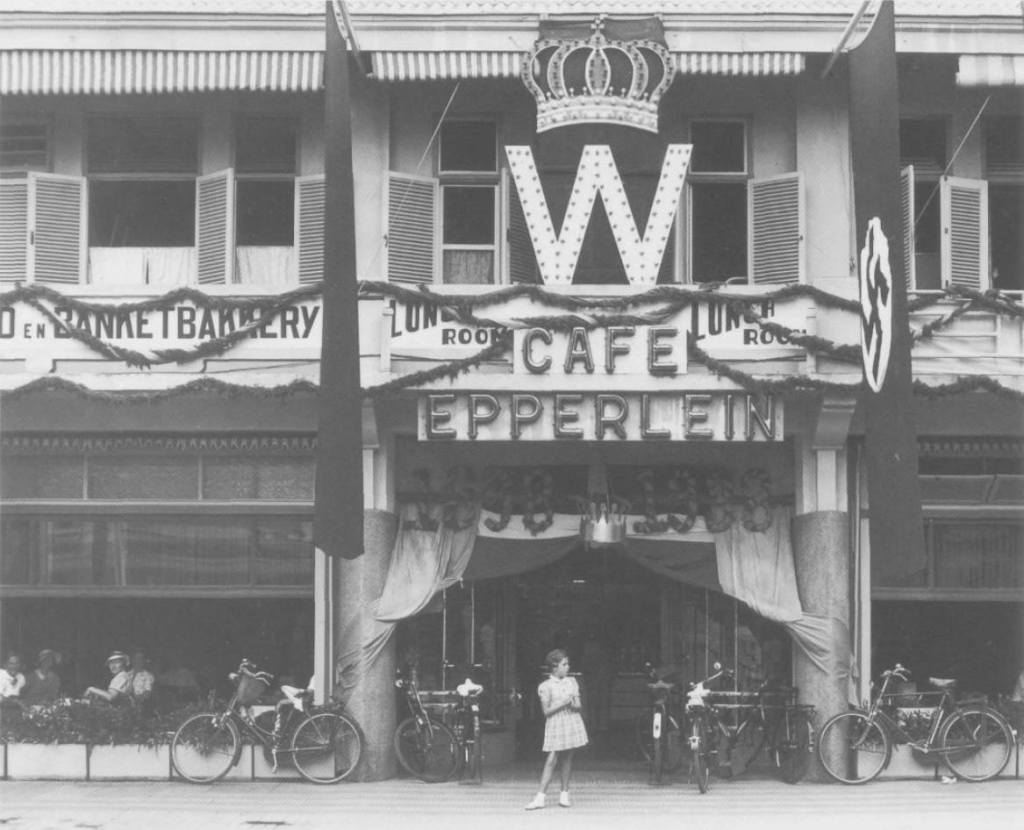
The Dutch Indies was not affected by the war. But Epperlein started to lose its business and closed down not long after.
An article on 22 Jan 1940 in Het Nationale Dagblad describes Epperlein and the war and Tip Top.
For years, Medan has few restaurant area with two hotels and with a restaurant, annex American Bar. In the capital of Deli, the city of the hari’s besar, it has been nicely done with two hotels with a restaurant cum American bar.
Until a European enterprise arrived. Epperlein started as a clean bakery, established In a few petak houses in the Chineese quarter (around 1919, Wilhelminastraat 150-152). In time (1933), they bought a building on the Kesawan, which was then a car dealer with workshop and showroom. He moved his bakery and pastry shop there and turned the showroom into a lunchroom that sounded like a clock. And the miracle took place.
Epperlein was chock-full. It was not open all day and it was not possible to have lunch there. But one could drink excellent coffee and tea, get ice-cold drinks, enjoy ice cream in all kinds of varieties, eat pastries and cookies. And especially – it opened at six in the morning. If there had once been rameh-besar in one of the hotels, which had lasted until daylight, one could move to the Epperlein lunchroom and have a meal there. Yes, people find it so pleasant to restore themselves. Lunchroom Epperlein went smoothly, full in the morning, full in the afternoon. After seven hours, it is closed. It was discovered, the Kesawan with its pleasant bustle. Medans Kesawan looked like Pasar Baroestraat in Batavia or Tundjoengan in Soerabaia. The traffic for Epperlein had to be specially
arranged and they could not come.
That does not take long: there had to be competition. And that competition came in the form of a second lunchroom. Medan has dozens of bakers, except for Epperlein all from the west. But among those Eastern bakeries, of good bread, by the way, one had become exceptional and elevated: Yang Kie’s bakery. It started in a few petak houses in the Chinese quarter it began to feel small.
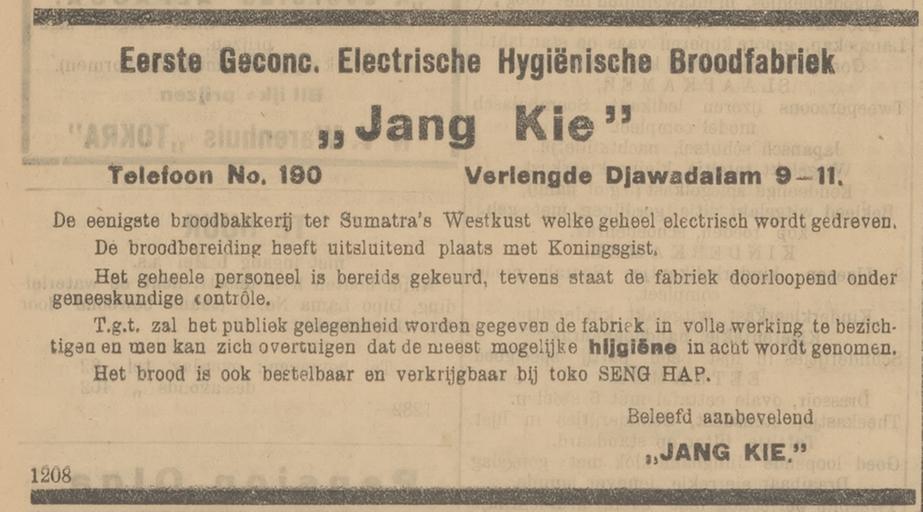


And it made the leap to Kesawan with a lunchroom. Diagonally opposite Epperlein. Although it had the advantage in the morning of sitting on the shadow side of the Kesawan, it didn’t work against Epperlein. Epperlein had two beds, which everyone knew and who did more work than the six lounges, in the lunchroom across the street, which had received the name Tip-top. Epperlein was expensive but had excellent food. It seemed that lunchroom Tip-Top was going to suffer a short time.
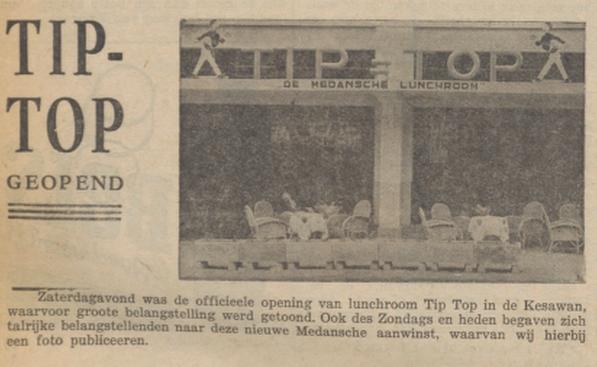
But then war broke out, but first something else. Toko “de Zon”, the large firm from Java, wanted to settle in Medan and bought the shopping complex in which Tip-Top was located. (De Zon Medan opened on 16 October 1939). The lunchroom had just been in existence for two months. But Jang Kie had an idea: he could build on the other side buy, a little closer to Epperlein. He could make an open terrace there, which was shady. He could build a large kitchen and pastry shop behind it. And that transition was already an improvement: more visitors would come.
The war broke out. If cholera had broken out at Epperlein, it could not have been more empty and desolate. Everything with it lunchroom Epperlein and looked for pied a terre at Tip-Top. They “discovered” Tip-Top. For the time being at least, Epperlein only had to rely on new visitors and Germans. But the Germans in Deli are wonderfully aloof from everything this time. They hardly appear in public anymore. In contrast to the English, who show themselves more these days.
And so the image was changed. In one stroke, lunchroom Epperlein became empty. Tïp-Top is full. But the edges do not remain sharp for long. Jang Kie may have an excellent Dutch cook, but there were things to get at Epperlein that one couldn’t get anywhere else. Why should they deny oneself? Did they help the Allies with lunchroom Epperlein? No more bread to order from Epperlein? No more tasty cakes, etc.?
Gradually old faithfuls returned to lunchroom Epperlein. Why should one, without necessity, give up that which one had always found good and tasty? Of course there are die-hards, even among the non-English. But it is now divided. Epperlein has customers; Yang Kie has customers. And if there are no major shocks now, the lead will come!
Deli Courant (18-02-1939)
DE ZON BUYS FOUR PROPERTIES
We learn that the well-known NV Handel Maatschappij Toko De Zon, which operates a number of large fashion department stores in Surabaya, Batavia, Bandung and Singapore bought two buildings on the Kesawan and plots on the Marktstraat, in order to open a department store there after it had been renovated, in the style of its business in Java and Singapore. The plots on the Marktstraat concern two Chinese kedeh. On Kesawan (which are situated in front of these kedehs), the bookshop of the firm Kohier en Co and the building in which the lunchroom ‘Tip Top’ of Firma Jang Kie has been established for some time. All these properties, which together form one “grant” and cover an area of 760 square meters, were the property of Mr. A. Cornfield in Medan. The sale price was, we hear, a sum of around ninety thousand guilders. The plots must be cleared within three months, after which the conversion to one building commences immediately. Toko De Zon hopes to be able to open as soon as possible.
The N. V. Handel Maatschappij Toko de Zon is under Chinese management. The staff is also mainly of Chinese origin. It will be transferred from Java to Medan. It seems to be the intention of the firm to have a number of smaller inexpensive dwellings built here for its shop workers, since such houses are not sufficiently available in Medan. As has already been noted, this is a so-called ‘fashion store’, where everything in the field of fashion articles for ladies and gentlemen is available. The aforementioned Handel Mij intends to start a similar shop in Palembang as well.
Deli Courant (10-03-1939)
“TIP TOP” TO THE OTHER SIDE OF KESAWAN We learn that the lunchroom “Tip Top” on Kesawan will soon be transferred to three plots on the other side of the street, which are currently leased to the Silversmith Company, the toko Kunstarbeid Djawa and the sports warehouse of the Liang You Company. These buildings will be furnished for their intended purpose at the beginning of May, so that the lunchroom will open its gates again at the end of that month. The three properties mentioned are owned by a Chinese insurance company and were rented for five years by the firm Jang Kie, which operates the lunchroom. As is well known, Tip Top has to leave the currently occupied building, because it will soon house a Medan branch of Toko de Zon
 Stories from Deli
Leave a comment