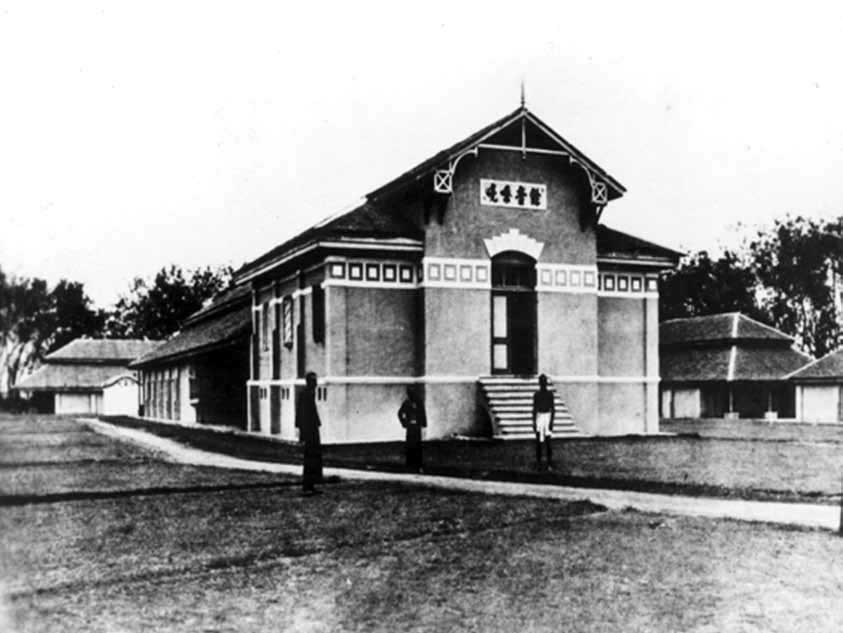
Indigenous people, such as Malays, Mandailing and Minangkabau live on the outskirts of the city. The separation of these ethnic groups was in line with the racial politics of the Sutch, which divided the people of the Dutch East Indies into three groups, namely Europeans, Foreign Easterners (Indians, Chinese, Arabs) and indigenous or inlanders.
The deads also follow this rule.
Indian Cemetery and Crematorium
Indian cemeteries are divided into Christian, Muslim, and Hindus. Cremation is for Hindu Indians from the North: the Brahmins and Chettie; and from the South: Bombayers and Bengali or Sikh people.
For Indian Christians, in 1906 the Medan government agency of public works issued a land certificate for the burial of Tamil people who are Christian. The cemetery is located in Kampung Keling and covers an area of 35.6 ha. However, this burial ground is not only used for Indians, but also used as for non-European Christians.
The funeral for Indian Muslims is located on Jalan Calcutta near Babura River. This burial ground is primarily for Indian Islam originating from Madras, Bengal, and Hindustan. It has an area of 50 × 60 meters and is surrounded by masonry walls, as well as in corners and a langgar made of stone. Inside, the land deed mentioned in 1901 that the land was a cemetery for Indian people who are Muslim. The land is part of the lands which was submitted to the Dutch government in 1886.
For the Hindu, the cemetery is located on the Ceylon Street (now Jalan Zainul Arifin) has an area of approximately 6,000 m2. The burial was used by Indians originating from South India. They are known as the originating Keling from Madras, and the caste division within these groups was retained. These Indian burials are used by the Pathans, the caste they comprise of the goldsmiths, including the lower ranks of the Vaishya class. This cemetery stems from the Polonia plantation given to the government Dutch and designated as a Tamil Indian cemetery in 1899. The location referred to is located between Petisah Tengah Village, Medan Petisah District and Madras Hulu Village, Medan Polonia District.
As for people from North Indian (Hindus) or what is commonly called Bombayers, they are cremated in the same place as Sikh. As for the Bengalese people (or Sikh), based on the statement of the local head on October 13, 1900, they were placed in the Polonia area with an area covering 1,600m2.
Japanese
Based on a decree issued by the Dutch East Indies Government in 1899, the Japanese funeral (Nipponjin Kiyokai) is located on Jalan Binjai with an area of 8,500 m2. This place is also used for non-Japanese people who come from outside the Medan area.

Chinese cemetary
The Chinese funeral in Gemeente Medan is divided into several types , public cemetery of the Chinese, cemetery for certain clans, Family tombs, Deli Maatschappij employees, and a Chinese Christian. At first all Chinese cemeteries were intended for Chinese who are Buddhist, but over time time there is a new case for Chinese Christian burials.
The public cemetery for the Chinese is located in Kampung Durian. The land was from a gift from the Deli Maatschappij in an agreement dated March 25, 1896. In one of the articles, it stated that the land of 92,300 m2 was presented to the Chinese in Medan represented by Tjong Yong Hian as the head of the Chinese. The Dutch government then appointed Major Tjong Yong Hian and Tjong A Fie as caretaker and manager of the funeral. But management was by “Kwong Tong Soh”. The Cantonese has an extensive cemetery on Djatilaan.
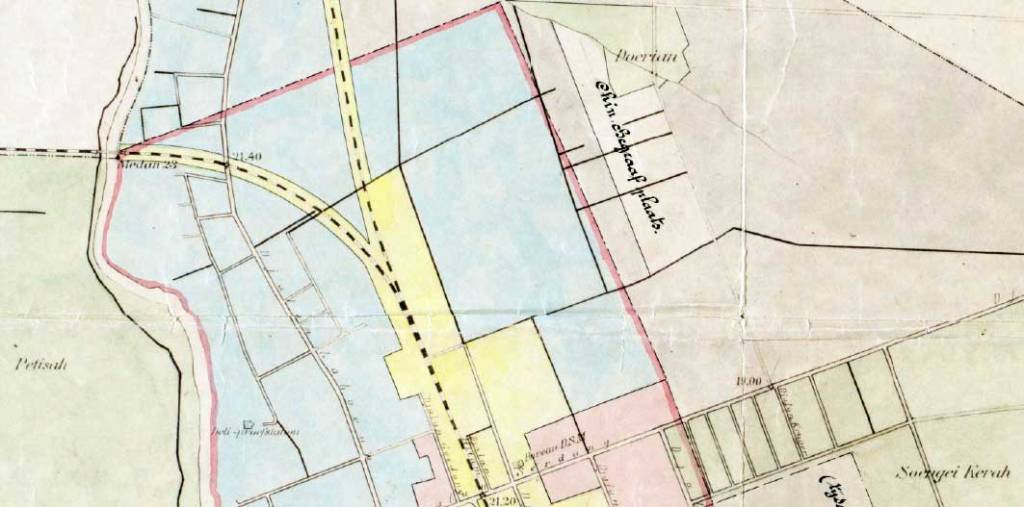
In 1896, the Dutch government in Medan also gave permission for a burial ground for a Chinese family or tribe i.e. people Hokkian and Tiotjoe people. The Chinese cemetery of Hokkien origin people is located on Bindjaiweg and covers a fairly wide area of 42 ha. The burial ground was founded in 1879 which was purchased for $713. The official permission from the government for use of the land as burial ground was the Decree of the Deli Sultanate on November 30, 1901 which was legalized by Resident of East Sumatra. Funeral management is managed by an association which is named “Hok Kian Hwee Koan”. The association was legalized as a body law by government decree of 6 June 1923.
Another version wrote that the Fujian Cemetery 昔 福 建 義 山 (xi fujian yi shan). In 1878 Mr. Wen Yanti first bought from natives an area of 424,600 sqm. outside of town at Petisah to set up the Fujian Cemetery, for which purpose he obtained the permission of the Colonial Administration. After his death, Wen Yanti was succeeded by Su Baoquan and later by Qiu Qingde as chairman of the cemetery board.
The Tiotjoe cemetery is located on the north-side extension Bindjaiweg Street about 7.5 ha. which was founded in 1886. Management of the funeral managed by an association in the form of a legal entity called “Tiotjoe Kongsie”.


The cemetery of the Chinese who work at the Deli Maatschappij company is located to the west of the Chinese public cemetery. The cemetery has an area of 2.5 Ha. separated by a ditch by a Chinese public cemetery. Origin of land the funeral was the result of an agreement between the Gemeente Medan government with the company Deli Maatschappij. In a land swap between Deli Maatschappij company with Gemeente Medan, then the land was taken over by Gemeente Medan, but the Gemeente government remains tied to designation of the land as a burial place for working Chinese
in the company Deli Maatschappij.
At first the Chinese who were Christians were also buried in Chinese public cemetery located in Kampung Durian. Then gatherings “Kwang Tong Kong Soh” who became the caretaker and manager of the funeral object if their burial is also used as a place Christian Chinese funeral. On this basis in a negotiation between funeral caretaker with the mayor of Gemeente Medan and the zending Methodist fight for the interests of the Chinese population who are Christian, then it was decided that part of the land was 1,750 m2 of the Chinese public cemetery separated for use as a burial place for the Chinese Christian. Then by mutual agreement the management is carried out by zending Methodist.
For Chinese family there are three funerals namely the funeral for the Tjong Yong Hian family, the Oei Swee Bee family, and Tjia Oh Noei. The Tjong Yong Hian family cemetery is located south of Jalan
Parkstraat. The Oei Swee Bee family cemetery borders the cemetery Hokkian which is located on Padangboelanweg and has an area of about 7,000 m2. The land came from Datuk Hamparan Perak in a land deed on the 16th April 1907 given to the Oei Swee Bee family for use as burial ground. Then the local government both the Sultanate of Deli and the Dutch government, namely the Assistant Resident, gives approval and permission to used as a funeral. Lastly is the funeral of the Tjia Oh Noei family which was founded in 1911.
European
The burial of the first European is located at the Polonia plantation which was founded in 1869 which is a funeral owned by the Polonia plantation family. In 1886 the cemetary was at Electriteitweg Street. In 1915 it was used not only for European burials, but also for natives who are Christian and also for those who serve as soldiers.
The public cemetery for Europeans is located on Paleisweg Road (Jalan Brigadier General Katamso- present). The cemetery was founded in 1880 initially managed and financed by private individuals and businesses. In 1882, the Dutch government in the Deli area, namely the Assistant Resident of Deli Serdang adopt regulations and begin to regulate and manage European funeral in the Medan area. As time went on at 25 October 1904, the Medan government authority at that time was administered by an agency that was named Gemeente Fonds or negorijraad officially managed by the government
as a European public cemetery. The Europeans in Gemeente Medan of course Christian so that the funeral is also called a funeral Christian Europe.
After the Medan region obtained self-government in the form Gemeente Medan in 1909 then the management of funerals for European also gets special treatment. As explained in the section
previously that the regulations regarding burial land in Gemeente Medan were contained
in the decree for the formation of Gemeente Medan.
The European public cemetery is located on the banks of the Deli River and has an area around 12,000 m2. With this area has been calculated by the manager and funeral supervisor in Gemeente Medan that each grave needs an area land approx. 6 m2 , and will suffice up to 2,000 tombs. So that the funeral it will be full in a long period of about 50 years. Calculation these are based on assumptions or estimates of European mortality rates at Gemeente. The estimate for the last eight years i.e. between 1918 and 1926 was between 30 up to 40 people each year.
Muslim Cemeteries
Medan people were buried in the Kayu Besar burial complex, on Jalan Orange Nassau (now Jalan MH Thamrin), while the Kota Maksum cemetery is reserved for residents of Kota Maksum Muslim in Sukaraja (Medan Maimoon District) and Sukaramai (Medan Area District) villages. The Muslim burial complex in Sei Kera-Percut was built in 1918. The burial complex in Petisah Hilir was founded in 1900. And the Haji Akub cemetery in Sei Kera-Pandau (in the Medan Perjuangan sub-district) was founded in 1893.
In the area of Sukaraja Village, Medan Maimoon District, south of the intersection of Jalan Brigjen Katamso and Jalan Ir H Juanda, extending north-south following Jalan Brigjen Katamso there is a burial complex. The public knows it as the Minangkabau cemetery, the Arab Cemetery, the Mandailing, and the European Cemetery.
Minangkabau cemetery occupies an area of approximately 5 (five) hectares. This is a funeral complex which is a community waqf originating from Minangkabau.
Further north, are the Arabs Cometary. This burial complex is divided into two parts, namely the northern and southern parts because of the small road that runs east-west to the village on the west. The southern part of the cemetery is the As-Solihin Mosque. To the north of the Arabian Tombs there is another burial complex, namely the Mandailing Cemetrary.
In the Mandailing Cemetery, there are still several quite old graves, including Sadikin’s tomb, who died in 1897. This grave with a stone headstone is located in the northwestern part of the burial complex.
Muslim burial complex in Jati Hilir village (a sub-district built in 1896, at Sei Kera-Percut Jl. Prof. HM Yamin, SH (in Medan Tembung District). As for Malay Muslims, his grave is in Petisah Hilir on the river side Deli is near the mosque (near the junction of Jalan Guru Patimpus and Jalan Adam Malik in Kelurahan Kesawan, West Medan District), whose land was given by Datuk Hamparan Perak to his family, while land in the northern part was given to the family of Ismail bin Hasan from Datuk Djusman bin Datuk Gajah.
Company Employee Funeral
Deli Matschappij provides a burial area for its employees near or in the area around the cemetery for the Chinese employees of Deli Matschapijj. The soldier / army cemetery on Jalan Binjai was founded in 1897, while for prisoners on Jalan Sekip (entered the Sekip Village area and the Sei Putih Timur I Village area in Medan Petisah District) it was established in 1912.
The information above is adapted from a book published by Balai Arkeologi Medan, Kota Di Pesisir Timur Sumatera Utara Dan Peninggalan Tuanya.
 Stories from Deli
Leave a comment