There are many temples in Medan, two largest and oldest are, the Kwan Tee Bio on the street of that name and the Thien Hioe Kiong on the Kapiteinsweg. There are also several smaller temples scattered throughout the city, and finally there are some in the cemetery temples.
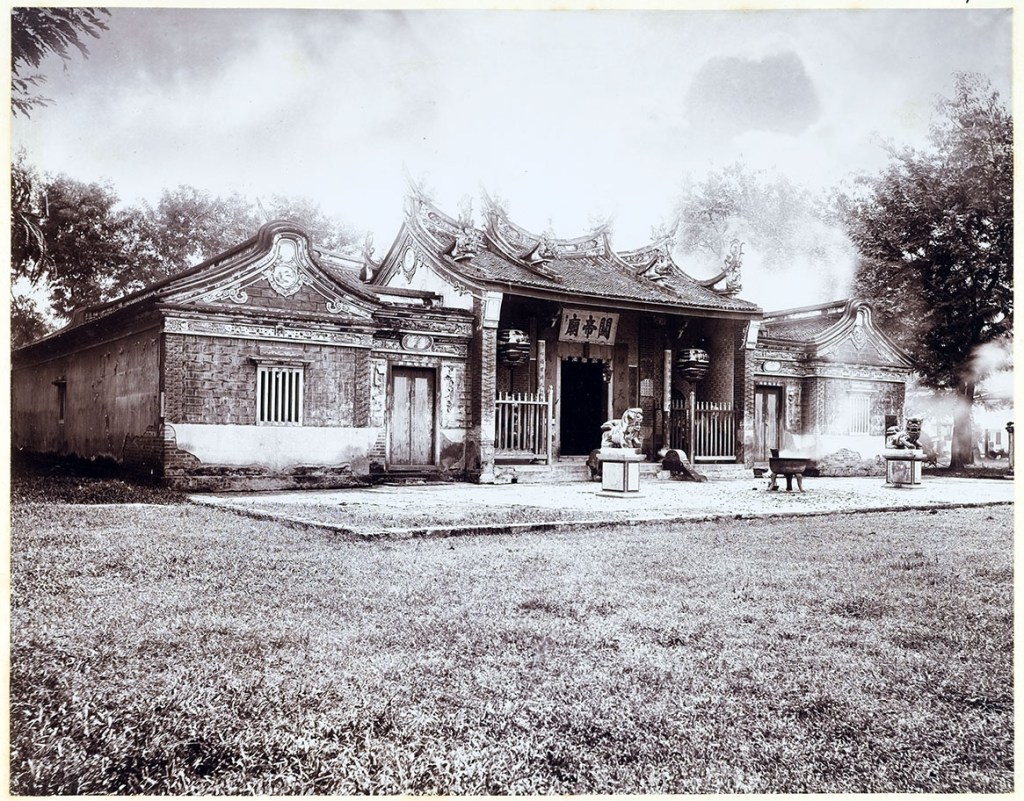
The Kwan Tee Bio is the oldest temple in Medan. Founded years ago, when Medan was so small, that it was almost nothing stood on the other side of the track. It was founded in 1884 to promote the solidarity of the different ethnic groups from Canton. It was said that Tjong Yong Hian took the initiative for building this temple.
A set of three stone inscriptions set up on the occasion of the construction of the temple and donations. The introductory text, composed by Zhang Yunan (Tjomg Yong Hian), gives a short
description of the area, at that time called Deli-Shawan (Deli Kesawan), and of the Chinese
community there. The temple is dedicated to Guandi shengjun, Caibe xinhjun (Chai shen) and to Fude zhengshen. One of the purposes of the establishment of the temple was to promote the solidarity of the different ethnic groups of Guangdong.
關帝廟
建造棉蘭題緣芳名碑 募建日程沙灣埠 關帝廟題緣簿叙
常思:物華天寶,山川華锺毓之奇,人傑地靈,庶彙著阜康之盛。夫砂灣居日理之中,不通海口,上至馬山,右出哩呤,左往籠葛,龍盤虎衛,水繞山環,正四時產物之坼,廼商贾輻輳之衛也。夫我華人經營斯地,士農工商,屢歡太有,無非籍聖德之覃敷,歲歲降祥宇市井,賴帝恩以默祝,時時賜福於人間,若不降其祀典,何以奉答神庥?茲通商公議,即以沙灣下地購基,創建廟宇,奉祀關聖帝君、財帛星君、福德正神,新塑靈像,恭進香燈,則豐□□□,斯足增赫曜,而愈顯威靈,亦薦享式憑,旣上妥□明神,即永叨福庇。第思工非一木,術愧點□,獨力難持,衆擎易举,爰集同人,設立章程,摹簿勸捐,伏願仁人君子,當思百粤情聯,□冀□信男善女,各抒誠意,踴躍題捐,慷慨之士,錢拾杖頭,殷富之商,金流布指,將見裘成囊腋,瓦□□鄰,由是早觀厥成,神人賴斯,赫赫英靈,表恩光於萬古,虔虔禮樂,薦俎豆於千秋,從此爲管者簪纓奕世,爲商者紫標朱提,喜看海國咸寧允矣。澤普衆信□□□慶□□,福有攸歸,是爲序。
光緒十一年乙酉歲孟冬月梅城張煜南榕軒氏敬撰(捐者芳名撰畧)
The list of donors is headed by four people who gave one thousand or more silver-yuan each. But only the name of Zhang Yunan can be clearly deciphered. The total of the donations cannot be exactly ascertained, but it exceeds considerably ten thousand yuan. Dated 1885.
The location of the temple must have been very nice then, at the end of the street, which is still called Tepekongstraat. Just a little bit about that name Tepekong. Here on the East Coast, that word becomes common used for every temple, often shortened to tokong. For example, the Hindu temple on Parkstraat becomes „tokong called tjitie ”. Tepekong, however, is not a Chinese expression for temple, but is the name of the god of the earth and also of wealth, Tho Thee Kong, that in our Indies too is referred to as Toa Pek Kong. The actual Malay word for Chinese temple is klenting, but that is done here in Deli not used. The Chinese of course have one syllable of their own words for this; that for great temple is bio and so it stands the main door of our temple a large sign with only three signs: Kwan Tee Bio, the temple of Kwan Tee.
A few years ago (around 1930), this temple was dilapidated and thus renewed and that restoration lost quite a bit characteristic.
Initially, priests Huizong and Huixin took charge. In 1965, Cheng xiong became priest in charge. In 1970 the temple was thoroughly repaired. But soon afterwards the back part of the temple, one third of its premises, was confiscated by the government in order to widen the street. Thus, extensive rebuildings became necessary which thanks to the generous help of many people could be successfully completed. It was refurbished again in 1980s.
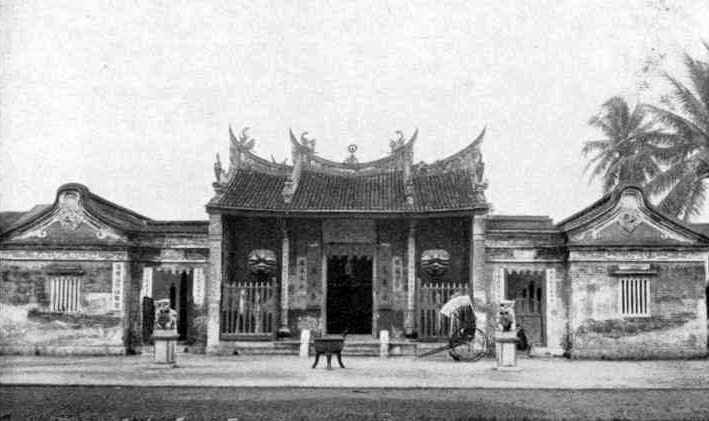
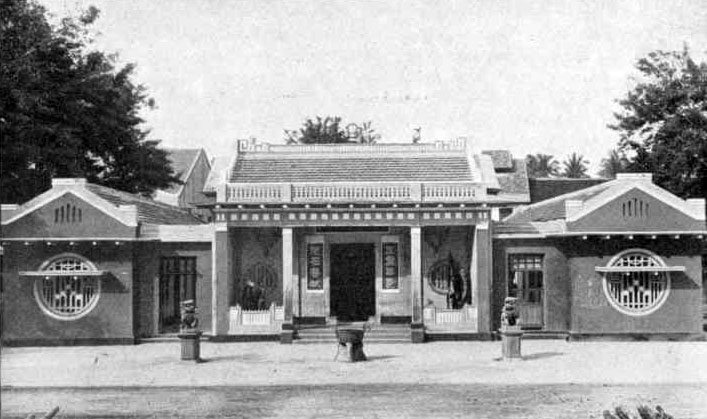
The roof has a the decoration of the ridge consists of two fish and a sun as one
Japanese chrysanthemum made of concrete.
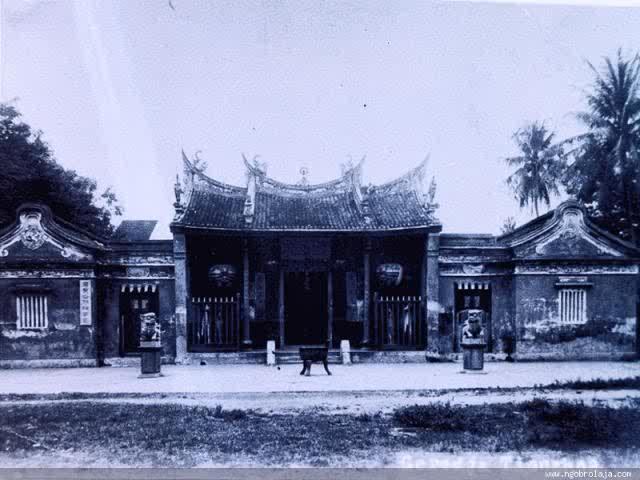
Gerard Jansen, Andere Wereld (1934) wrote
Immediately upon entering falling images, those left and right in the narrow front gallery
standing, on the left a grim warrior with a horse in bridle, right one with a banner. You will notice that with these images always some burnt incense sticks, which shows, that was sacrificed there.
Upon entering, the whole turns out to be a bit new and bare to be. Still, this has its advantages, because the carvings are at least now visible, while they used to be full of mud mason bees and were dark with smoke. Immediately upon entering one sees a large gilded image high in it hangs in the middle, it’s worth taking a closer look, just a pity that it hangs so high. It’s a performance of heaven, earth and underworld, with countless dolls and animals and fish in the ocean that covers the underworld. The earth, where people live, is in the middle and therefore call it the Chinese their own country, that for them the whole world is, Tiong Kok, the realm of the middle.
Now that the temple is so empty, great stone slabs falling on it, that are built in the wall on the left. Such records, which are almost none temple are missing, contain date and purpose of the foundation of the temple and any extensions or conversions, and and in long series the names of all donors of contributions. That is a typical Chinese custom, which again proves how business is a Chinese in these cases. For what belongs what and it is therefore good that every donor is properly immortalized. For to contribute to the temple is a good deed, for which the giver will be credited in the afterlife.
A very strong example of this custom can be seen on the cemetery at the Djatilaan. There is an octagonal column, one somewhat resembling a Dutch kiosk, where marble slabs thousands of names have been chiselled, each with the amount that was donated. And there are amounts of 50 cents. The chiselling of the name must cost more.
Behind the temple is the great old altar with the five usual dishes, two flower vases, two candlesticks, one censer. They are made of tin and a meter high. The altar’s fore-piece is particularly beautifully carved with numerous representations of people, animals and gods.
Thus we finally arrive at the image of Kwan Tie, in whose honor this temple was erected. Deep in pitch black niche is an image darkened by forty years of daily life incense, so dark that there is hardly anything can distinguish. But recently they have one for the niche placed a new image, flanked by two grim ones warriors. His face is not as gruff as one of the pine Chinese Mars would expect; besides it’s not right him to be called the god of war, as you will see.
Kwan Tie was born in the year 162 our era, the land comprising the present-day province of Shansi and he is called the greatest hero of that age of chivalry, then before For centuries there was a continuous battle between the three kingdoms, into which China was divided. That battle is an inexhaustible resource for stories and plays and therefore very popular. Kwan Tie was general of the Prince of Shoe, who pretended to be to be rightful heir to the imperial throne. That frost
had more great warlords, including Tjoe Ko Liang, whose image in our temple is on the left hand of Kwan Tie? the other is Kwan Bing, his son.
These generals performed the most wonderful deeds and found extraordinary weapons of war, such as a bow, that many shoot arrows simultaneously, draft oxen and riding horses of wood and
metal. They could fly and dive under the sea. Despite all this, the Prince of Shoe had to lose out
serve from Woe. Kwan Tie was captured and at 58-years of age executed. After his death he received honorary titles and he enjoyed more and more veneration like the picture of a noble knight. So much so, that at the end of the sixteenth century the emperor Wan Lie deified him.
It is understood that this worship does not concern the warlike, but the chivalry that Kwan Tie does are the example for young and old of faithfulness, sincerity and courage. Are most used honorific therefore reads simply: the Knight of Shansi, like an inscription of four simple letters above the altar
indicates.

Every temple has its special holidays, of course, but in none is it so universally celebrated as at this temple from Kwan Tee. Its size falls in the fifth month of China feast day and then there is a festival in the temple yard all month long celebrated. It is then a real fairground bustle, with rows of stalls,
where all possible and impossible eateries are sold. The central point of the revelry, however, is the opera.
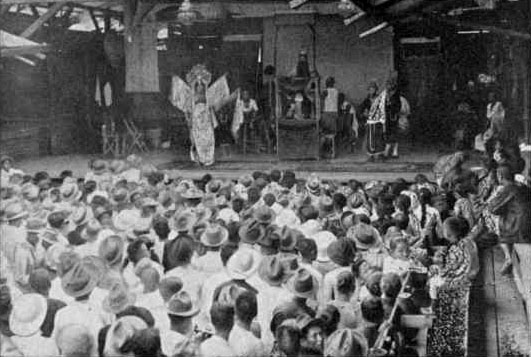
Right across from the temple is a scene, sort of about six feet above the ground, making it for all spectators clearly visible. Most of these are simple parterre and with a beautiful performance, in the evening after work, it is incredibly busy: man to man to the front gallery of the temple the spectators stand with tense attention following the game. Left and right are covered seating areas:
a corridor with rough wooden benches in our photo to the right visible and behind them large spaces with chairs. The audience do not have to pay for access, but only for the seating.
The scene itself is very simply decorated. A solid back cloth with a beautifully embroidered silk curtain on the left and right, whereby the players appear on the scene. They are not alone
the entrances to the changing rooms, but also to the buffet, because under the game the kids walk in and out with big ones trays of treats, cigarettes, ice cream, jams strung on skewers, and they praise their wares with a loud voice in the midst of one delicate aria.
Otherwise there are only a few chairs and tables on the scene, who should portray all possible things. The stagehand he can be seen sitting comfortably on an animal chair on the right in the photo
sitting, it depends on the needs of the game more or less fancy doilies over it, put them together like it is necessary. So at the moment our photograph captured two tables on top of each other with a curtain on two above to strike. On a table behind it a chair has been placed and the whole
represents an exalted throne. One can easily ridicule this but let us be grateful that our own art
the demand of realistic imitation has been abandoned and also looks more for suggestive portrayal.
We would of course make the whole thing more aesthetically groomed want to see. Such a stagehand, who will set things up for sure another scene while the singers are still at their height
being play would annoy us. But when one sees how the spectators following the players with full attention, one can understand that for them all that incidental fuss on the scene is no objection
yields.
That is why the orchestra can also sit at the back of the stage. It consists of six men, some of which have different instruments to play. There is always at least one violin, one with two strings, where the hairs of the bow pass between them: they indicate the melody, continuing in flageolets. A three-string guitar and a four-string mandolin such a flat round, with short necks follow the melody, sometimes also a nasal one clarinet. But the power is in the percussion. The player of the
small percussion is therefore conductor. He can be seen in our photo sit between the two singers: cigarette in mouth, shirt collar loose and his single rolled up from below because of the warmth. He plays his instruments with a few sticks, mostly of wood, which gives a hard dry tone. With that gives
he directs the whole and once one has gotten used to it in the strange part of this music it will be seen how he met these simple wooden instruments delight the gestures of the players
knows how to accentuate. A major part of it orchestra furthermore form the gong and the great cymbals. It’s amazing which extracted a variety of effects by muting them in different ways.
But whatever it may be of naive simplicity, one thing is beautiful: the clothing of the players. The troop of the overalls is ordered here often has a wonderful collection of costumes,
no fake stage clothes, but real heavy silk with gorgeous embroidery. The main roles do not come twice in the same costume and one is more beautiful than the other.
Two pieces are put on stage every day; At noon from noon to five and in the evening from seven to midnight. Especially in the evening it is packed until the last moment, but also in the afternoon countless people brave the heat of the game to enjoy, as our illustration may show.
The set-up of a Chinese play is entirely satisfactory not the three classical demands of unity. The extraordinary easy stage change makes it possible, that a lot consists of countless scenes, which follow each other without any pause. Thus we see, for example, how a warrior in the field one
receives a summons from the emperor to come to the capital. He reads the letter so that the public is aware of his plan and go right. Immediately he comes back on the left with a riding crop in hand and sings a song, showing that he too horse is on its way and just in the night through the dangerous mountain pass must. He gets off the horse, with the reins on one clerk seems to hand it over by throwing it up riding crop and climbs on a table, where he tells that it is a hill is; after looking into the distance, turn right again. Left the robbers come up and speak of an ambush to lay; off. Throne Room; frost with consequence. Where is the general? There comes the messenger to tell you that the letter has been delivered is all finished. Mountain region; warrior and robbers each other. The robbers are defeated and fall dead on the pillows that the stagehand has laid out for them. Throne Room, monarch with effect on, then general on: that’s about the scene, which is depicted in our illustration.
The unity of action is also lacking, but it has Chinese scene in common with popular scene in other countries. There are endearing scenes, where weeping and grinding teeth being, there are fights, which by the orchestra in top action up to a fearful reality, and never one is missing comical intermezzo, often with the greatest pleasure looks at the auditorium, with a broad smile and shining eyes sympathizes.
The repertoire is extensive, with pieces of varying quality loin tendency. Several have been taken from the history of the three empires, the Sam Kok, into which China incorporated second century our era was divided. There is reason for that, for that century of chivalry is an inexhaustible source for it histories. But there is also a special reason, for at that time lived the most famous warrior Kwan Tie, who was identified and in whose honor the feast is given, right in front of his temple.
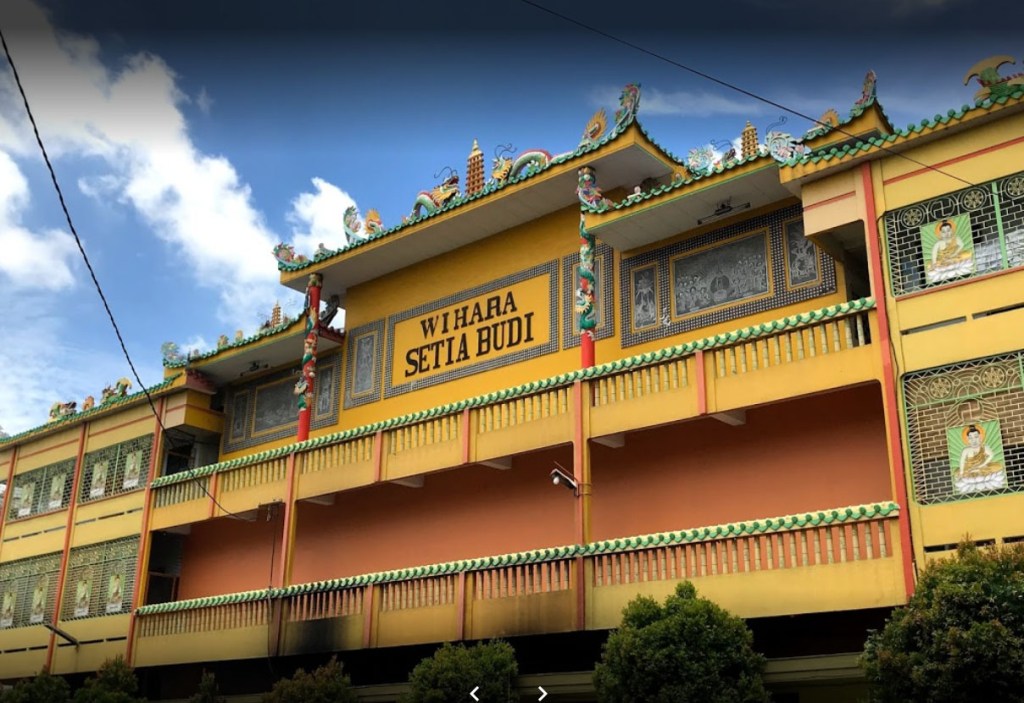
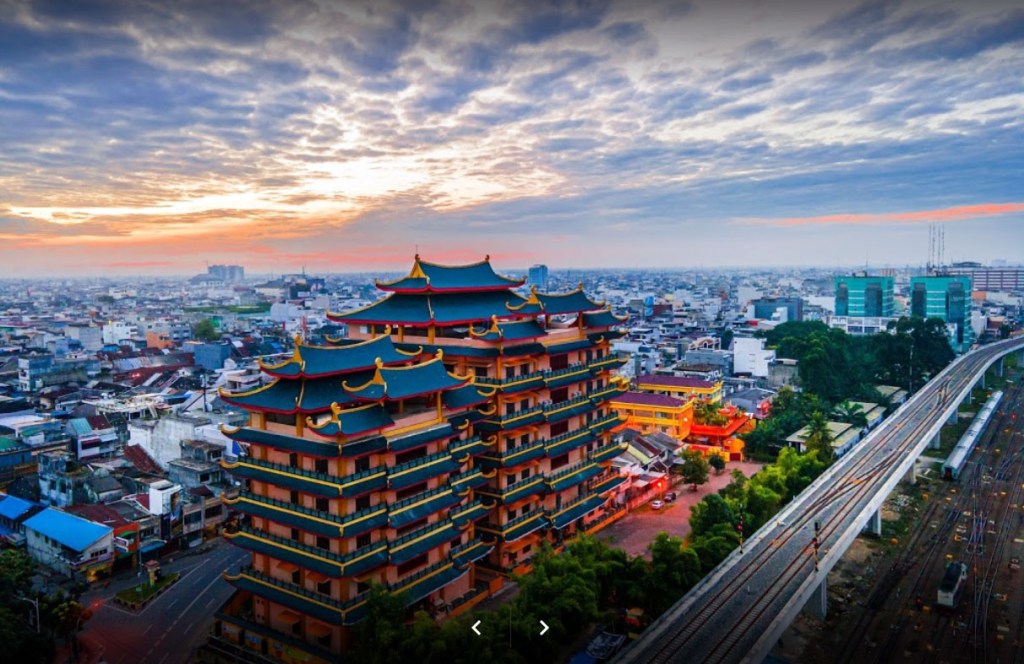
Nowadays Kwan tee Bio has expanded its area with a multi-storey Chinese temple style building occupying area of Oranje Bioscoop.
From Gerard Jansen, Andere Wereld
 Stories from Deli
Leave a comment