天 后宮
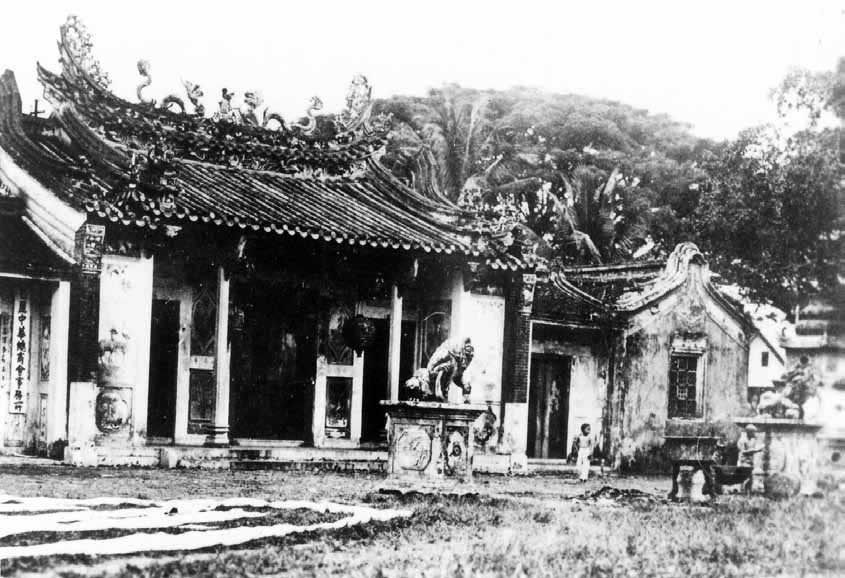
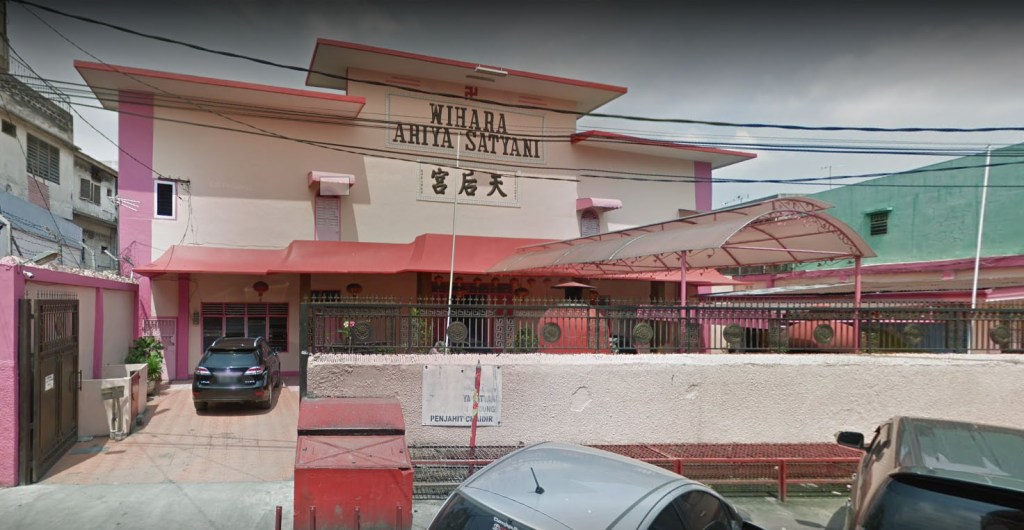
Thien Hioe Kioeng or Tianhougong or Vihara Ariya Satyani or Dewi Maco) at Kapiteinsweg (Jalan Pekantan) was dedicated to the Ma Co, protector of the seas. It is managed by Fujian people.
A stone inscription set up by the Chinese General Chamber of Commerce of Deli on the occasion of donations made for the construction of the temple. In the introductory text, thanks are expressed to the deity Tianhou for protecting the Chinese merchants on their overseas voyages which enabled them to develop Deli Medan, originally a remote place at Sumatra, into a commercial centre of Southeast Asia.
The list of donors is headed by the firm Wanlianxing , Zhang Zhenxun (Thio Tiauw Siat), and Zhang Yunan (Tjong Yong Hian), who gave 2,000 yuan each, and three further firms, Zhang Hongnan (Tjong A Fie), Xie Rongguang, and Qiu Zhaozong, who gave 1.000 yuan each. The following list mentions 124 further firms and individuals, who donated amounts ranging from 500 to one yuan, including the first nine together 16,912 yuan. A second list gives the names of additional 32 persons, who contributed various amounts ranging from 484 to five yuan, together 3,233 yuan. Both sums added together give twentv thousand odd yuan. A detailed statement follows, as to how the money was spent. A deficit of ca. 4,000 yuan was made good by an additional donation by Zhang Yunan. As evident from the statement on expenses, Dabogong had a seat in the temple too. Dated 1911.
A stone inscription set up on the occasion of the restoration of the temple by the priest in charge Miao Jie. The temple was first founded on the initiatives of Zhang Yunan and his brother. The present priest, a native of Xianyou who had lived in several temple of Fujian province came to Medan in 1947. He stayed first at Guanyin-tang in (that time) Jalan Taibei. Later he was transferred to Tianhou-gong. When in 1961 the priest in charge died, Miao Jie took over the administration of this temple. Thanks to the generous help he received from many people, he could carry through the restoration during the years 1976 to 1978. Dated 1980.

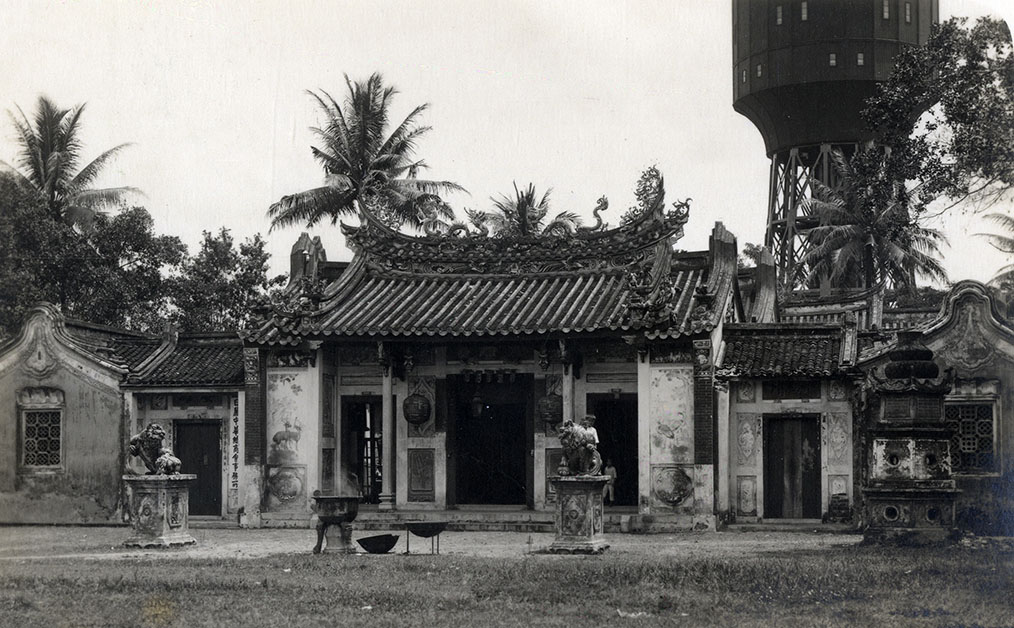
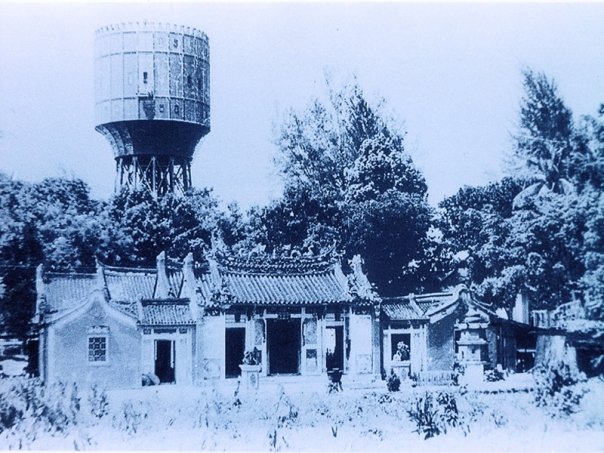
According to Gerard Jansen (1934):
This is at the beginning of the Kapiteinsweg (Jalan Pandu), with the front to the Djalan Mahkamah. What strikes us immediately is that the temple is slightly skewed in relation to these roads. (Which according to Feng Shui is not a good location).
The first thing that strikes everyone Chinese temple is the roof shape, namely the towards the ends
top curved ridge. In temples this form is common, but also we can see that peculiarity in more prominent houses. A look at our illustration shows that the roof shields almost flat, but that only the bricked ridge indicates the strongly curved line. There was a claim that the Chinese roof shape is derived from the shape of the tents in which the nomads lived, who used to be a large one
part of the Chinese plains. Indeed a tent sinks, which rests on two posts, in the middle and shows a curved ridge line.
Be that as it may, I can only say that the form, that maybe preserved from tradition, very graceful and I can myself understand that there are many who do not have to explain all that
have, but point out, that the Chinese in general very are sensitive to shape and that they are in their own with the soft undulating terrain (to which so much value is attached, as I said) have chosen a shape for their buildings, which harmonizes with the line of the horizon.
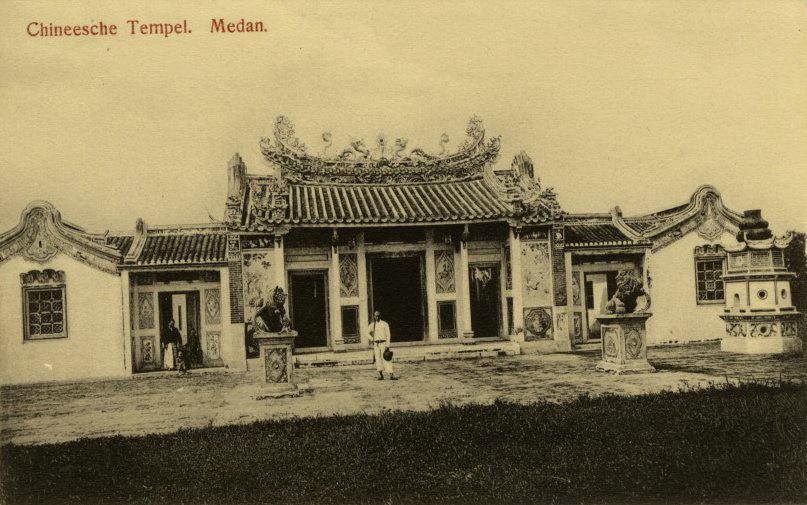
On the ends of the ridge are dragons and in the middle is a shining pearl. I have to say something about those dragons too, for that is a typical Chinese symbol, however, since the Republic of the Imperial Dragon, is in danger of falling into disuse. A dragon is by no means such a thing in the Chinese view monster of darkness as the medieval knights thought they were have to fight. On the contrary, it is the Chinese dragon symbol of the earth-fertilizing rain, which in such a land ‘
building people is of the utmost importance. It’s one for them favorable sign when the thick clouds appear in spring pile up like a writhing dragon and finally even the sun seem to devour. You can also see on the roof of our temple the dragons gasp for the sun in the middle and you remember,
how about the Chinese New Year there are parades through the city traits of little boys, who are a long dragon of painted good twirling and the improbably creepy head with the wobbly bulbous eyes gasping for a dispute ‘ third sun. The rain brings blessing to the thirsty earth and on it in the same way the government should be a blessing to the people. Hence, the dragon became a symbol of imperial rule.
Let us now take a closer look at the main shape of the facade. We have here an example of the temples common to Chinese usual layout, namely a main building with two smaller ones
side buildings, the end façades of which face forward. The end walls are, also in our case, often of a nice line and with a beautiful decoration.
Three doors can be seen in the building, namely the great door in the middle and two smaller doors in the connecting corridors between the main building and the outbuildings. At many temples
the middle door is only opened for tall guests while the devotees do not just walk straight up to the altar, but pass by enter a side door. A pair of lions stand in front of the temple of stone. They are watchmen for the temple, as they are there so often found in tombs and houses. It always belongs
to be a couple and the artists do not hesitate, this was clear let them come, if only, because the lioness is a cub has with him. They are nice little creatures with their mane and tail like foam curls on a mocha cake and their round looking ahead eyes. I have the impression that dog breeders are doing their best have done to those funny Chinese dogs on these lions and they have succeeded. With those lions for a temple you should watch the ball for fun, that they have in their mouths; that is an example of sculpture, for a stone ball to work the open beak sparing, which cannot go out through the mouth opening.
Between the lions you see a large iron pot on three legs. That pot is not only for burning incense sticks and setting off fireworks, but also for it burning the papers, which are meant as money and of which it is thought that when it goes up in smoke, the essence for good comes to the obese one who wishes to endow with it.
There is another burning place in front of the temple, on the right: it’s a little oven that has a special purpose has. The Chinese have a very great respect for it the written word. In one word they see more than simple a means of understanding each other; it is something lofty for them. Therefore, one finds Chinese the criminal between a written or printed piece of paper throw away the trash. He’d rather burn it and for that serve the ovens at the temples. The younger generation is attracting
is no longer aware of this good tradition. They have grown up at a time when newspapers flooded the world; it would be a shame are those to burn, because just like with us the newspaper finds his
most useful destination, when used for wrapping paper.
The facade and ridge are lavishly decorated, for a large part with pieces of colorful porcelain, which turn into fantastic animals and flowers are joined together. It’s well worth it too pay attention to the side walls of the main building, of which the special beautiful line of the masonry leaves a corner quite for rich decoration.
When we enter now we first enter a narrow front gallery, whose walls are painted. High at the top are one few drawings depicting the greatest lusts in this life, namely, old age, wealth, and blessing of children; one sees therefore old gentlemen in rich robes were pushed around by children.
If you do look up you have to give it a look the beautifully crafted beams that support the roof. Also indoors in the temple they are worth seeing.
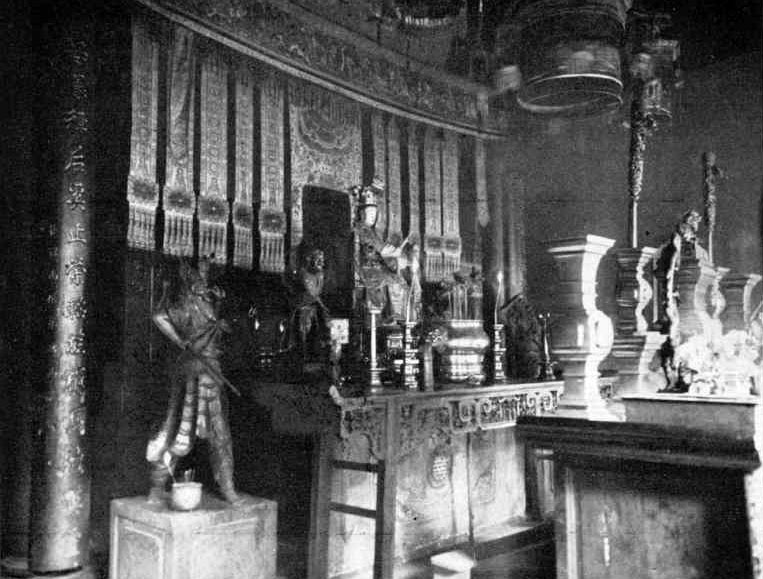
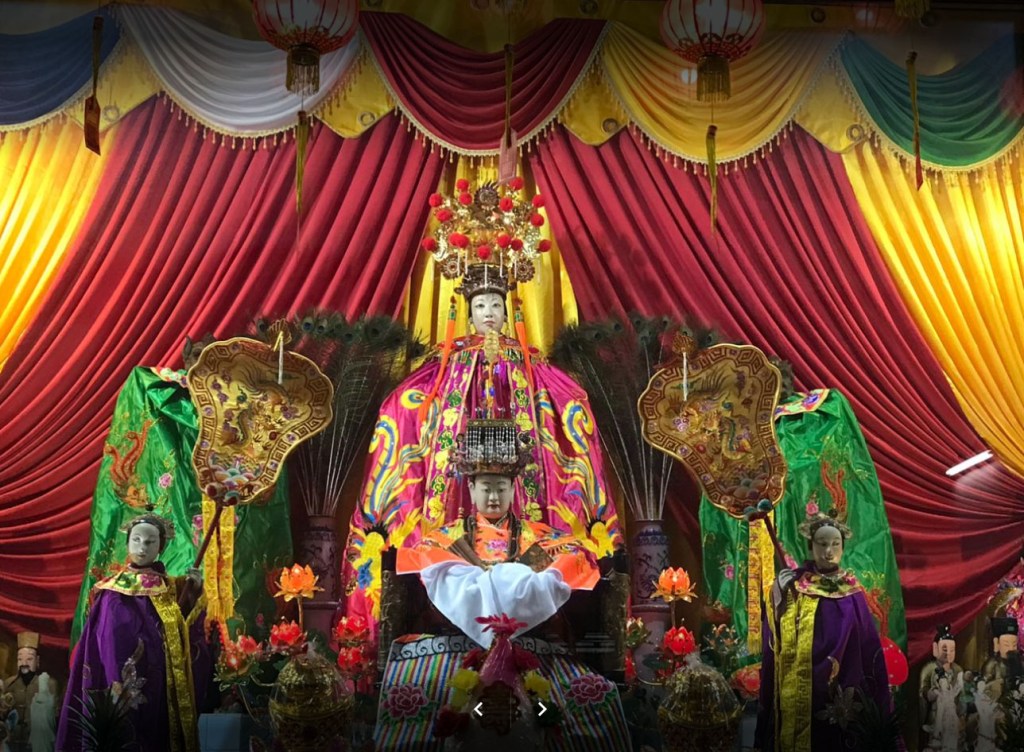
The name of the temple is inscribed above the main door; Thien Hioe Kioeng, temple of the queen of heaven. That’s Ma Tjo Po, to whom this temple is dedicated. Let’s get right to it continue to the main altar in the back, where we see a fairly new one image of her found on a table in front of the old alcove. In that niche it is dark and of the original image, flanked by two statues of maidservants, little can be seen. Also the new image, which is only a few years old, is not in the full light, but it was still possible to take a picture of it, that is hereby reproduced. The princess is seen thrones there
a rich silk robe, the head covered with a sumptuous one crown, in one hand a fan and in the other a rosary, with a friendly face, lost the calm gaze in the distance. She is the patrons of all who sail the sea. As well as from Kwan Tee and Kwan lem is told how she once as a human being lived. On the island of Bie her father was a simple fisherman, who braved the treacherous sea with his two sons. On a when they went out for fishing again, they became caught by a whirlwind that seemed to collapse the hood pinching and surely father and both sons were prey to the waves if not Ma Tjo, who was sleeping at home at that moment, them by its miraculous power in the mind help washed quickly and with in each hand a brother and father between the teeth on the shore tried to achieve. But before she got there, her mother came at home, who, upset about the laziness of her daughter, the body on the resting chair. Then Ma Tjo had to have her let father slip and he drowned sadly, but both brothers managed to reach the land.
For everyone who has to go by sea and those are all Chinese here, who trade with foreign countries or who trade for them land return is Ma Tjo the protector. Before taking a on a journey one goes to her temple and prays for protection against shipwreck and against pirates. The prayer will be answered wherever one may be, for both of them helpers hear and see everything. Images of both of these are seen standing next to her, a couple on the table and a couple next to it, on ours
illustration clearly.
On the left is Ban Lie Hie or Soen Hong Djie, Favorable wind-ear, who hears everything, and one sees his posture listening expresses. On the right is Tjin Lie Gan, Thousand Mile Eye, from whose eye nothing is hidden; with the hand over the eyes he peers into the horizon.
Every day, candles burn here and in the great pot of ashes in front of the statue the incense sticks are scented, very thick often, that are particularly sacrificed or of those thin sticks, as pious people buy them in thick bundles and burn them on a candle to light the altar to go about all the temple, to those who are due to pay respect by in front of each altar or statuette to place three sticks. In our photo, the censer, the candlesticks and the flower vases, like those in almost all Chinese temples. Here they are made of copper and have colossal dimensions. The candles are not real but of artfully carved wood, in which an oil lamp is made, that only on festive occasions is lit.
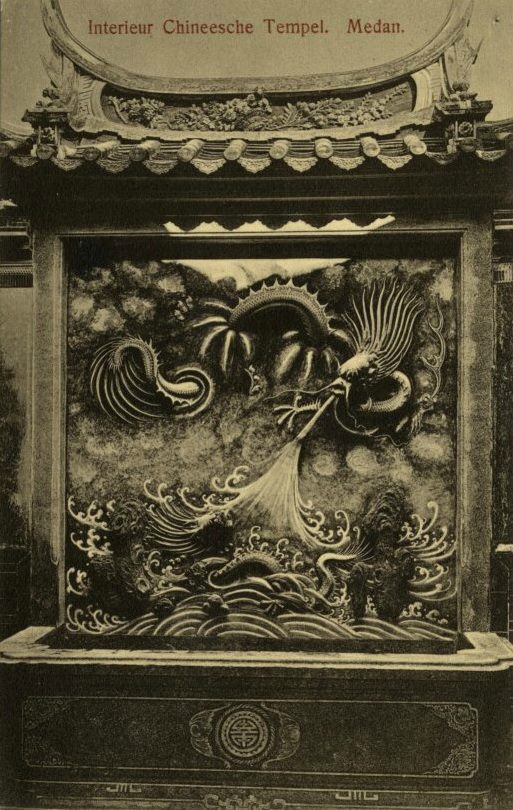
Now that you know who Ma Tjo is, you understand better why with the decoration of the temple often occur with fish motifs. I also want to draw special attention to two water basins along the side walls where fish used to be kept, and on the reliefs above it. On the left it is the fantastic bird Hong, above rolling waves; on the right a whimsical one dragon that twists up from the wild waves. It should pay particular attention on its claws where in the gray cement in a single piece
Porcelain nails are accented to become an anxious symbol of it gripping force.
Under the hospitable roof of this temple also has Kwan lem got a place. For some years now it has been in the middle large hall an altar with a statue of this one in a glass case goddess of mercy. She carries a child on her arm and on the left and on the right are her childlike helpers, while in front of her one bearded tangerine. There are flowers and one on the altar table great spherical chime, a splendid example of metal gear, since this gong was hammered apart from a single bronze plate.
On the other side is a large wooden bell in the shape from a fish head. During the prayer the gong will be sounded and the bell will ring given, as for prayer to Ma Tjo, the great drum clock, be struck in the left corner. Behind Kwan lem are left and right along the side wall eighteen Lohan, small gilded wooden figurines in two rows of nine, each with its own attribute. The images of these eighteen saints from the Buddhist heaven are usually in one Kwan lem temple, but those other usual images, those of the ten hells are not here. Only one has for festive occasions painted canvases with these representations, which are then hanged to adore the believers remember, that Kwan lem’s mercy even the tortured sustains souls in that place of terror.
Left and right, at the very back of the temple, are two more smaller altars. To the left is Toa Peh Kong, the god of the earth with his consort. I noticed earlier that his name gave rise to it has given rise to the use of the word tepekong for temple or picture. On the right is also a couple, Hoa Kong and Hoa Who especially protect small children. In particular, you must pay attention to the many red papers that are taped here. It it is customary, when a child is born, to do this under the
to grant special protection to this couple and as evidence a piece of paper with the name and date of birth of the baby to a style of the altar. If it is sick now or in difficulties, becomes a similar piece of paper with a prayer for healing or help hung there.
It is worth considering several other things, which we passed on the way to the main altar.
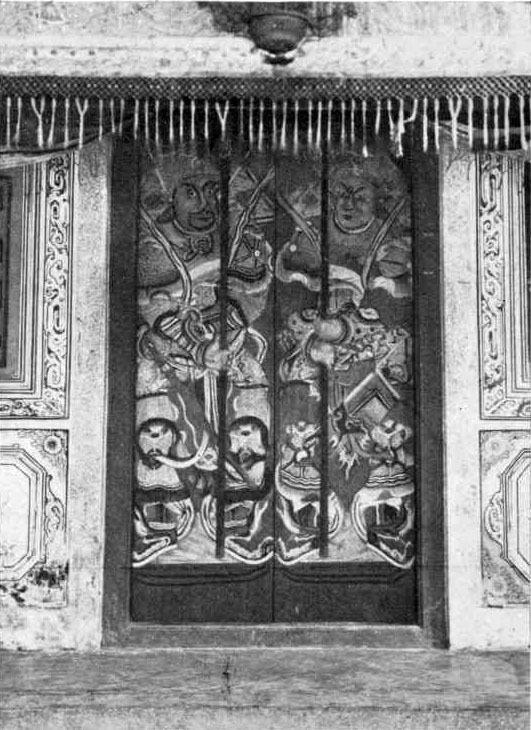
First the doors, which are painted with portraits of some shocking doorkeepers. One of our illustrations gives a picture of such doorkeepers of the temple in the Hokkian cemetery
at the Bindjaiweg. They are grim gentlemen, armed with halberds and dressed like Chinese warriors
time of chivalry, as they are still presented today. There is a counter on the right. It is not lacking in any Chinese temple, for the sale of sacrifices is a first name company. There are those red candles on a stick of all sizes, sometimes with a gilded spell on it, and incense sticks, many little ones or three larger ones in neat packages. And then bundles of money paper over to burn, holding the priest with a convenient twist and by scratching with a long nail until a circular fan turns. Also of course fireworks. And then the series of papers with answers from the oracle, which I will describe to you shortly.
Hang above this counter and elsewhere in the temple countless plates with the decorative Chinese inscriptions. There even a layman who cannot read what is written can be of two kinds in distinct, namely the horizontally hanging signs, which usually do not mention more than a name or a short spell, and the plates or embroidered silk strips, which hang vertically and then usually in sets of two occur, on which the spells run parallel in meaning and in grammatical construction
The first species is called spawning and the other ljen. It is very common, that there were a set of these proverbs by believers at the temple be given as a gift; except for the spell in great gilt. Characters are then left at the bottom of the name of pine the giver and the time of the donation and often the reason for donating.
The spells themselves are hopelessly complicated. Chinese have a special preference for all kinds of word games, as well as with what the rhetoricians among us kept themselves idle in their decay.
Thus, for example, there will be a set of lines for this temple made, one of which begins with the word Ma and the other with Tjo, in allusion to the name of the protagonist Temple. In addition, dark allusions are made to classical texts created, with the result that a translation only possible
is for a scholar and one an ordinary Chinese, by the way speaks another language well, never a slightly intelligible one translation.
In the temple hang some great bells and a drum, who are beaten for praying. The wooden fish-mouth bell, which lies on the altar and which, beaten with a wooden hammer, gives a piercing sound. I point You can also use the wooden stamps, which are often used in temples, on which appears an honorary name of the worshiped being. Print such stamps serve as an amulet and sometimes even as an infusion or burned as medicine.
The temple would not be complete without the sleeves containing wishing sticks on the altars. Consulting it oracle is performed in a very ingenious way.
Now a bunch of kidney-shaped sticks are taken from the hardwood root of the bamboo, in clasped hands. People pray appropriately and throws up the sticks: cross or coin. When the sticks are both convex or both concave side up, is this a sign that the stick that has been shaken out is not the real thing: if one is on the flat and the other on the convex side, then it’s okay. So there is exactly a fifty percent chance that the tube needs to be shaken again to make a new stick make it fall out.
It can be seen: the whole act is a slightly cumbersome one way to draw a number, but is undoubtedly complete fair, because it cannot be influenced, neither by the questioner, nor by the priest.
The good commercial spirit comes with the further treatment Chinese reflected, which also in spiritual matters on good administration states: the answers are in the larger temples often stored according to card system. And everyone can do one neatly get a printout of the answer to his special question.
Probably those answers are in the usual oracle language, ambiguous, so that everyone can read from it what he needs has. But it is difficult to get them translated. I have some once heard translate in the style of „kalau maoe baik, jadi baik ”or“ he who does good, meets good ”, a wisdom that one
in a less cumbersome way, but that maybe many people keep from starting an unfamiliar business.
To keep the answers too crazy for the questions, one has different sleeves for different ones
groups of questions. A very important part is of course the tube for the obat: who is sick simply let fate decide, what medicine he will use.
There is another category of people who like to consult fortune before they start a case and they are in especially the players. Before we put a ticket, Let’s see if we will have veine. And to ask that to
the oracle, one does not even always have to go to a temple, for there are people who make a business of it and as fortune tellers travel around. They can be found in the evening in the Chinese
neighborhood, between the food and drink stalls at its own table with the tube in front of her, or walking, inviting the sticks let it sound in the tube: “tengok nasib”, you try luck.
From Gerard Jansen, Andere Wereld
 Stories from Deli
Leave a comment