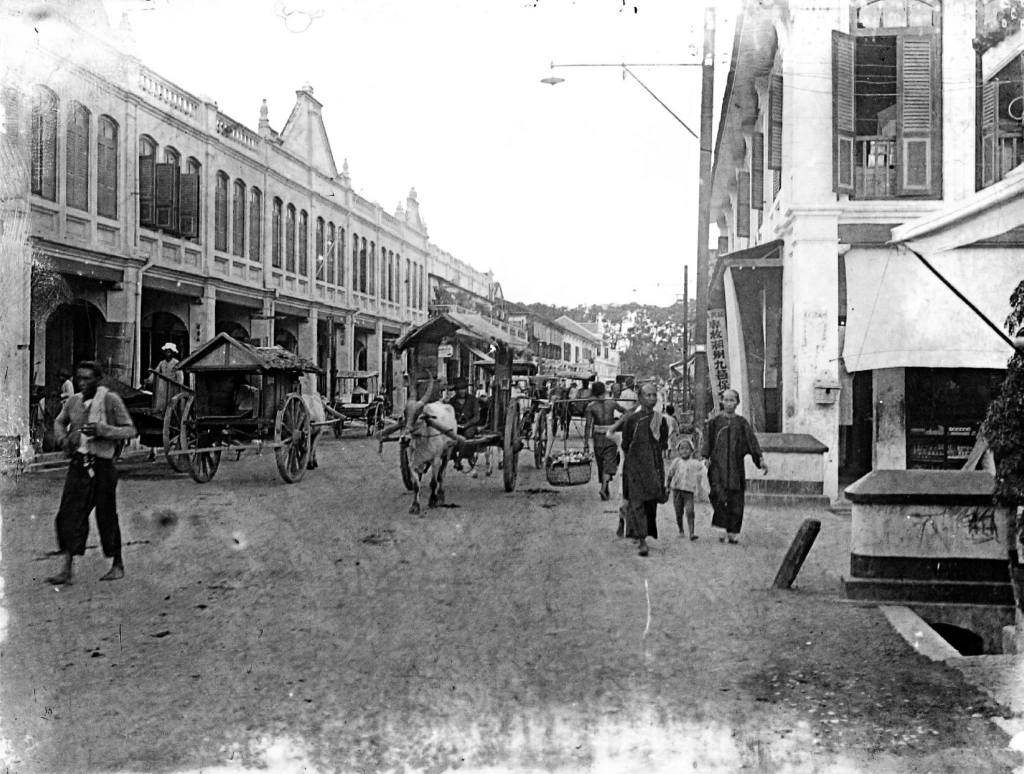
First we get Canton, the capital of the province Quantung. The Cantonese are an important group to which end among others are those who here as goldsmiths, furniture makers, tailors have established. Their great association manages the extensive cemetery on Djatilaan.
The second place is Swatow, from which two groups come: the Teotjus, who mainly act as coolies at the tobacco companies have worked and for which also the sajur and pig farmers and the Hakkas, who, among other things, as shoemakers, rattan workers, tin makers are employed. The Teotjus have one own cemetery on the north side of the Bindjaiweg.
The last place is Amoy in the province of Foekkien or Hokkian. These Hokkians are mainly based here as traders. They also have a separate cemetery, on the south side of the Bindjaiweg.
As far as the Chinese are concerned, I will suffice to mention the wide pants and the bottom with braid closed on the side, that young one girls can wear so brightly. Older women wear mostly black, shiny well and a few still staggering on the deformed feet.
The Japanese women too do not walk very gracefully on the geta, that give the start something of tumbling forward each time. The split socks allow these clogs or straw sandals clamp with the toes. I need the kimono hardly to mention: it has become an international garment.
Except the Chinese and the Japanese have the others mentioned peoples have a common idiosyncrasy in them garment, namely the leg garment, which is simply folded apart rag exists. However, there is still a great deal of variation in this both in the manner of decoration of the material and in the manner on which the garment is worn. Some simply wear all white cloths, like the Sikhs and Chetties here.
Many centuries ago, the East Indies contributed a great deal to the development of our archipelago, both through immigration as through culture. But the immigrants are with the population has become one and the culture has become its own, in particular Javanese culture developed, with the ties with the pre-Indian tribal land. In Java recent immigration of pre-Indians of little significance. From the residents on the East coast, however, are the immigrants from India an important part. We can immediately make two groups distinguished, according to their origin from the south or from the north Indies.
The Klingen come in from the south of India number are greatest. They consider that name ‘orang kling’ themselves as denigrating, I was told, because kling makes you think to killing and they are just very little homicidal. However, it is established that there used to be a rich Kalingga on the coast of Coromandel existed and such a name can have a tough life. In the meantime they have moved the government to no longer use the word Kling officially; it is now prescribed, that instead will be said Indian, which cannot exactly be called a clarification.
It would have been better to call them “orang Madras”, after its presidency of their origin, or else Tamil to the language, which most of them speak.I will tell you quite a lot about these Tamils, because the mostly adhered to the Hindu faith. There are also called Mohammedans among and Catholic converts, but most have maintained these special customs, which are so interesting to strangers.
With our fellow townspeople, those from the north of the East Indies is a bit of confusion. People here called Bengali to name the people who are by no means from Bengal, but from the north-east of the East Indies from the Punjab. Being milkmen and night watchmen with their patriarchal appearance. It is better to refer to them as Sikh, according to the religion they profess. Real Bangladeshis are here few and then only Mohammedans usually working as ladies tailors and bread bakers.
Another common confusion is that of Bombayers, who are not from Bombay. Being merchants in supplies for ladies’ clothing. They are from the land of Sindh, on the lower reaches of the Indus, of which the port of Karachi as the landing site of K. L. M. aircraft is known.
Finally, I have to mention the Arabs who are here not occupy as important a place as in Java, but still the have increased sharply in the last ten years.

From Gerard Jansen, Andere Wereld
 Stories from Deli
Leave a comment