后土
When I am the places of worship for the Chinese I must not forget the graves. I have to start with that with recalling that in the spiritual life of the Chinese ancestor worship occupies an important place; from in the earliest times it was a worship service and it still is today always the main expression of religion in this people.
It seems to me that ancestor worship in itself is not so pissed off. It can almost be said that the lack of respect for old age in general is a pernicious phenomenon the youth of today also among the Chinese youth and men see what a scattered land their land is becoming, now by the western one upbringing the patriarchal relationship of the family head to all the young has been undermined. The whole Chinese state was founded on this ratio, five classical ratios, drawn up by Confucius.
Now the good thing about it is the great feeling of togetherness from a family. But this brings all the objection in the first place that the young Chinese do not stand alone until the father or grandfather has died and often the result is that she will have learned to spend money, but not to earn it.
We see that all too well with the rich Chinese in our area What, however, is of much more far-reaching consequence, that is the fear that the neglect of the ancestral service for the
whole family will bring bad consequences. Love for the ancestors is supplanted by superstitious fear
for punishment of negligence. Especially the missionaries in China have felt that. No one, not even a missionary, can object to paying tribute to the dead, as is also brought to the living of great old age.
But when the souls of the ancestors become guardian spirits raised, capable of doing good or evil over their descendants pouring out, then it becomes an idolatry, which the self-confidence
destroys.
It is understood that in such a state of affairs the final resting place is of paramount importance to the deceased to propitiate. So it is very common, that the graves very made precious, to show how much the descendants have left over for the deceased, but always with the rationale, that this is the possible wrath of the obese is sworn. One hears of fabulous sums spent beautify a grave, often the material and toucangs are summoned from China.
I also mentioned earlier the hong-soei, the doctrine of the currents of air and water and of magnetism, used in the determination of place and direction of a grave is applied. It will be
assumed, that the dead, who have their resisting body misses are particularly affected by this magnetic currents, but also that they can use those currents for the salvation of the living, or for their misfortune. And so it is the importance of each family, to the most painful accuracy
to try when searching, but also when maintaining one good environment for a grave.
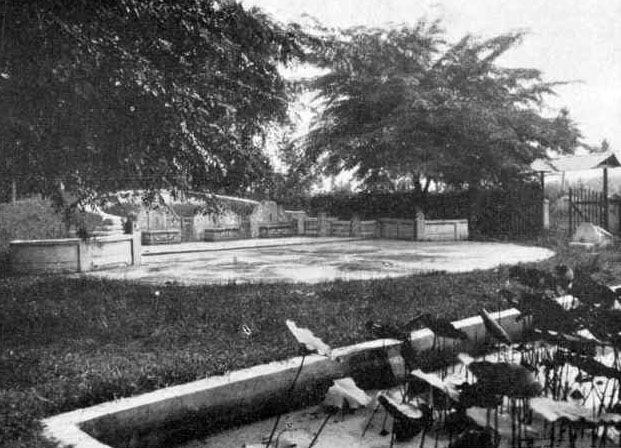
Our illustration shows one well an example of how a rich Chinese has a charming place
managed to find for the final resting place of his father. This is a grave in a corner of the cemetery at Gloegoerweg and it is really a place that gives a sense of consecration: that tall trees behind the grave, the beautifully carved blue-gray stone, which harmonizes very well with the deep green behind it. And then a lotus pond, where the tar-red flowers stretch out to light up the dense leaves.
Gerard Jansen : Andere Helft
 Stories from Deli
Leave a comment