觀音堂
According to Gerard Jansen (1934)
The temple is on the Oranje Nassaustraat (Jalan Thamrin), on the corner of the Louisestraat (Jalan Gandhi) and consists of a complex of different ones smaller buildings. That’s because they have been transferred here the temples, which used to exist in more places in the city, even one on the top floor of an ordinary shop house the Moskeestraat (Jalan Mesjid).
The present temple consists of a series of rooms next to each other, two of which are altars, while behind them and above the living quarters is for the priestesses. Our photograph gives a good view of one of the two altars statue. There is a tall cupboard against the back wall of the room, in which, on two shelves one above the other, the different images stand. In front of it is a small table for the usual offerings candles and incense and flowers and also edible treats. The latter are usually just some biscuits. The priestesses are vegetarians, “makan sajur poenja olang”.
The front of these altar tables is decorated with very beautiful gilt carving, which stands out very well in our image: a dragon-like lion flanked by a pair of stylized birds. In the altar cupboards are several statues, which is notorious Chinese view is very common. Stand next to the main image at least some followers or protectors or pupils. But otherwise there are often numerous other figurines interred with gods, saints and heroes, whose history is in more or less related to that of the protagonist of the temple.

It is nothing strange here, as of the same deity or man two or three figurines stand fraternally next to each other. There really is something of the comprehensive nature of this religion, because the statues often have the characteristic details of another stroked. I once saw a statue side by side of a fat Chinese Buddha and a slender Siamese figure, with that typical tower-shaped headdress. This temple is intended for the worship of Kwan Iem so her image is paramount. She is indeed a general beloved goddess, although originally a pre-Indian deity from the Buddhist pantheon, but now it is mainly venerated in China and in Japan (where she is known as Kwannon). In the Pre-Indian view it is a male deity, who supports the people in trouble and gives them the favors, why they pray. This is done under the assumption of several forms to which these divinities are able, and the is to understand that in bestowing the highest favor on Eastern women: the mother’s joy, the deity herself as woman is depicted.
Kwan Iem in China and Japan almost wholly become the goddess, the goddess of grace. She is so kind, so compassionate, that anyone who takes it in grief prays to her, receives comfort. A mother anywhere in the world is in trouble wherever a child lifts its eyes For support, Kwan Iem sees it and reaches out to rescue. To see that power of all sorrow, to relieve all need, is symbolized by more heads and more arms than any material man owns. Kwan Iem is depicted in countless ways: as a princess, as she passed through the ten hells in her exalted purity, as divine mother with a newborn in the arm, as a benefactor of humanity, with many heads and arms. With the latter one is gone so far that there must even be a statue in Beijing, true people wanted to express the metaphor so much in matter, true one has made an image, literally a thousand heads and a thousand arms, which in our eyes is a horrible monster must be.
In some side rooms being murals or better drawings, of which I would like to mention a few details. That drawing is simply applied to the limed wall and proves the virtuosity of the painter to use his brush with a steady hand feed. The entire drawing is done in some black ink we call Indian ink, but a bit more correct in Malay tinta-tjina is called with just a touch here and there red and some gray. The artist must immediately hit his brushstrokes because it is no longer possible to modify or repaint : the ink immediately absorbs into the lime wall.
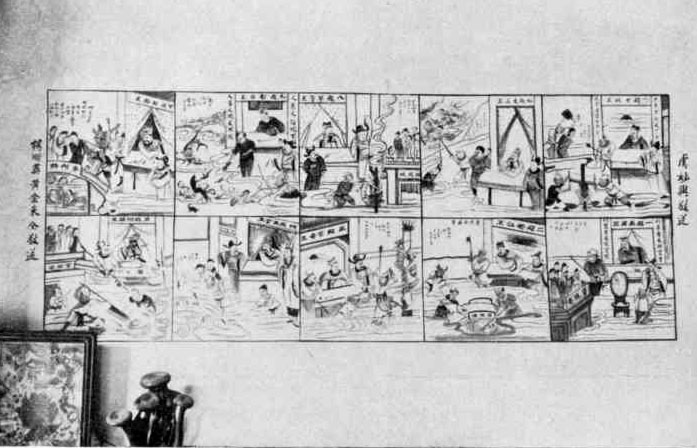
The first mural depicts the ten as the Chinese imagine them. People usually speak of hell, but it would be much better to refer to them as purgatory, because the Chinese have a happier faith than most Christians: eternal damnation does not exist for them. Depending on whether one has sinned on earth, one must more or less tortured in the ten realms of purgatory, but at the end of the established torture, the sinner is purified and he can rise from this purgatory to happier places. Sinful people must pass through all ten kingdoms after death and in every realm through those particular divisions, true the punishments correspond to the sins committed. The classification undoubtedly has gone a long way to ensure that everyone has his share gets. Good people, however, only pass through the first and tenth realms and skip the eight realms in between. Everyone comes to the first kingdom. It is shown in our illustration bottom right; one can clearly see a herd of newly arrived kill like first emerging militiamen on one step and a sergeant major with a cow cock and trident point in hand at a round thing in the center of the picture. That’s a mirror, a magic mirror. The deceased who looks into it, sees his entire past life pass before him all good and bad deeds, it’s remarkable that in it West also generally believes that someone is in it moment of his death oversees his lived life: it becomes even told of people who had an accident that happened to them actually had to cut off the thread of life, but that as if intertwined miraculously that they are saved in an indivisible moment, as in a flash, saw their lives spread out before them. In the Chinese view, the showing of this life film becomes used for drawing up an estate. You will see the expert from the orphanage room to ensure that everything is done properly to be valued. The mail that is handled is a dirty passive: t is almost completely invisible on the reproduction, but you must go and see for yourself to see that precisely what appears in the mirror the image of the delinquent, who is acting very unkind to one pair of defenseless goats. The notary behind it raises already on his writing brush to complete the appraisal and in his box sits the mandarin, Prince Yen Lo, the Hindu Yama, and looks evil to the poor sinner. Soon the balance must be and he has to make a decision. In all ten divisions, one sees such a mandarin, one more grim than the other. Especially those in Section Five bottom left makes an ugly face, to be frightened.
That being princes of the ten kingdoms. A Chinese introduces himself that the underworld must also be properly administered. The princes have a staff of servants in every conceivable way ranks and positions, as here on earth. There is one bureaucratic governance, as in pre-revolutionary China; the poor deceased has nothing more to say: his estate is managed by others. It goes a bit like that also as with a bankruptcy; he has managed his affairs to his death, but now he has to remain passive. He can naturally appeal, mainly on the verification of various claims and above all about whether different matters belong to the estate. Such a petition then gives cause to the necessary advice, conclusions, memories of more or more less tall tangerines, and it is of great importance to remember that those officials in purgatory differ little of their earthly colleagues. I do not want to say that they are would be bribable, but a good introduction is coming anyway useful, if only to speed things up.
For the poor sinner must be fed up as someone who litigates pro bono with right: pro bono! When finally the balance is established, it will go to the lake or less short, an order by the prince of the first division taken. The worst sinner has to go through all eight of the following divisions and you can see that it is far from wrong. In section number two bottom row, second from right will be den souls a boiling bath. You see a servant with a pit hook Submerge the victims well, while there are still left a few are suggested. The prince sees that it is good, with the hands nicely in the sleeves, and a tangerine checks the papers. In the third area, a few are tied to one stovepipe, under which a fire is lit, sees the tormentor blowing the fire with true win, and the poor men tongue out of the mouth: these are those who sinned through lusts des flesh. Number four is a repeat of number two, but now it looks like ice water, but number five gets bad again: the sinner is cut into pieces with a turning around a point cleaver, as is used in medicine stores. The typical is here that there is a box where a number of spectators stand: the seems to be a horrifying example to some how others are tortured. The odd thing about this and a few previous pictures is the appearance of people with cow heads. That seems to mean retribution for it defenseless cattle, which became through him in the life of the tormented one abused. By the way, an entire department is devoted to this.
The following area is depicted at the top right. The punishment is here it is being sawn through, in a literal sense. Behold the pigeons the two of them wielding the span saw. Everything is equally horrible, as in section seven, where souls become in flames tormented or in the next, where the tongue of an evil speaker is cut off. One wonders what actually remains after all those tortures remains, but the answer is very simple: they are obese souls who just feel like they are in their body be so mistreated. After all, in these hells only come souls: they are under the ocean but see the indication of water on all pictures and no one in there would be physical casing. The last place of torture is for the vengeance of the animals. Mangen, a dog, a dog will recompense their suffering; a tiger chokes on a soul, that the blood flows down on it. Then is almost done it, because in the last picture, top left, you see the now purified souls are to cross the bridge to the places of bliss. Another mural is divided into twenty-four cubicles and in each of them one twenty-four examples are depicted of childhood love.
In the temple of Kwan Iem, which glows with human love, there is of course also room for that part, the childhood love. But you have to keep in mind that bad Chinese view this lake is considered a duty, then as an expression of what we would call love. That will make the examples clear. _ Tradition has it that Confucius was once mixed up his disciples asked about the first rule for moral qedraq. The sage said that it was the duty of the children to them parents is the source from which all virtues spring and also starting point of all education. By way of illustration, the twenty four examples are given.
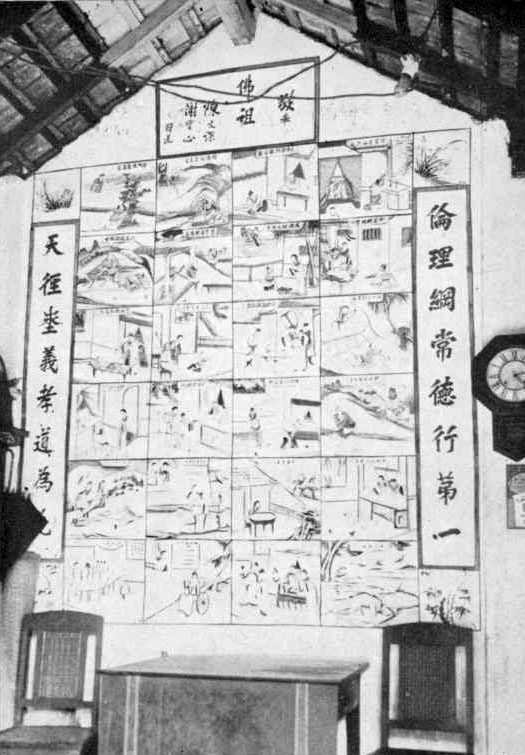
Many centuries ago, Kwong Tjoe lived. He had a wife and a child and his old mother lived with him. She suffered bitter poverty, so that there really was for them to celebrate with food. Then Kwong Tjoe noticed one time that the old granny still gave part of her meager portion to the son, a little boy barely a few years old. Kwong So Tjoe that there was not enough food for his mother and therefore only one of them four had to be out of the way cleared. He said to his wife: we can do it easily enough have a child again, but once Granny is gone, we have never get her again. They therefore decide the poor little bastard to be buried alive and Kwong Tjoe immediately goes to work. He laboriously digs a chill the hard frozen ground, but as he digs two feet deep, or he stuck on something hard, that sparkles. It is a golden pot, filled with money and if he is taken from the grave tilt, a voice sounds from heaven: “For Kwong Tjoe, the dutiful son”. The morality is somewhat shocking in our opinion. The plan to it burying your own son alive is still rewarded. We would be in addition to Kwong Tjoe’s child duty want to enforce parental duty towards his son, but a Chinese does not consider the rights of a child. This story is found in our illustration depicted in the third box from the left, on the second row from the top. The woman is seen stand with the child in the arm and Kwong Tjoe with a tjangkol in it the hand, while from the dug hole found the brilliance of the treasure, as if a fire were burning in it. In the clouds a heavenly mandarin appears with a roll of paper in hand, whose inscription shows the words, die Kwong Tjoe hears. I believe this example is the worst of all. The others are more common, as is the case, shown at the top left, that a boy, despite the sky, whips him with hail (see the mandarin with the karwats in the clouds) faithfully appeared every day to pick medicinal herbs for his sick mother. Or in addition, the boy who performs the prescribed ceremonies on his grave fathers, despite the celestials who shower him with rain.
Like in the third row on the left, the boy whose father is too poor to have a to buy a mosquito net, and the one now, that he may rest his father’s sleep grant, lie naked in front of the bed, so that the mosquitoes themselves can satisfy him. There is no deus ex machina here, that the bloodthirsty mosquitoes keep away from the good little fellow, as they do probably would expect. On the contrary, a thick swarm buzzes about him, but reproduction does not show it well. Besides that is such an impractical help. An old toothless one father, who can no longer even eat rice, becomes through his daughter nursed, while the child, who lacks his rightful food, is kicking on the ground with hunger. In the same row on the right there is another such unlikely thing. There is a father who wants to eat fish in the middle of winter. The dutiful son lies naked on the ice because of his body heat melt a bite in it. One can see on the mural the goldfish under the ice await the good son to reward his virtue with their lives.
Those examples may not all be worth following, however, they indicate very clearly what an invaluable cost long the Chinese ethicists have considered childhood virtues. Indeed the source, from which all other virtues spring. In this temple we still notice a few altar niches, true are not statues, but are numerous on several steps one above the other shelves. That being so-called soul tablets, like those are drawn up for every dead one, in elegant writing mention of name and date of life, the latter on a slider in the back. Often boards are provided with a beautifully carved edge; in the Japanese temple they can be seen simply unpainted wood. These same boards are also often seen on the Chinese house altars, as bearer of the name of the deceased ancestor, but according to popular belief as a residence for his soul. Indeed these become soul tablets when in use be set according to a fast rule. Obviously, it may be called a privilege, when the soul tablet is set up in a temple, where daily miss read. Faith even wants it to be there makes a difference whether the tablet is in the middle or on the side. Hence there are some who already become one at life a favorable place for their own soul tablet.

Note that this is not a real Buddhist temple. It is more a Taoist Chinese folk religion. The priestesses are not monk, but called Chai Ko (Vegetatble Auntie). They are meant to be vegetarian, but was known to secretly consumed meat. They performed rituals, fortune telling to earn money. They are well known for their high fees.
 Stories from Deli
Leave a comment