The settlement of Europeans in the sixties of the last century on the place where now the city of Medan coincides with the time when attention was first devoted to it the question of decentralization in the Netherlands Indies. The Kampong Medan then still belonged to the area of the Residentie Riouw and Onderoboorigheid. In the 1870s the “East Coast of Sumatra ”a separate region with Bengkalis as the capital.
In the eighties Medan, the capital of this new region. In 1886 the Resident settled in Medan, that since the foundation of N.V. Deli Maatschappij in 1869 and the bringing into operation in 1884 of the route Medan-Belawan der Deli Spoorweg Maatschappij, had expanded considerably. With the The elevation of Medan to the capital of the region in 1886 coincides with the establishment by den Resident Kroesen of a ‘Commission for the management of the Municipal Fund’, called Negorijraad. This council had as its object the local interests, the interests at his disposal of Medan. The Negorijraad has been the forerunner for over 20 years of the Medan Municipal Council established by law in 1909. Both the Negori Council and the Deli Maatschappij have done a lot of good work for the benefit of these years of the capital Medan, which in 1906 already had a population of about 15,000 person.
In 1906, as a result of the Decentralization Act 1903, the Deli Departmental Council was established. In addition to this council, the Negori council continued to exist in connection with arranging some matters. With Effective April 1, 1909, the jurisdiction of the Division Council was disbanded and established the resort of the Local Council of the Cultural Area of the East Coast of Sumatra (Cultural Council) and that of the city council of Medan. After the act of donation of the territory of the Municipality of Medan by the Deli Self Government to the Municipality of Medan on December 31, 1918 was registered in the public records and named territory as of January 1, 1919 had been drawn from the directly administered area of the Netherlands Indies, became the Negorijraad was dissolved and his assets and liabilities as well as his rights and obligations passed to the Church Medan. From 1909 to 1918, the City Council was chaired by the Assistant Resident of Deli and Serdang; then by the Mayor. Until 1912 became members of the Municipal Council appointed by appointment; in 1912 the election system was adopted for Europeans, and in 1918 for the other councilors. The number of members was also increased from 15 to 17, while the number of members of each group was slightly changed. The new state of election lasted until 1926, when it was determined that each of the three groups of councilors known by law would be chosen by the corresponding of the three groups of voters. As a result actually divided the council into 3 parts, and thus more than usual given the opportunity to change the thoughts to be determined by the group interests rather than the public interest.
Many years have elections stood in the sign of the public interest or of the group interest, now (1930) will very much probably the results of the periodic election show a representation of the political parties. More than before, this is now being considered, to a considerable extent with with a view to the election of the Volksraad. The Municipality of Medan received its Board of Mayor and Aldermen in 1927, when 2 aldermen and 1 deputy alderman were appointed, while in 1929 the college was expanded by 1 alderman, especially for the indigenous matters. The aldermen each receive an allowance of NLG 150 per month; they are all elected from among the councilors.
The 25th anniversary of decentralization may well be commemorated by the large share of the Municipal Fund (or the Negorijraad) and N.V. Deli Maatschappij have had in the development from Medan. Yet it was they who both looked after the instantaneous local interests as having an open eye for the future. Expression of this was at the institution of the Municipality Also seen in the existing system of open gutters, which is by no means very good, but it is proved to be useful, as well as in the spacious layout of the Chinese neighborhoods. That’s for that thanks in large part that relatively so few traffic problems served in later years to be overcome. Three important things among several had already been before the establishment of the Municipality of Medan had the attention of the authorities and others. These are the town hall, the street lighting and the drinking water supply. The currency purge on the east coast of Sumatra, the elimination of the dollar and the introduction of pine guilder brought in its consequences in 1908 that N.V. “De Javasche Bank” was an agency in Medan. The office built on her behalf was approved by the management did not acquire, with the result that the Deli Division Council bought the building and used it as a town hall furnished. With the division of properties in 1909 from the district of the Division Council the Municipality of Medan, including the town hall, so that from her birth she has been in undisturbed possession from a town hall.
The later Major of the Chinese, Mr. Tjong A Fie, donated in 1913 the tower with the clockwork. Because neither the Government nor the Negori Council is responsible for the relief of Medan wanted to take over, the company Langereis en Co applied for a concession for the supply of electric power in Medan. This concession was granted in 1897 on the basis of the provisions of 1890, and in 1898 the Negori Council concluded a contract with the supplier for the relief of the roads in Medan. The supplier was the then established Electriciteits Maatschappij Medan (E. M. M.), who lived a poor life from 1898 to 1920. The roads of Medan became indeed illuminated, but the lighting was insufficient. Disorders were very common. After the Nederlandsch-Indische Gas Maatschappij (N.EG.M.) started its gas street lighting in 1919 Medan had ignited and in that year, the Negori council having disbanded, the lighting contract with the E.M.M. was taken over by the Municipality, followed in 1920 by the takeover of the E.M.M. by the N.EG.M., and since those years street lighting has been controlled by 2 contracts with the N.EG.M., which company received its gas concession from the Municipality and its electricity concession of the Government.
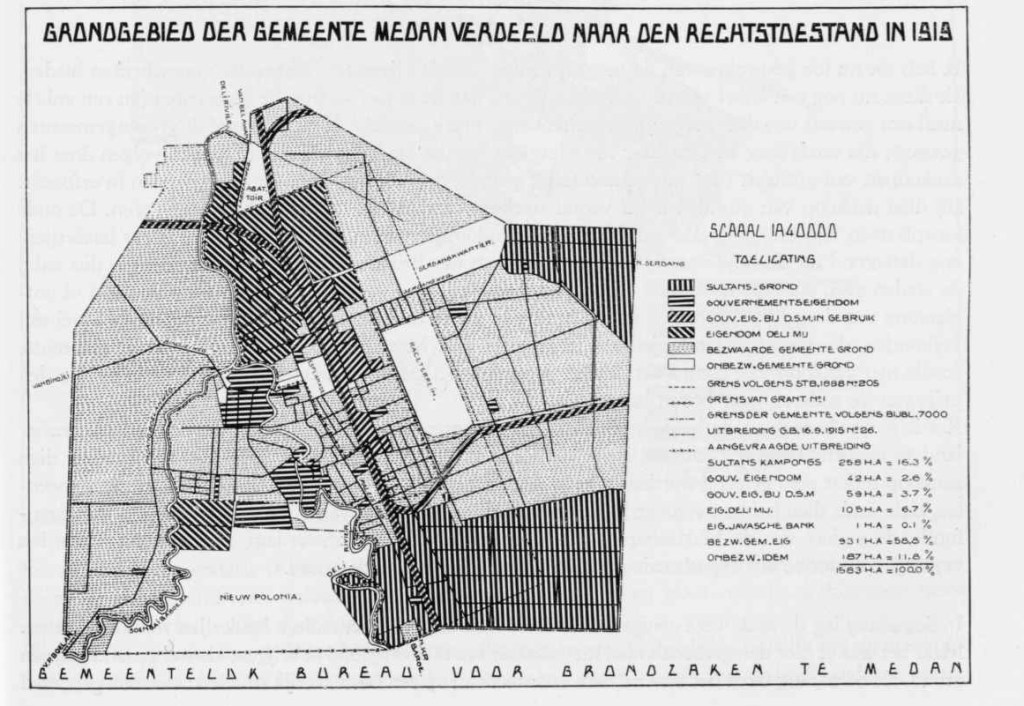
The drinking water supply is thanks to the Deli Maatschappij. It was she who concession in 1905 requested the supply of pressurized water to the capital of Medan. This concession became granted to her, and so was the N. V. Water Supply Company “Ajer Beresih” by the Deli Society given life. The exploitation began in 1908, and since that year the city of Medan is allowed enjoy the constant possession of very pure water. The concession is still in hands of the ‘Ajer Beresih’, which now has a number of wells with large quantities of water in concession. The first concession was given by the Government, the last concession amended became it given in 1929 by the City Council. In 1918, n.l. the so-called decentralization article of the concession conditions apply. Most likely, the port area of Belawan will also be located at about 28 k.m. from Medan, will be supplied with water by the Ajer Beresih this year. When the City Council of Medan took up its duties on April 1, 1909, so existed for its benefit from Medan the Town Hall, the lighting and water supply, while further simplicity form was a spraying service; in addition, Medan had a road network of 49 km, of which 39 k.m. paved and 10 k.m. unpaved. The City Council immediately took up its task. The condition, that the land on which Medan built belonged to the Deli Self-Government area, brought very many difficulties also why the Government made efforts to settle the fundamental question arrange for. For the land issue, reference may be made to the chapter ‘Decentralization and the ground ”, and may suffice further to remind that until January 1, 1919 the land of Medan was Sultanate territory, and from January 1, 1919 on some plots after is owned by the Municipality of Medan become and pulled at it directly governed territory of the Netherlands Indies.
The consequence of this has been that the Municipality Medan from 1919 onwards the ~ grant chaos ” to arrange a new service was instituted, which was given the name some time later obtained from “Municipal Office for basic matters ”. Most of them asked for immediate care municipal interests falling under Municipal Works and construction supervision. The roads in themselves were well laid out and good cared for, but the open gutter system required profound change. As much as possible proceeded to brick the gutters, after first having the necessary drainage facility in the system was laid. Year in year a lot of care and money was spent on this, first in the city center, then in the suburbs. Later many of the non-masonry gutters were provided with concrete base pieces, while a few of these, which would have to process a lot of water, were still provided with slope protectors. In this way a good open channel system was created, which should be flushed regularly. In 1911, the water of the river Batoean was diverted to Medan, and this water served flushing the gutters. Later, in 1918, East Medan was flushed by the Batuan leadership while West Medan received rinse water from the Ajer Beresih, being surplus water, that flowed into a municipal reservoir. was collected and admitted to the gutters once a day. This flushing system exists yet. Part of the open gutter system has already been or will be converted into closed sewers. The City Council decided to do this in 1920, when the office T.A.8.R.0.5 was commissioned. in Utrecht to draw up a sewerage plan. This plan was completed in 1922 and covers the whole city center and a part beyond. In 1927 a start was made with the implementation, this one was continued in 1928 and 1929. An amount of about NLG 184,500 has already been processed. The Government pledged a subsidy up to a maximum amount of NLG 600,000. -, to be divided over 12 years and per year ƒ 50,000. -, for the first time in 1931 if the state of the country’s funds allowed it. Needless to say, the underground sewage system is a very desirable improvement thereby serving the hygienic condition to a significant extent. Furthermore, the spraying service immediately took care of it. The old and outdated equipment wagons pulled by 4 oxen was replaced by tank trucks pulled by 2 mules. This traction lasted until 1919 when the first car sprinkler car was put into service. This car was expensive to operate, so that in 1926-1927 three other car sprayers were purchased, that perform particularly well. As more roads have and become asphalted, less is possible watering will suffice.
As regards building supervision, a private architect was appointed (1909), die den title of harvester. He didn’t get a salary; the grubbing-up money was his. Since he built a lot for his own account, and this created criticism, the City Council decided to transfer go to appoint a director of the Municipal Works and also a rooimeester. This first director of the Municipal Works, Mr. J. Hogervorst, was appointed in 1910 and accepted his function as of January 1911. Until 1927, when he retired, he served the Church faithfully and honest. The first grubbing-up regulations were published under his directorship, which were subsequently replaced in 1914 by a building code (building and demolition), and replaced in 1926 by a building and residential ordinance. Then, starting January 1927, became the service of the municipal works separated into 2 parts with 2 directors, namely: municipal works on the one hand and construction and construction home supervision and housing business on the other. It was under the leadership of Mr. Hogervorst road network greatly expanded, and started asphalting. The latter was started in 1912. The attached statement, indicating the length and area of the road network, provides an overview of expansion and asphalting. In another state is found an overview of the awarded building permits. Building lines were not established before 1913; in 1913 this was discussed the first decision made by the City Council. In 1921 the different building lines, in addition to other data to which the building would be bound, redefined and united under the name of “road register”. This road register has been amended several times, and completely revised in 1926. History is kept of each road; a card system. A number of subjects were raised above, which had already been addressed before the foundation of the Municipality or immediately afterwards, the following subjects are associated with this. There was no refuse collection service at the institution of the Church. To set up this service and to do work, the Negorij counseled the material, while the Municipality operates the operation funded. Thus there were inside for a short time 12 wagons hitched with oxen. This number rose to 32 cars in 1928, still strung with oxen. In 1929 started the mechanization of it company, and will be completed in 1930, so that then only the stationed garbage trucks will be run by oxen moved forward. Garbage disposal asked more and more over the years care. In recent years it has been against the plague of flies the garbage doused in a 2% arsenic solution in sugar water and it becomes fuel oil on Saturday garbage burned. Likewise was the institution of the Church missed a feces service. The feces were Taken away in barrels and girls by the Chinese and thrown here and there. In 1911 this improved. The former Captain of the Chinese, Tjong A Fie, donated in that year an installation for pneumatic emptying of cesspools, consisting of 2 tankers and a pump.
This material was expanded upon expansion, so that in 1924 the service de had access to 8 tankers, 2 pump trucks and 2 hose trucks. The wagons were through mules drawn. In 1928 the mechanization of the company started while in 1929 its continuation took place. The service is completely financed. In 1912 the receipts were ƒ 238.—, in 1929 ƒ 29,100. -. As for the cleansing service, it was initially maintained by the punished. This arrangement remained in effect until 1912, after which the sweeping shift was occupied by free workers. Five years later, in 1917, the first horse-drawn sweepers were purchased, then in 1928 and 1929 the car spray sweepers entered the municipal service. Became the cleaning service maintained in 1910 by 3 mandoers and 34 workmen, in 1929 this was done by 7 mandoers and 140 workmen. With regard to the kampongs, it is stated that a great deal remains to be done for their improvement. Labor is done on this as much as the funds allow. The fact that the The municipality has full say in and over the kampongs, which means that in Medan fewer difficulties than elsewhere. Improvement of the kampongs is mainly pursued by opening them up, making the kampong accessible, improving the drainage, the lighting is provided and hygiene is promoted. This must be preceded by the creation of the possibility of drainage and of obtaining and maintenance of hygienic conditions. Over the years this claim has been continued the Municipality, with significant support from the Government. Related to To improve the kampong, the gentleman’s redemption money (toboggan money) was specially designated for use funding of part of the works to improve the kampongs, while after abolition by the municipal council of this redemption institute continued with at least the same amount make the same target available annually. Hygiene in the kampongs was not insignificant promoted by the creation and operation of 15 bathhouses for men, 15 bathhouses for women all with privates and 32 hydrants. Used the water at those places is not charged to consumers. It has been remarkable how through the opening up and improvement der kampongs the houses automatically got a better appearance, as it were. The Native went feel more for a tidier appearance of his home. The desire to improve the houses became not only through the works to improve the kampongs stimulated. This also happened through the den municipal work in the field to improve of public housing. This subject of a social nature was initiated and stimulated by the former councilor H. A. Wakker. Had the Church before 1919 is limited to supervising construction of houses and to reject dilapidated ones homes, in 1919 were by way of the first 4 double wooden Inlandsche homes built. In 1920/1921 the construction of Kampong Sekip followed with 4 European houses of permanent material and 36 Inland semi-permanent homes material. To that were added two bathhouses with privates, a hydrant and a toko.
Kampong was built in 1921/1922 Djati Oeloe with 30 European dwellings and 158 Native dwellings, all of permanent material, as well as a double bath house with privates, a hydrant and 2 toko’s. Built in 1923/1924 in permanent style the Kampongs Padang Loemba I with 48 Native houses and Sidodadi II with 40 Native houses, as well as a double bath house with privates and a hydrant. In the meantime had the Native initiative was spoken and was in 1923 by Natives and led by the technical service of the Municipality of Kampong Sidodadi I, consisting of 108 wooden houses. By the At the direction of the Municipality, the terrain was properly parceled out and the houses were placed correctly guaranteed. Finally, the Kampong Padang Loemba II was built between 1926 and 1928 with a number of houses (Europeesche and Inlandsche) of 90. In total 414 houses were built by the Municipality to improve public housing. The European homes are depreciated in 50 years, the permanent native houses in 40 years. Becoming in a companion state the construction costs per house as well as the rent per house per month. On the making The Municipality is not committed to profit from the housing business; the net surplus in 1929 was ƒ 10,521.—. Finally, plans are underway to build 67 European homes by the Municipality on behalf of the Landscape greenhouse of Deli and at 132 (European and Inlandsche) houses to be built by and for the account of the Municipality and for staff in Government service, in which case the Government acts as tenant vis-à-vis the Municipality.
Partly after the establishment of the Municipality of Medan, the subject became: inspection of meat and fish taken by hand. In 1911 a loan of NLG 75,000 was taken out for the construction of a double slaughterhouse, for large and small livestock on the one hand and for pigs on the other. At the end of 1928 was a capital from ƒ 134,754. put in the slaughterhouse. The slaughterhouse was put into operation on January 1 1 9 1 3- Slaughter in a slaughterhouse is mandatory; during the poeasa and on special occasions slaughter outside the slaughterhouse is authorized. All meat also imported meat is being inspected. All meat sales places are under control. Fish is on the pasar tested. Except for the inspection of meat and fish and the control over those articles, is up to the Head of the public health service assigned the milk check (since 1915) to the control the mineral water and ice factories (since 1922), those in the bread and biscuit bakery and (since 1923), and those in hotels, coffee and eateries (since 1924). Furthermore, pasars have been placed under the care of said Head. The passar question in Medan runs between the years 1886 and 1930. Successively founded: the Vleeschpasar in 1886 (private), the Vischpasar in 1888 (private, since 1922 municipal), the vegetable pasar in 1906 (private) and the neighborhood pasar Petissah in 1915 (municipal). The strong growth of Medan has meant that the pasars had to be radically reorganized turn into. Now, April 1930, is the loan plan by the Volksraad and by the Governor-General approved for the new pasar complex. Once this is done, it will run for a series of years the pasar problem have found its solution. Closely related to the pasar is the passar credit system. Money was often provided to the Pasarmenschen by lenders from the British Indies, Chettys, who in the Dutch East Indies have their seat exclusively in Medan. Their principals live near Madras. They lend money at high interest with no collateral, while accurate registration of their financial transactions. Because it followed by them system was seen by many as borrowing against usurious interest, measures were devised to to open the opportunity to obtain money in another way. In 1921, the municipality started its passport credit system. Exclusively on the pasars are due to its small advances at moderate interest provided; advances from ƒ 5.— to ƒ 100.—. This way of helping is greatly appreciated; the chetty’s have abandoned the pasars as an area of activity. Another measure was the foundation in 1923 on the initiative of the then Governor of the East Coast of Sumatra of the Medansche Volksbank as an institution with a philanthropic character. This bank certainly meets a need and is currently working on the East coast region of Sumatra. Both institutions have as expected could not bring about the disappearance of the East Coast Chetty’s. The development of the city until 1909 and then that of the Municipality of Medan made it necessary to change by providing for regulations as well as for the maintenance of the municipalities housekeeping as well as the ability to make demands on order, traffic, cleanliness, safety and hygiene, to their advantage. These regulations are mainly covered by regulations: from 1911 to 1918, 15 ordinances of various kinds were born, from 1919 up to and including 19 29, i.e. during the years of strong progress of the Church, some 25 ordinances.
 Stories from Deli
Leave a comment