Law Ah Yok or Law A Yok is a businessman, contractor who lived in Medan in 1900-1930s. Law Ah Yok is known in Medan as Sukaramai, China town in Medan, or Kampung Law Ah Yok. Little is known about Law Ah Yok. He developed Sukaramai as the residence area for poor Chinese in Medan since late 1910s.
Based on Dutch newspaper, here are some information on the legendary Law Ah Yok.
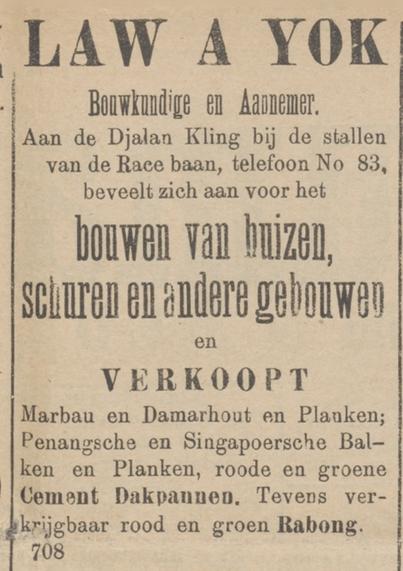
An advertisement in 1907 showed that his business is in building construction and a contractor:
LAW A YOK, Architect and Contractor.
At the Djalan Kling near the stables from the Race track, phone No 83,
recommends itself for it building houses, sanding and other bonding and SELLS
Marbau and Damarhout and Planken; Penang and Singaporean Balken and Shelves, red and green Cement Roof Tiles. Also available red and green Rabong.
Law Ah Yok is a Macao or Cantonese and president of the Association Kwong Tong Kong Soh. Law A Yok had a house on the corner of Hakka Street (jalan Nusantara/ MT Haryono) and Wilhelmina Street (Jl. Sutomo), currently vacant. It seems that he has occupied the “old house” since 1910s. It has been empty, at least since 1980 and became a place for big billboard.
Djalan Law A Yok or Law Ah Yok was constructed in 1911. Djalan Law Ah Yok is an extension of Julianastraat or Jalan Asia. It is currently Asia Mega Mas and Sukaramai. In the early day, Chinese in Medan also refer to the intersection of jalan Sutomo and Nusantara (Hakka St) as Djalan Law Ah Yok, becuase his house was there. Probably because they found it difficult to pronounce Wilhelmina.
In 1912, his son was born, which he advertised in Sumatra Post.
In honor of the birth of my son: Law Hien Khoen, May 11, 1912, I will hold a big party at 5 pm on Friday, June 7, 1912. All friends are invited. LAW AH YOK.
Activities
Law Ah Yok was the head of the Cantonese society in Medan. In 1924, he requested Exemption from road fees. (De Sumatra post, 17-11-1924):
“Law Ah Yok, president of the Association Kwong Tong Kong Soh requests free-statement of payment of road fees for a Tepekong to be established on Thu Chinese cemetery on Djatilaan.”
Ah Yok was also an angry man. He hit a Chinese reporter. De Sumatra post, 27-03-1936 reported: “A young city editor of a local Chinese newspaper, yesterday walking on Tjong Jong Hianstraat. A Chinese came to him, and hit him. The press man complained to the police. The next day, the attacker, known as Law Ah Yok was brought to trial, fined f. 2.50 for abuse. Apparently the editor concerned in the newspaper wrote harsh criticism of Law Ah Yok. “
Companies
Law Ah Yok had several companies as a contractor and building materials. But he seem to declare bankrupt in 1920s and 1930s.
In 1923, he was back in Medan, with an announcement:
The undersigned hereby shares politely that he’s back in Medan has returned and the management
taken over his case from LAW A KIE . LAW AH YOK (De Sumatra post 15-09-1923)
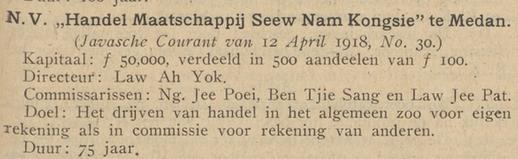
His companies include
NV Handel Mij Law Ah Yok at Law Ah Yokstraat, declared bankrupt 24 May 1935
NV Handel Mij Seew Nam Kongsie, declared bankrupt in Sept 1924
Lai Kwong Siong Giep & Co. Laboeanweg 165.
Member of the Supervisory Board P.J.M.V. Hens. by judgment of the Council of Justice in Medan from 14 Sep-December 1923 the bankruptcy from : Law Ah Yok (Sumatra Post 15 Sept 1923)
By judgment of the Council of Justice at Batavia of 8 August 30, the bankruptcy of: Law Ah Yok, merchant, formerly resident Medan, now at Pontianak. Het nieuws van den dag voor Nederlandsch-Indië, 08-08-1930
Sukaramai
Law Ah Yok established a kampong for Chinese in 1910s at the end of Julianastraat (eastern end of jalan Asia), near Kampung Tempel. This is at the edge of the municipality of Medan. The street is named Djalan Law Ah Yok and had a Chinese gate. Kampung Law Ah Yok bordered with kampung Soekaramei. Kampong Soekaramei, was described as a very intensive built-up kampong, located just outside the Medan municipality, in-between the municipal boundary and the boundary of Medan estate (SP 06-02-1936).
Djalan Law A Yok or Law Ah Yok was constructed in 1911. It had a theater called The Indra Mahnikam Theater Coy. of F.S.M (Federated Strait Malaya), showing Malay theater. The New Bangsawan was also on show there in 1911. The Shows include Njai Dasimah (SP, 17-07-1911), Hamceford Robert (SP 2-8-1911), Tjau-Tjau Merba Rambai-Rambai (SP 12-8-1911), Saiful Kahar (15-8-1911), Tjahaja Gemeleng (12-7-1911)), Noerdin Parsen (17-8-1911), Romea en Julia (17-7-1911).
Soekaramei was under the local Sultan’s rule. It was called Sultanskampoengs, other include Soengei Kerah-Pertjoet, Kota Masoem, Sukaraja. This kampongs lie within the limits of the Medan municipality, and not directly controlled by the Dutch. The houses were called petakhuis (rumah petak) with no roads, but muds. The Sultan in 1932 forbid Chinese and Arab to live and open business in Kota Masoom and Soekaramai to protect the native’s trade (SP 25-04-1932). It is an slum area with reported fights, theft, murder, drunk, etc.
Chinese community who lived in kampong Law Ah Yok is considered impoverished and even violence. Even the native Indonesian did not want to cross the border to Low Ah Yok. It was said that if a native who passed Kampung Law Ah Yok, he would came out naked, everything will be robbed.
In 1934, Djalan Law A Yok was established for the unemployed Chinese, with the help of Chinese Consul.
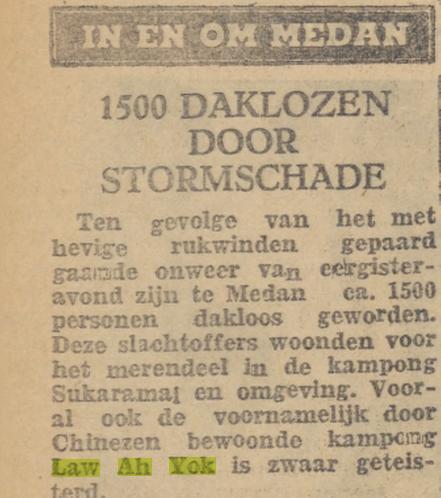
In 1952, Kampong Soekaramei was hit by a storm, and the news mentioned Chinese-inhabited Kampong Law Ah Yok is the hardest hit, with around 1500 people became homeless. The Chinese council visited them.
Later Kampung Law Ah Yok is referred to Sukaramai. It was inhabited mostly by Chinese and called Kampung Cina. The houses were still made of woods. In 1979, there was a big fire and wiped out most of the houses. Later more permanent brick houses were built. And in 1986, rumah susun was built as a public housing. The part on the edge of Jalan Asia is now known as Asia Mega Mas.
 Stories from Deli
Leave a comment