By the beginning of the 20th century (1905), the number of Chinese in Medanhad reached 6,400
The entire population of Medan (about 13,000 people, including about 950 Europeans, more than 2,000 indigenous people, Indians and others about 3,700 people. Furthermore, most of the urban population comes from other regions, forming a special immigration culture.
According to statistics in 1930, “Medan has a total population of more than 70,000 people, of which 27,000 are Chinese , one-third of the population exceeding the capital in Batavia. It is the center of a large number of Chinese, Westerners and aboriginal lives.
By 1918, Medan became a direct territory of Dutch Indonesia. city The autonomous region has the first mayor Baron Daniel Mackay , governing Kesawan, Sungai Rengas, Petisah Hulu and Petisah Hilir.
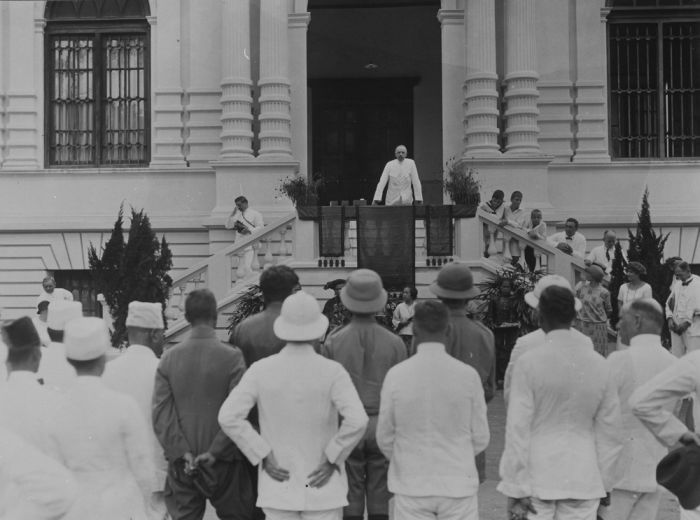
After World War I to before World War II, due to the rapid development of world capitalist industry, the demand for raw materials such as rubber and palm. Seeking rapid growth, Medan, as a resource distribution center, has entered a golden age of development with the help of the prosperity of the planting industry. This is to promote modern regional unification and the formation of national communities are of great significance.
The development of the city and the prosperity of the economy continue to attract the surrounding Chinese from Penang in Malaya, Hat Yai in Thailand, and Yang Yang in Myanmar, British Singapore and other places.
The larger number are Chinese in southern Fujian. Compared with the early days in northern and eastern Guangdong. They came with capital and soon entered the retail market that supplies Europeans and local indigenous life needs. Industry and occupy a dominant position. According to field interviews, in the past, Cantonese originally immigrated to northern Sumatra as indentured laborers. In the later period, some Cantonese who got rid of their labor status gradually moved to cities through business, and then led the family moved to Medan one after another. However, Fujianese entered less as laborers, and more often migrate after the opening of Belawan Port for business. Living together with Malaysia’s Penang and Kedah, Thailand’s Hat Yai, Myanmar’s Yangon and other places to form a Fujianese trade and culture ring. As a latecomer, Fujianese have no way to own land and docks, so they entered the market earlier. Long-term business accumulation has formed Fujian Southerners’ economic advantage. Gradually, the Chinese in East Sumatra adopted the Hokkien dialect, which incorporates some Hakka dialects and aboriginal vocabulary.
The entire northern Sumatra area should be dominated by Cantonese, but in the cities of Medan, Fujianese dominate. Moreover, because Fujianese economy is strong, and they mainly live in cities, and occupy the central position of market circulation. Therefore, its language becomes a universal language.
The majority of overseas Chinese in Medan are labor and commercial immigrants, “more than half of them started from China (according to 1930 statistics)”, mainly Chaoshan, Meizhou, Jiaying, Guangzhao in Guangdong and Zhangzhou, Quanzhou, Xiamen and other places in Fujian, and are divided by region and occupation work.
In the entire agricultural reclamation area in the eastern part of Sumatra Island, Chaozhou people usually come first, followed by the Hakkas. Both account for the majority of the Chinese in the entire agricultural area.
Then the Fujianese came here to engage in the service daily necessities business. Taking Deli as an example, the ratio of dialect groups to 1930 is as follows, Fujianese, 24.3% of the total population; Cantonese (artisans), 21.1%; Chaozhou, 21.8%. Hakka (Little Merchant And farm workers) accounted for 8.7%.
The common blood relationship, ancestral identity and Chinese cultural identity, etc., have allowed the Chinese in Medan to maintain loyalty to the politics, culture, economy, and ethnic group of the ancestral homeland, forming a new overseas Chinese society, and the place of residence constitutes a “dual society” sssociation structure”. At the same time, due to its distinct occupation and geographical division of labor, there has also been a “dualism” within the Chinese society in Medan.
More and more Chinese emigrate to Medan, which has played an important role in urban expansion, commercial prosperity, regional market unification and ethnic integration.
Take the example of brothers Zhang Rongxuan and Zhang Yaoxuan, the overseas Chinese in Medan. They act as the overseas Chinese leaders who coordinate and manage the local Chinese, not only for
For the sake of solving the living problems of overseas Chinese, we have established the Dunben School, Ji’an Hospital, and Leprosy Hospital as a sole proprietorship; at the same time, it is a harmonious ethnic group relationship, they also donated to the indigenous peoples to build a mosque and built the “Chengde Bridge” (won the United Nations Cultural Heritage)
Although there were gang struggles among the expats from Fujian and Guangzhou, they all recognized the status of the Zhang brothers as leaders of overseas Chinese. When the author interviewed his descendant Zhang Hongjun (chairman of the Medan Hakka Association),
Witnessed a lot of material and written materials about the two men’s early entrepreneurship and management of the Chinese society. As someone commented: “Hundreds of thousands of living creatures in the port, in the deep and fierce waters of the day, the turbulent wandering, there is nothing to tell from the sufferings, fortunately, sitting in the place is regarded as abusive, namely
Compete with foreign workers, get free air today, live and work in peace and contentment. “
Like the overseas Chinese in other parts of Indonesia under the rule of the Dutch colonial government, the movement and residence of the overseas Chinese in Medan are restricted.
The economy has been squeezed out and squeezed, and education has also been excluded and discriminated against. The legal status is the lowest in society like the indigenous people, thus pushing
It moved the “involution” and self-rescue of overseas Chinese. In order to save themselves, the overseas Chinese in Medan not only resisted the atrocities committed by the colonists, they also “copy”
The organization model of the hometown has spontaneously established various associations, clan associations, chambers of commerce, industry associations, and trade unions, etc., to protect itself
Rights and commercial interests. They joined forces with the community to fund the construction of Sudong Middle School, Yangtze Middle School, Fujian School, Zhonghua School, etc.
The Chinese language school creates opportunities for the Chinese to receive education; founded the “New Chinese Newspaper” (first edition in 1928) and “Sumatran People’s Newspaper”
(First edition in 1926), etc., to promote and maintain the Chinese national consciousness and promote Chinese culture. ¨ Correct the wave of nationalism at the end of the 19th century
When it reached its peak in Asia, it was driven by the “influence and mass base of the Chinese progressive forces in the overseas Chinese society in northern Jiangsu”.
The ethnic consciousness of overseas Chinese is so high that they have established the Medan Chinese Overseas Chinese Association to jointly fund the refugees of the motherland, and the overseas Chinese in Medan raises the refugees of the motherland. Organizations such as the Charity Committee contributed to the Chinese revolution and construction.
At the same time, in the national independence movement in Indonesia, the overseas Chinese in Medan joined the indigenous people in Indonesia to resist colonialism. In the struggle to govern and fight for national independence. They raised funds, materials and provided public opinion support for the Indonesian independence movement.
During the Northern Sumatra period, the overseas Chinese in Medan established the Sumatra Island Overseas Chinese Anti-enemy Association and the Sioux Island People’s Anti-Fascist Alliance, etc., and joined forces with the Indonesian people to fight against the enemy. Faced with the comeback of the Dutch colonists, the overseas Chinese in Medan also devoted themselves spiritually and materially to the Indonesian people’s struggle for independence support. They took advantage of the convenience of business with Singapore and Malaya to transport Indonesian local products to Singapore and Malaya for sale. Singapore, Malaysia and other places import medicines and daily necessities needed by Indonesia.
According to the interview, Chen He, the father of Chen Mingzong, chairman of the Medan Yingchuan Clan Association Lan, is a supporter of the Indonesian Revolutionary Army against the Netherlands. He once risked his life to buy guns and ammunition from Malaya to support the Revolutionary Army. Later he was awarded the “Veterans Card” by the Sukarno government.
After entering independence, the overseas Chinese in Indonesia have confronted and split due to their different political tendencies toward China. In addition, the Chinese and the original
The conflicts among residents have always existed. As a result, the Indonesian Chinese society not only faces internal political divisions, but is also subject to the exclusion of Chinese by the host government.
The influence of emotion is in hesitation and confusion. After Suharto came to power in 1965, the government implemented a policy of compulsory assimilation. Started to make a difficult transition to the Chinese, and endured painful choices in this transformation of economic and cultural identity. In the late 1980s, whether active or passive, overseas Chinese in Indonesia basically completed a comprehensive shift in their political and economic identity. Due to their distinctive and lasting Chinese cultural influence and unique social history, the Lanhua people have survived more than 30 years of government repressive rule. Strongly continue the Chinese traditional culture and maintain the ethnic consciousness of the Chinese.
2011年3月, 第1期, 华侨华人历史研究
Overseas Chinese History Studies March 2011
印尼棉兰的华人:历史与特征木 杨宏云
 Stories from Deli
Leave a comment