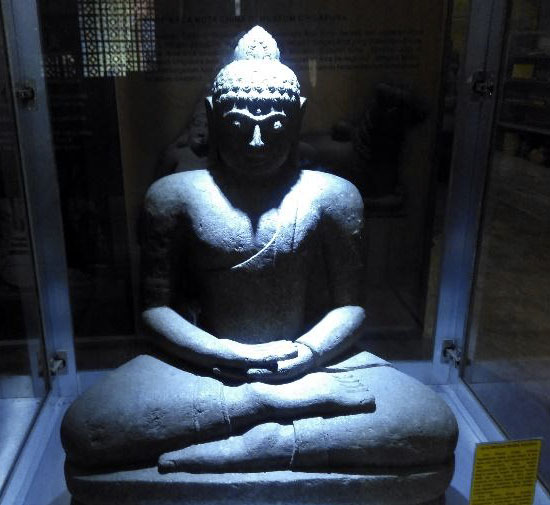
John Anderson first recorded Kota China in his mission to East Sumatra in 1823 . He noted that “at Kota China is a stone of a very large size , with an inscription upon it in characters not understood by any of the natives”
Later an excerpt and comment upon Anderson ‘s note were published in Tijdschrift van het Bataviasche Genootschap . In 1882 , shortly after the Dutch had established themselves in the Deli area , the Controleur of Labuhan Deli , having been requested to search for the inscription , visited the site but found no trace of it . Another stone , known locally as the lumpang batu ( stone mortar ) , apparently a yoni or statue base with an indented rectangle measuring 4 5 x 53 cm and 5 cm deep , was , however , removed to the Controleur’s compound at Labuhan . At the same time the Controleur recorded a tradition at Kota Cina which related that Chin ese had occupied the site many years previously . Except for a brief resume of the literature relating to Kota Cina in the Oudheidkundig Verslag of 1914 , the site appears to have been forgotten until 1972
The present Kota Cina is located at 03°43’ N and 98°39’ E, in kelurahan of Paya Pasir, kecamatan of Medan Marelan. It is less than ten kilometres away from the harbour of Belawan and approximately two kilometres west of the Deli River.
Kota Cina was rediscovered by Edwards McKinnon and Luckman Sinar at the very beginning of the 1970s, after tracking the supply in Song and Yuan Chinese ceramics to antique dealers based in Medan.
In 1972 McKinnon interviewed a local on the history of settlement to the site:
” Originally the village was an Indian settlement by the edge of the sea . It was a time of commerce when everyone was busy with various things . Then Chinese arrived in the harbor and soon fighting
broke out between the Indians and the newcomers . The Indians lost and ran away . There is a tale of a silver statue , with eyes made of diamonds which was in the village at that time , but it is now lost .
The outcome of the fighting between the Indians and the Chinese was that the Almighty was angered. The Chinese did not enjoy the fruits of their victory over the Indians for long , as retribution in the form of a plague of shellfish that came up out of the sea was sent by the Almighty and soon the settlement was overrun.
The shells swamped the Chinese , getting in to everything , into their eyes and ears , filling their cooking pots and rice bowls until they could stand it no longer and they too ran away . Some fled back to China and others scattered to places in Sumatra. The Chinese who live in the village now are all newcomers , having arrived in the past thirty or forty years.”
McKinnon’s thesis summarised that
Kota Cina indicated early foreign settlement and direct commercial contacts with South India and South China . Tamil involvement in northern Sumatra started in the early second millennium A.D.
Foreign traders established permanent bases in Southeast Asian waters . In doing so, they set up religious institutions served by their own Brahmin priests and, in the case of Kota Cina , brought stone images of their gods with them from their homeland . This practice help s explain the presence of early bronze images of possible Indian and Sinhalese origin , both on the mainland and in the islands of the archipelago .
The first Chinese immigrants to appear to have settled at Kota Cina in the mid to late twelfth century, a time when Chinese ships bound for Sri Lanka and South India were sailing along the northeast coast of Sumatra in ever increasing numbers . Eventually the numbers of Chinese may have increased until the site became known as the Chinese “kota” and their presence became a subject for local lore . Present-day evidence suggests that Chinese Buddhists would have had no difficulty in adapting an Indian Buddhist sanctuary to their own use or at least would have found no objection to using Indian images as objects of their devotions. A Chinese presence at the site is strongly suggested by the large numbers of cash and other evidence such as the fragments of artifacts which may be considered outwith the normal range of trade . The fragments of ceramic figurines , which may relate to Taoist religious practices , and a fragmentary talisman inscribed with Chinese characters indicate that this may have been the case. Chinese immigrants were certainly settled in Tumasik by 1330 and in South Sumatra and Java by the late fourteenth or early fifteenth centuries . This
process of immigration , however , had probably begun about one hundred years earlier. Kota Cina thus app ears as a cosmopolitan settlement , though with more emphasis on the Indian , rather than the “Chinese” aspects.
Ceramic evidence suggests that the site was abandoned in the third quarter or the early part of the last quarter of the fourteenth century. Much of the imported ceramic material can be attributed to products of the kilns of South China during the Yuan period and possibly to the first few years of the
Ming dynasty. A few shreds of evidence suggest that Kota Cina may ultimately have been burnt.
A recent study suggests a Tsunami event on the cost of north Sumatra in the late 14th century that may contribute to the disappearance of Kota China.
Edward MacKinnon’s Thesis https://www.iseas.edu.sg/wp-content/uploads/2015/07/edwards_mckinnon_1984.pdf
The French-Indonesian Archaeological Project in Kota Cina (North Sumatra) https://www.persee.fr/doc/arch_0044-8613_2013_num_86_1_4434
 Stories from Deli
Leave a comment