Tobacco culture is the most complicated of agriculture of the Dutch East Indies, above all it is complicated in Deli, where people always work on a precious sheet, renowned as cover-1 sheet. Its organization determined the nature of the enterprise: the division of land, division of labor, division of buildings, composition of wages. How much simpler is the cultivation of rubber, tea, coffee, palms, even with perennial crops with permanent gardens and the cultivation of the harvest, which is united in one field!
Since the labor of the Chinese worker, hitherto the most important on the tobacco plantations, and also his wage scheme are closely related to the organization of the enterprise, a brief outline may precede this.
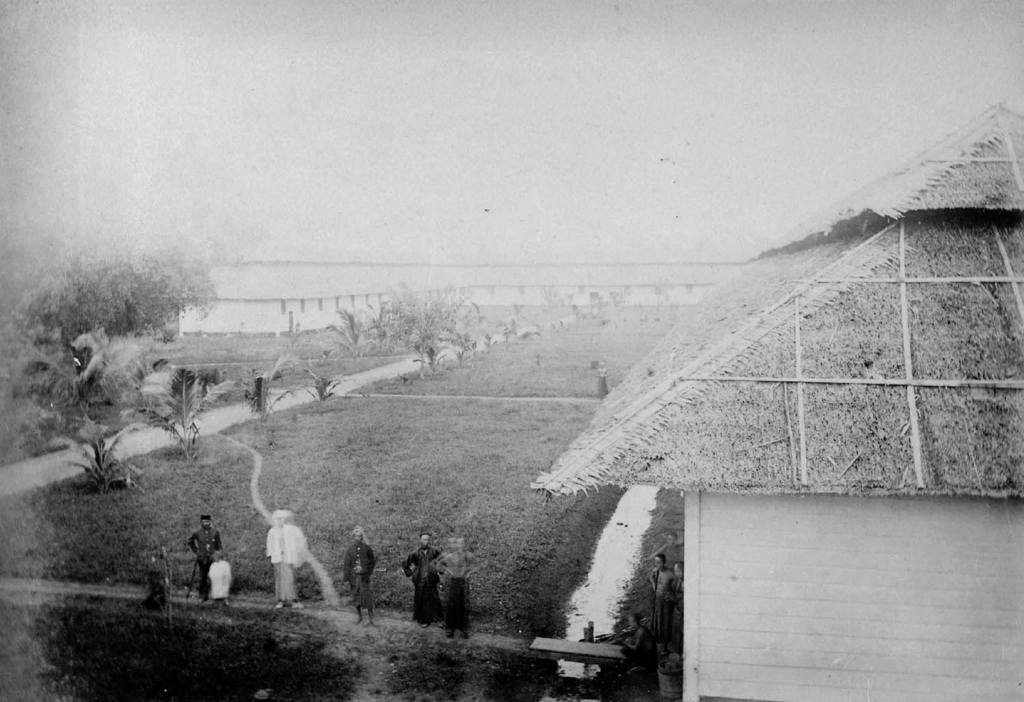
The centerpiece of the enterprise is the “establishment,” where the manager’s house, assistants ‘houses, the office, the fermentation shed, the chief tandil’s residence, the Chinese workers’ kongsie houses, their temple, their kedei (shop), furthermore the pondonks of the Javanese, their kedei and furthermore stables, all at great distances. The chief tandil is the chief overseer of the Chinese, a man of influence. The Chinese coolies live in groups (kongsies) of 30 to 40 in their kongsie house, where a tandil exercises some supervision and keeps order. Small rooms are separated in the pondoks of the Javanese, because many of them live married life. All these buildings are of a permanent nature and without exception look neat, giving the establishment as a whole a neat impression. In some enterprises a hospital is found, serving the sick of a few enterprises together; usually have the companies, which own more than one enterprise, one central hospital for all, including the homes of the doctors and the hospital staff.
The fermentation barn has undergone changes over the years due to the conditions for good work. The oldest type was very simple, around 1890 an improved type came into use, which can still be found here and there – but in later years the barns were built according to a modern concept. They are buildings, those fermentation sheds, 100 to 150 meters long and 25 or more meters wide, where the tobacco from the drying sheds is applied, stacked, fermented; After fermentation, the heavy work of sorting by color and bundling by length begins, and the tobacco is finally pressed into bales and packed. The shed must meet certain requirements regarding the supply of air and light.
In normal times, a mature company has a plantation of 400 fields, each field is approximately one baoe (= 0.7 hectare) in size. Since after the tobacco harvest the field is planted once with padi and a further 7 to 9 years must lie fallow, in which years the growth of forest is promoted, a tobacco plantation in Deli must have at least 4 thousand baoe.
A main road through the company and perpendicular to it the planting paths divide the whole into sections, some of which are planted with tobacco every year. The company therefore goes around all those subjects in a period of 8 to 10 years and so does the staff and the workforce. About 8 months Chinese workers in the field, about 4 months on the establishment in the fermentation shed. Their place of residence depends on that. Temporary residences involve the workers and assistants, located on the planting roads and close to the department where they work. An assistant supervises the work in his department, large 100 fields, and each field cooler has one field. With them belong the auxiliary coolies (kongsikangs, or now called tjapkangs). The Javanese in a section, about fifty under their mandoers, cut bosch, build roads and dikes, dig gutters, build houses; Javanese women do light field and barn work.
On the planting roads are the drying sheds, which, when necessary, ie every three or four, sometimes every two years, are moved to the fields from where the tobacco is hung to dry. In addition to the permanent large barn and houses on the establishment, a tobacco plantation therefore always has drying sheds and houses in the divisions, which are not permanent. Klings from the Madras region serve as herders and feeders; people of the Bawean Islands, as well as Bandjarese and Bantammers, are often barn builders.
The preparatory work on the fields consists of the cutting and burning of young forests, the tilling of the soil and the preparation of planting roads, all together the ‘preparation’, which is done by Javanese, although some Chinese take part in it. In January, after the divisions have been divided, the field coolies arrive armed with the tjangkol (spade), a parang or arit (crooked grass blade) and other tools and lots around the fields. This is followed by a deep tillage and another shallow tillage, while in the meantime on the well-chosen soil the seed beds for each section are being put in order and treated with great care. After six weeks young plants are suitable for planting, on the higher farms after seven weeks.
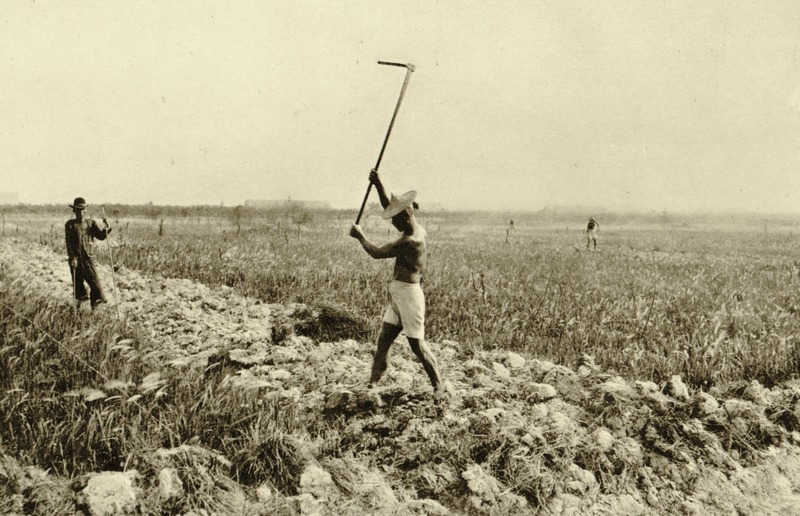
Planting time starts in mid-February on the upper farms, and in the low mid-March countries. The field coolie is in full vigor and zeal in tending the nursery beds, and in planting and tending his field, for he receives payment for every thousand horns that he puts in during the harvest, and that payment is connected with the care spent for his crop. Supervision exercises his tandil, whose income is connected with the income of the coolies subordinate to him; The assistant also supervises the entire department. In plant rows, the coolie must plant and maintain a certain distance between the plant rows (3 feet) and between the plants in the row (1.5 feet). If instead of 16 thousand trees in his field the coolie can plant a few thousand more, he will probably see benefit but supervision must ensure that the planting is done according to the regulations. In an older period many entrepreneurs have planted double rows to reap more in a field; especially those, whose land license was not large enough to follow 8 to 10 years of fallow land, gladly tested it. People came back from it, seeing that the quality suffered. But in 1907 and 1908 it started again with most entrepreneurs. In the application of that plant system, the entrepreneur needs more workers, while the chance of various disadvantages increases.
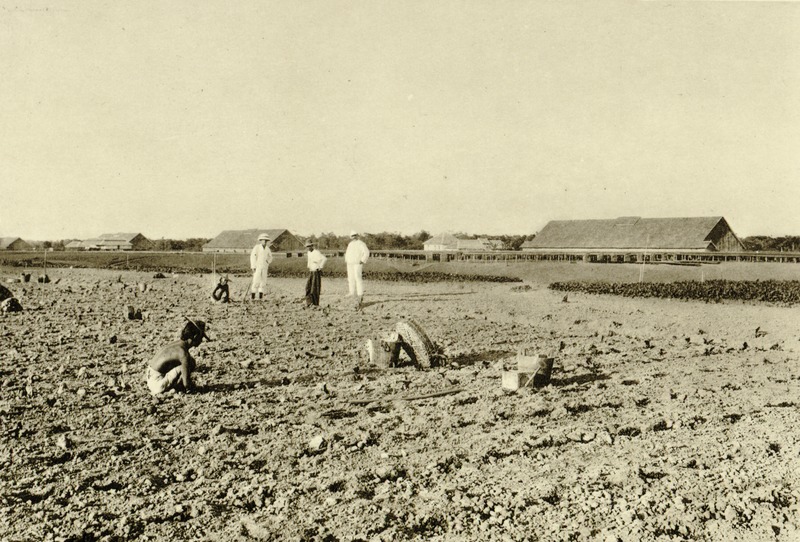
In the beginning, the field coolie will check its young plants every day for caterpillars and other insects, whether there is damage or dieback, and in that case replace the plant if necessary with another. From time to time he has to raise the earth in oak plants. He divides his time working on the seedbeds, checking his plantings, extending them until his field is planted. He works with great effort and pleasure, the farmer is in his strength. After 5 or 6 weeks, he has to top his plants, which again requires care because the growth of the leaves, thickness and color are related to this; about 3 weeks later the plants ripen and the blister plucking begins, the bottom one first, and then according to maturity.

The harvested leaves were brought by the field coolies in a large basket to the drying shed, a wooden frame with walls and roof of atap; for 6 or 7 fields there is one drying shed, placed and arranged in a specific way. The tobacco leaves are strung on a thin rope and hung on sticks to dry. For the sake of its uniformity, the supply of light and air with shutters must be regulated according to the time of day and the weather. Little or nothing can be done against the evil of the Bohorok, the scorching wind.
After drying, which takes about 3 weeks, the blisters are carefully removed and combined and tied into bundles of 40 to 50 pieces; that is ‘coarse bundling’. The bundles are then carefully loaded in boxes on carts to the fermentation shed and are marked with whether they contain sand sheet, foot sheet, middle sheet or top sheet. In the fermentation shed, the bundles are stacked and the temperature is also regularly taken on of the scalding tobacco, which should not be affected by the weather and the temperature outside. The scalding process, in which the accumulation is also a factor, is regulated by the European staff according to experience, another criterion cannot be followed.

When the forcing has progressed far enough, sorting by color and fineness and bundling by length can commence. To this end, the coolies come from the fields, the assistants as well: the whole company is now moving into the establishment together and the ‘shed time’ has begun. The bundles are taken from the stacks and distributed to the workers who are seated as conveniently as possible for their sorting work, so that no changing light from outside deceives them. The market has some twenty distinctions of the tobacco leaf and the worker sorts according to those (mostly Chinese, sometimes Javanese women), after which he hands the leaves to the bundler sitting opposite him for proper collection.

The Chinese field coolie, but also the Javanese woman, possesses an admirable ability to observe the required awards. However, negligence occurs, for example because of the haste to get rid of a lot and earn a lot or because of drowsiness as a result of little sleep and a lot of effort. The reception assistant in the reception room, assisted by some select Chinese workers and Javanese women, examines the bundles from each sorter, rejects the wrong bundles and returns them to the worker, who thereby loses his time and wages. An accountant immediately records the number of bundles delivered for each worker. The tested bundles are put back into stacks and then pressed into bales of 80 kilograms.
In order to understand the merits of the Chinese workers, it is necessary to separate the barn time from the field time, for during this an account is made of each coolie, while he regularly receives advances for his maintenance. The credit balance reverses the company to him when he was about four weeks end fermentation shed is active. The day of payment is the most important day of the year for him. The sorting and bundle wages earned in the fermentation shed are paid to him daily. Approximately 14 days after the payment of the credit balances, the opportunity is opened for re-engagement for those who have fulfilled their contract period; the advance is 14 guilders, the gift 21 guilders. The contract year ends with the end of the work in the fermentation barn.
The composition can now follow from the income which a Chinese field coolie receives for a year and which is partly governed by the provisions of his contract, which first mentions the activities which the manager can entrust him with, then a maximum working time per 24-hour period, namely 10 hours during the day or 8 hours in the night, specify the minimum daily wage of 33 cents for the emigration contract (the contract entered into for the first time) and 38 cents for the re-engagement contract, x) which amount serves as the basis in case of calculation piece wages or wages for contracted work.
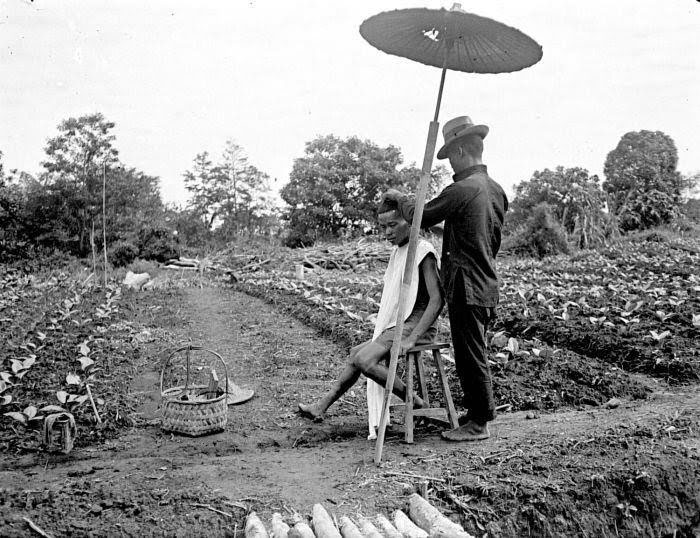
As to the advance, the amount of which is stated, the agreement states that it may be withheld in its entirety from the amount paid at the end of the field time, or that it may be deducted in installments from the periodic wages. The wages may also be reduced by the advances provided during the contract year, which together with the initial advance may not exceed 50 guilders, and furthermore, the amount paid for the (Chinese) coolie may be deducted to the barber, the cook, the den. kongsiewaker, what has been spent for breeding plants and the tax, which for the Chinese
*) The wages were increased a few years ago by 2 cents and in 1920 again by 6 cents, so that the standard amounts in money were 41 and 46 cents. In the same year a new increase was made, to 55 cents for men and 50 for women; at re-engagement 60 and 55 cents, while the rice price was then set at 20 cents per kilogram. 10 guilders per year (income calculated on 300 guilders), for a Javanese f. 3.18 (income calculated on f. 144.).
The contract specifies the days off, the payment for overtime, the right to adequate housing and medical treatment, to a proper burial in the event of death, free return to the place of origin if the contractor requires it after the end of his contract term.
The duties of the employee who mentions the contract are: to work according to the method specified by the manager; provide unpaid assistance in the event of a disaster or imminent danger, even outside normal working hours; watering the nursery beds even on public holidays against payment as overtime (7 cents per hour); keeping his home in a clean condition; to behave in case of illness according to the prescriptions of the doctor. The contract also says that the harvest year will not last longer than February 15 of the year, following that in which the tobacco was harvested.
The amounts for piece wages and those for deductions for labor, which the coolie does not perform himself but which the administrator has performed for him, are stated in the contract, as follows:
a. For every thousand plants, whose leaves have been harvested when ripe and delivered to the drying shed, at least f. 8.50, at most f. 11.50, depending on the care spent, but on average the worker must pay at least f. 10.— per thousand plants received. This is based on at least 16 thousand trees per field. If it is ordered that less is planted per field, the amounts must be set higher.
b. For plucking and bringing the blisters to the drying shed and for threading 17.5 cents per thousand blisters; 7 cents for picking and delivery without threading, only 10.5 cents for threading.
c. For lowering the threaded tobacco and coarsely bundle one cent for every 10 bundles.
d. For sorting and fine bundling in the fermentation shed 10.5 cents for every thousand blisters.
e. For cleaning and tidying up in the drying shed, maintaining fires there and opening and closing the hatches and doors 38 cents per day of labor.
With regard to the payments, the agreement states that the wages under a must be paid at the latest after the end of the sorting, while semi-monthly advances must be made during the field time, at least f. 3.5 per half month; the wages for other activities can be paid in the same way or also monthly, weekly, daily, as the manager wishes. A portion of the wages may be paid in good rice up to an amount as the contractor needs for himself and his family for not more than half a month at a price which leaves the administrator no profit, or in full prepared food for 14 cents a day. The worker is entitled to the stipulated daily wage on the rest and public holidays.
The deductions from the earned wages take place until the advance payment is deducted and furthermore for the activities that the workman did not perform himself but the manager had carried out for him, namely:
1 ° for felling, clearing and cleaning the field, digging or plowing f. 7. on the understanding that the field coolie gets his field in one state, in which he only needs to chant it coarsely once and fine once;
2 ° for field help, ie for activities that he himself did not perform on time or properly;
3 ° for the tools, whichever else he may keep;
4 ° for the purchase of another field with the amount due to the predecessor. Discounts for bad work should not occur. The assistant, checking the fieldwork of his coolies, assesses how much the coolie is due per thousand trees and determines, for example, f. 10.50 or f. 10.60 etc. The field help and other activities for the field coolie are done by the less capable Chinese, tjapkangs (formerly called kongsikangs), Javanese and Javanese women.
On the debit side of the coolie is also the amount that he sent through the Immigration Office to his family in China . The labor inspectorate has insight into everything that belongs to the wage calculation of the worker. The provision of rice is important at the same time as the semi-monthly advance. The coolies were charged a price of f. 10. – per 100 kilograms, the companies usually bought at a price between f. 9. and f. 11. – Free Belawan. The war has greatly increased the purchase price, quadrupled four years, but for the coolie the old price has been maintained.
Below I give a statement for the field time of Lim Seng Moy, who was employed by the Deli-M’j in 1916. Every coolie has his card there, as it is printed here, with a credit on the front, a debit on the back. That is the calculation over 8 months of field time, after which he earned at least f. 12. – could still earn per month and at the time of transition between barn work and new field time by working in the fields.
According to calculation, the field coolies earn an average of f. 26.37, but in the fermentation barn the average is less. For a large company, the annual average, calculated over a period of five years, was f. 18.37 per month.
After the settlement of Lim Seng Moy’s field time follows a settlement of an entire kongsie at the Senembah IVD also for the field time. In this way, all companies set up the account of their Chinese field coolies, which corresponds to the terms of the contract.
9 Only in 1920 was the price of rice at 20 cents per kg. brought together with the special wage increase. When wages were reduced in 1921, the workers were again given rice at a low price (1272 cents per KG).
The Chinese worker, whom people prefer to overtake in Deli, is a farmer at heart. Armed with his tjangkol, he goes to his field in the early hour, and all the working day his care is for the crops, for which he will be rewarded with pieces of silver. It shakes off its roughness at the freshness of the intact leaf; tobacco is the object of its nurturing from the youngest cultivation plant to the tree of abundant maturity.
But when the field time is over and the barn time has come, then a three-month sitting in the fermentation shed awaits him, the moving outdoor life under the fresh, healthy air is over, the necessary sorting and bundling does not require physical fatigue that makes the peace of the evening hour tasty, but tightens the nerves. It is an unalterable gaze of color from thousands of scalded blisters, with the risk that the work will be rejected and returned and the mediocre merit diminishes. During the shedding season, the field-cool’s temper tends to suffer, becomes irritable, touchy, and jacks up small disappointments or displeasure of fortune to great injustice and deep calamity. In the evening, heights in the dice worsen his bad temper.
The great ray of hope in grinding time is the payment of the credit balance, which brings money into his hands and enables many to fulfill cherished desires.
The credit balance is paid in the hands of the coolie himself. But the Chinese worker likes to borrow small sums from time to time in addition to the advances he receives from the company. He closes these loans with his tandil or the main toothil. Then the tandil, as a creditor, will be waiting for his debtors to pay out the credit balance. It happens that a head mandil collects 8 to 10 thousand guilders on that occasion. There are also companies, where he receives 2 thousand and yet also companies of 400 field coolies. Much depends on the involvement of the administrator: if he adds all the amounts that the tandil lends, the amount of the repayments remains within moderate limits. The closer the tobacco companies become, the more such managerial interference will become widespread.
Besides the tandils, the kedei keepers are also inclined to rip off! In the past the coolie was also indebted to him for the supply of rice and other goods, for years the companies have sought means to protect the coolies from the skills of the shopkeeper. For a long time now he has not been allowed to distribute more rice, which the company supplies at a low price. Furthermore, there is a price list in every kedei. Messing is still possible, for example when weighing, but it is not easy.
A time of useful use or worthless pleasures follows the payment of the credit balance. Well to him who could plan for a return to China and now has the moment ahead when he will settle down in the circle of the family. Well, he who has the satisfaction of already withdrawing amounts to have them sent to his family in China, or who leads a family life in Deli with a Chinese or Javanese woman. Many, on the other hand, know that they are not bound by the destination of their money and can offer themselves more widely to the pleasures that make up the evening relaxation of the barn time: games and scenes on the enterprise or games and women off-duty.
The company offers the opportunity to play dice in the play shed. Like so many Orientals, the Chinese is a passionate dice-player, and if he could not play openly in the shed, he would do it covertly on the enterprise or outside. In the past, the playing lease was in the hands of a wealthy Chinese, without whose license the Chinese were not allowed to play. He then granted a license to play in the shed for usually a thousand guilders. The main tandil got his money back from the bankers and they had to earn it through the losses of the players. A limitation of the game lies in the provision that the company may only be played in the pilot house. The sense of play is greatest during the sanding time, credit balance. Some, having lost their money, allow themselves to be committed to try their luck again with new money from advances and gifts. The measures are of little use against the incorrigible dice players; the decent Chinese do not need them; they deposit their credit balance with the chief tandil or clerk or the Immigrant Office. But between these two extremes floats the great mass, which becomes weaker as the opportunity is more generous, but more abstained if a restrictive regulation exists.
On April 1, 1918 (Stbl. 160) the Indian government abolished the leasehold and introduced a licensing system. It was forbidden to hold or cause games of gambling to be held in premises open to the public, but the head of local government may in practice give the principal tandils written permission to hold games of risk, to be named, play sheds. Costs are 25 guilders for every 24 hours. The regional government will every year shorten the time for which a license is issued and also limit the number of games.
The Planters Committee has strongly urged an official ban on playing in the Kongsie houses and also demands a general ban on playing, provided that the police exercise proper supervision. It is now heading in that direction, so that the situation will be reached that gambling is prohibited except on a few days to be determined.
Wayang is a popular and less harmful relaxation in shed time. The main tandil establishes a connection in advance with impression scenarios of Chinese theater in the Straits and then discusses certain playing days. The principal mandil pays, it also happens that the company bears the costs for one or two days.
Some Chinese workers are very fond of a pipe of opium. Most companies have a sales house, built according to the regulations of the Government, which, to the exclusion of all other opium, sells in tubes of 1 mata, 5, 25 and 50 mata. One hundred mata are 1 thail, 16 thail are 1 katti 6 ounces; 1 mata costs 16 cents, a few years ago 14 cents.
In the foreground is that the Chinese coolie, who comes to work in Sumatra, does not need to learn to shuffle anymore. His Javanese buddies at companies do not seduce him: if the Javanese who has arrived is already a slider, he will continue to use opium, but the great mass of the Javanese coolies will not slide.
The entrepreneur has no interest in the fact that the Chinese coolie can obtain opium unless that one which the Chinese does not want to live on a plantation where that stimulant would be denied him. The Government brings the opium into the region as well as many others and holds the exclusive sale in order to regulate: the regulation contains a restriction on its use. For, in the first place, the price-setting can prevent the smuggling of everywhere from benefiting the smuggler. Furthermore, the Government may apply a licensing system, as it has done in Batak countries since Jan. 1. 1919: those who shove opium can continue to do so with a license and obtain an amount equal to the average of their use. The opium director has already remarked, that since the introduction of the license consumption decreased and some licenses were surrendered. Those who do not have a license cannot buy opium.
Against the Chinese, the Government could not do so without robbing the tobacco-growing region of its best workers. When the opium lease still existed, the tenant had a direct interest in high consumption. Nowadays, the Chinese cannot buy more than 1 thail at a time from the Government’s sales outlet at the company, nor can they transport more than 1 thail. Each purchase is booked, whereby a distinction is made between Chinese and Javanese and between regular and non-permanent buyers. This serves to determine consumption. It is possible that anyone who buys a thail communicates it to others; he is asked, but it is not certain that his answer is correct. It is not possible to say whether consumption, calculated according to the person, will decrease. When the Chinese coolie is in the fields, Busy all day in the weather and relatively far from the sales house, he uses less opium. And he arranges there settling in, waiting for the sanding time, in which he receives his credit balance, has his wayang and game and…. are opium.
The opium, used in moderation, does little harm: the man smokes for a moment and takes a break. This cannot be said of fermented drinks, the use of which is increasing in the Indies and is in danger of becoming a serious evil. It is a good policy for the Government and the entrepreneur to try to keep the strong drink out of the environment of the worker and not prevent him from consuming a little opium, which is a great stimulant for him and which he considers indispensable.
At the end of the harvest year, about 10 percent of the coolies leave for China, and most of them return. In addition, by convention, all companies annually send 5 percent of the field coolies to China for recruiting. They are at the expense of the company and receive their credit balance in the form of a money order, which is paid out at Swatow. Those who bring them to the office in Swatow receive an advance of 35 guilders and leave as free people to Deli to enter into an agreement there. If he does not wish this upon arrival, there is nothing that can be done about it.
In China, the laukeh receives a commission of 28 guilders, of which, as has been shown, he often gives a portion to the recruited sinkeh. There are laukeh’s that do not bring anyone; there are even those who do not return as laukeh, but are recruited as sinkeh for a higher advantage.
Dr. R. BROERSMA
DEVENTER 1922
OOSTKUST VAN SUMATRA
 Stories from Deli
Leave a comment