
Chang Puching (also called Tjong Hau Liong) was the Chinese Consul General Titular in Medan, born in May 1885 in Meixian. China. He was the eldest son of the late Major of the Chinese Tjong Yong Hian and Lady Tjie She. The late the famous Major of the Chinese in Medan, Tjong A Fie, who was also Advisor Honorary der Ned. Indian Government, Chinese Affairs, was an uncle of his. Chang Puching is married to Lady Wun Sukjaw. Their son, Chang Shih Liang, studied in England and now works as right hand of his father through these managed admin registration-cantoor Chong Lee, Medan.
He was educated in China and western as well. He held the traditional licentiate, the lowest degree of classical degrees. By the age of 20 he had passed the Government High School and received a Government appointment as record keeper at the Board of War. In 1909, he was appointed acting managing director-general of the Chow Chow and Swatow Railway Company, and a committee member of the Communications. He was later the principal of the Ching Shi School, and, through the recommendation of the Governor of Canton, was honoured with a certificate from the Government.
Later he was part of the entourage accompanying Prince Zaixun, the half-brother of emperor Guangxu, an acting navy minister of the Qing empire, on the tour to Europe, Japan, and the United States in 1909-1910. The study tour was to purchase military equipment. He received decorations conferred by Italy, Austria, Germany, Russia, and Japan. As vice-president of the Board of Communications he received the title of San Si Pin Kin Tong. In the final years of the Qing dynasty, Pu Ching frequently advised the government and ultimately earned brevet mandarin standing himself.
In the first year of the Republican Government he was requested by cable by the Board of Admirality to act as naval inspector, but could not, for business reasons, take the position. He also received communications from the Board of Culture and Commerce at Peking requesting him to act as adviser; but he declined the position.
He returned to Medan due to the death of his father. In the fourth year of the Republican Government he was asked to return to China under the Board of Foreign Affairs, but had to decline this service,
With the fall of the Monarchy, Chang Pu Ching went to Medan, and quickly won for himself high social and commercial standing. He acts on the directorate of the Chow Chow and Swatow Railway Company, and has succeeded his father as adviser to the Chinese Commercial and Industrial Board. He is also a large shareholders in the Deli Bank, and a member of the Chinese Chamber of Commerce. He is the founder and proprietor of an excellent brickworks, well installed with modern machinery, which supplies a great deal of building material to the town. He owns a great portion of the residential property, and is a share- holder in many rubber, tea, and coconut estates in Sumatra, also the proprietor Babura River near the town of Medan.
He has presented the Dutch Government with a steel bridge, which crosses the managing director of Chong Lee & Co., importers, general, merchants, and com- mission agents, and in January 1917 was appointed managing director of the Deli Bank.
In 1887, a Chinese official General Wang Yung-ho had visited Deli and suggested that the Deli planters install a Chinese consul to arrange the immigration affairs of the coolies. The problem was that there first had to be a Sino-Dutch consular treaty on the matter, and this treaty could not be concluded because Imperial China and the Netherland held different opinions about the nationality of the Chinese living in the colony.
It was not until 1911 that Chinese consulates were opened up in the Netherlands Indies, a compromise had been reached between China and the Netherlands about the ‘nationality question’. The compromise was that Chinese born in the Netherlands Indies, were considered to be Dutch subjects. But when they were in China these people were Chinese subjects. Chinese born in China but working in the Netherlands Indies should remain Chinese subjects and, hence, were represented by Chinese consuls. China effectively gave up her claims on the Netherlands Indies-born Chinese and agreed to recognize them as Dutch subjects. The Dutch in return admitted Chinese consuls to handle
affairs for the Chinese community.
In 1912 a consul general of China was installed in Batavia for the whole of Java. Following, consuls were installed all over the Netherlands Indies.
In December 1915 Chang Pu Ching, the eldest son of Tjong Yong Hian, was appointed as the first Chinese consul to Medan covering East Sumatra, Atjeh, Djambi and the Riauw Islands. Chang Pu Ching made his residence in Kesawan into the consular office. The house was next to Tjong A Fie’s mansion in Kesawan. The official inauguration of the consul was in February 1916.
In the fifth year of the Chinese Republic Government he was decorated with a Fifth Class Chia Ho, and on Republican Day (1916) was again honoured with another decoration of the Fourth Class, Chia Ho.

In 1930 Chang Pu Ching submitted his resignation as Chinese consul to the Nanking government. He explained that he could not do much for the Chinese community as his advice to the Netherlands Indies authorities was too often ignored. Chang Pu Ching continued to do his private business and died in Medan in 1963.
The Chinese consul was then replaced by
1931 Chen Tso Ling
1932 Lu Hwi Yu (or Lu Hwe Gu)
1932 Liang Jung Sung (or Liong Weng Soen recalled October)
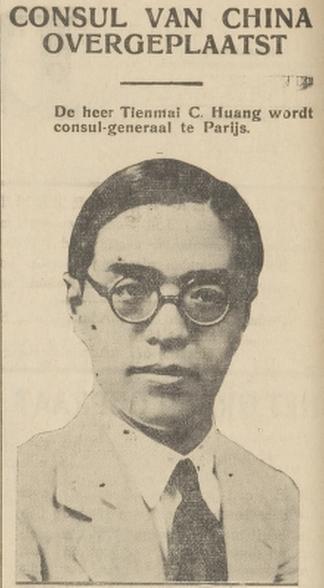
1933 (19th Sept) Tienmai C. Huang, or Quang Tcheng see https://cihc.nl/en/35-my-childhood-medan-sumatra-1933-1940/
1937 Lei Ping Yang, Vice consul: Dalton T. Zhang
1939 Chi Ti Fang
1949 Mr. Tsai Wei Ping.
 Stories from Deli
Leave a comment