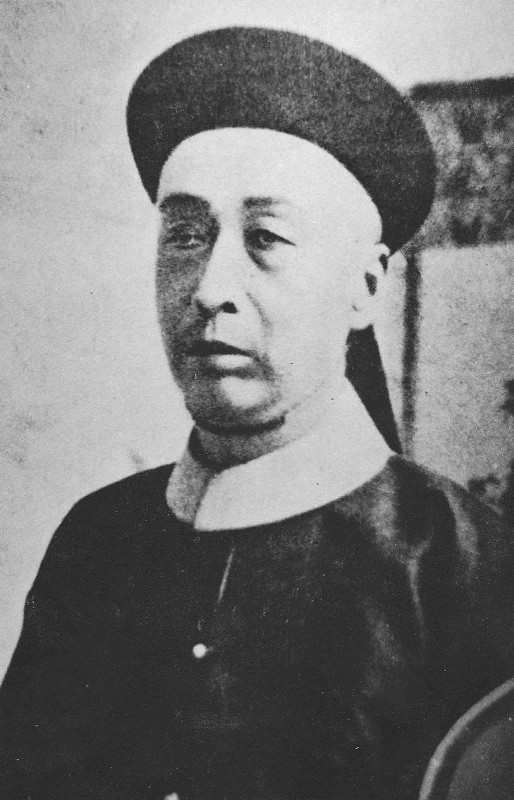
Thio Thiau Siat or Zhang Bishi left his home in rural Tai-pu county, Kwangtung province, to seek his fortune in Southeast Asia when only seventeen. Sources disagree as to the exact social status of his family but he definitely experienced poverty in his youth. Determined to make his fortune in Southeast Asia, he was able to build a commercial network with connections throughout the entire area. By the time he had become Chinese consul in Singapore in 1895, his business operation was firmly rooted in Java, Sumatra, the Malay States and the Straits Settlements of Penang and Singapore and he was just beginning to expand to the China homeland.
Shortly before his confrontation with the German shipping line, his career in Nanyang could boast of the following accomplishments. With the aid of his inlaws, he had established his first business in Batavia at the age of nineteen. Trading largely in foodstuffs, he became a provisioner for the Dutch army and navy and by gradually gaining the favor of the colonial authorities, he used his position to advantage and made successful bids for a number of monopolies made The foreign experience in Western Java including opium, tobacco and spirits. His arrival in the Netherlands Indies fortunately coincided with a period of concerted Dutch expansion.
Unsatisfied with local labor and leadership, the authorities turned more and more toward Chinese for the necessary labor and managerial supervision. Thio was among the earliest Chinese businessmen to receive the very lucrative contracts offered by the colonialist companies for the development of plantations and the reclamation of previously unutilized land areas. With the Dutch supplying most of the capital and the tools as well as the market, Thio furnished the coolie labor and managerial supervision and established his first major company, the Sjarikat Yii Huo Tidak Terhad, an unlimited concern for the development of coconut and rice plantations.
In 1875, only twenty years after his initial arrival in Java, he was one of the most prominent Chinese businessmen on the island and, as the Dutch shifted their attention to the conquest of Sumatra, so did Thio Thiau Siat. In two short years, again with the strong cooperation of the colonial power, his business had extended to embrace the whole northern half of that island. He was soon farming all the major revenue farms. In Deli, he set up a company to plant land in coconut palms, rubber and tea. Inevitably, his attention moved to British-ruled Penang which was the strategic transhipment point for the produce of Sumatra and, in partnership with friends (the captain of the Chinese community in Batavia named Li Ya-i and Wang Wen-hsing). He opened the Li Wang Company with branches in both Deli and Penang to expedite the export of Sumatran products. In a short time, Thio gained sizeable interest in almost all the revenue farms on the Malay side of the Straits of Malacca.
The Dutch program for the development of Sumatra was thwarted from the beginning by the resistance of the Atjehnese Sultanate at the western tip and, as the Dutch army and navy required supplies for their military campaign against Atjeh, Thio was again the provisioner. With so much potential and real influence with the ruling imperialists, he was able to place many of his cronies in important positions as headmen under the Dutch system of using Chinese to supervise Chinese. The Dutch authorities honoured him on many occasions and he was able to secure a number of commercial plums. Not only did he receive the opium farm at Atjeh when the trading town was finally subdued, but the European rulers also permitted the overseas Chinese Thio a virtual monopoly of coastal shipping.
In 1879, his first steamship, the S.S. Rajah Kongsee Atjeh was making a profit all along the west coast and by the mid 1880s his three steamers were said to dominate the area’s trade and to be reaping a fabulous profit. It was much more than that his vessels flew the Dutch flag. He received a salute when he entered port and Anthony Reid, a leading authority on Anglo-Dutch rivalry in Sumatra during this period, has found that the Dutch authorities even paid the $25,000 ransom when one of the ships, the S.S. Hok Canton, was plundered by rebellious Atjehnese in the summer of 1886.
Long after he had shifted his base to Penang and Singapore, Thio still farmed six districts near Batavia for a Dutch limited company. As astounding as it may seem, the Straits Times observed that ‘the area of all these districts is sixty miles in length by thirty miles in width and is inhabited by over 100,000 men and women’. With at least the foregoing 1,800 square miles of Dutch-owned land under his hand. Thio also owned outright a place called Karatan reported to be eight by ten miles in dimension with as many as 8,000 inhabitants. By 1895, Thio’s steamship business had expanded to the English port of Penang where he started a company with nine more steamers running along the Sumatra and Malay coasts between Penang, Perak and Deli.
Shortly before his struggle with German interests, it was widely reported that Li Hung-chang had specifically offered him the management of the China Merchants’ Steam Navigation Company. No wonder the Germans decided it was prudent to take Mr Thio’s challenge seriously. His career, however, was just getting off the ground, for Thio is the Hokkien rendering of the surname Chang and the Singapore consul of 1895 is none other than Chang Pi-shih Or Zhang Bishi.
Thio became Chinese vice-consul at Penang in 1893. By January 1896, he had been promoted to Singapore consul general.
Zhang was involved in setting up the Chang Yu Pioneer Wine Company. In 1891, Thio had a meeting with Sheng Sheng Hsuan at Chefoo, the conversation invariably turned to the area’s weather and its suitability for the cultivation of wine-making grapes. In the next few years, with encouragement from Sheng, Chang Pi-shih imported grapevines and a European brewmaster, petitioned for a fifteen year monopoly and three year exemption from taxes, and set out to make Western wines in China. Arguing that his project would help keep Chinese capital at home while reducing the profits of foreign merchants, he echoed the self-strengtheners’ belief that “the road to national power begins with making the nation wealthy.” But Chang also went a step further to ask permission to organize a commercial corporation along Western lines free from government interference. Imperial sanction was obtained in September I895 and the resulting company became the first native enterprise to produce a non-Chinese consumer product. By 1900, several thousand acres of foreign grapes had been planted on the hill slopes behind Chefoo and before the end of the decade a winery complete with glassworks had been constructed. Nanyang capital and initiative thus provided the beginnings of the modern wine industry the Shantung peninsula has become noted for.
Thio Thiau Siat was also included among the earliest supporters of the Hong Kong college. He contributed at least $50,000 of his own in 1912 and, with the aid of the representative of his estate after 1916, has been credited by Brian Harrison, the official historian of the university, with having almost alone kept the Faculty of Arts going in the institution’s difficult formative years by supplying working funds in an annual gift. In 1916, the very first Doctor of Laws Honoris Causa granted by the University of Hong Kong was awarded to Thio who was known to the Cantonese speakers present as Cheung Pat Sze.
In 1914, Zhang Bishi was elected president of the Chinese Federation of the Chambers of Commerce and the following year, accompanied a Chinese industrial delegation to the USA. He visited Wall Street and planned to start a Sino-American
bank and a trarupa.cific shipping line. At the back of these proposals was his desire to forge a means to counterbalance Japanese might, but America was not yet ready and the scheme did not uke off. He died a year later.
The descendants of the lhree Zhangs lacked the genius of Zhang Bilhi, and the financial empire, spanning many political frontiers that. he built, has since long been splintered. His contact with the colonial establishments had, in a manner of speaking, made Zhang nationalistic. He dreamt of the modemi7.ation of imperial
China, by means of which the Chinese capitalists of the diaspora
would supplant their Western counterparts.
With the fall of Qing empire, he promptly became a special advisor to President Yuan Shih-k’ai and, gaining his ear as he had that of the empress dowager, he was formally appointed a first-class advisor to the government assigned the special task of developing inland ports. Of course, Chang retained the title of commissioner to Nanyang. It was Chang who was elected chairman of the All China Chamber of Commerce in 1914. This position earned him a seat in the Legislative Assembly (Li-fa hui). Ultimately, his wealth and general influence brought inclusion on the State Council (Ts’an-cheng yuan), the pro Yuan rump parliament which took over legislative responsibilities so as to pave the way for an attempted restoration of the monarchy.
Once again, Chang Pi-shih found himself on stage and at the imperial court. Any of these posts would have been enough for the ordinary septuagenarian, but Chang never lost interest in the business world. When Yuan Shih-k’ai decided to send a high-level industrial delegation to the United States in 1915 to seek American aid in the modernization of China, who but the 75-year-old capitalist could be selected to head the group?
In the twilight of a fascinating life, Chang Pi-shih visited Wall Street. The delegation visited America for a total of fifty days and logged nearly 11,000 miles. The eyes of the entire nation were on the visiting Orientals but no individual attracted attention like Chang Pi-shih. The New York Times, on different occasions, called him ‘China’s Rockefeller’, ‘the J. P. Morgan of China’ and ‘the richest of Chinese financiers’. The fact that this and other newspapers could not decide whether the visitor was worth 100 or 200 million U.S. dollars may well have stirred even greater interest. When the delegation arrived in San Francisco, Chang reportedly cashed a letter of credit worth $200,000 to use as spending-money.
The reporters who followed the Chinese capitalist around New York City were likewise astounded to watch him spend several thousand dollars in a ten-minute shopping spree. Chang, who was accompanied by his English-speaking son, overwhelmed American observers. The younger entrepreneur told the press of a family glass factory at Hong Kong, the brick factory in Canton, their rubber interests in Southeast Asia including 35,000 acres on Sumatra, the Deli Bank, coconut, tea and coffee plantations. He also described for the newspapers the brandy and whisky then being produced at Chefoo and the new coconut-oil factories established in the Straits Settlements and Dutch colony. In the first ten days, the group was subjected to some eighty-five formal gatherings, quite a shock to a delegation accustomed to Chinese cuisine.
On 27 May, the visitors reached Washington, D.C., where they were entertained by the secretary of state and other dignitaries. It was not until Chang’s party reached New York, however, that Americans realized the true force of his personality and the real purpose of his mission. On 3 June, Chang addressed a luncheon held in his honor at the Hotel Astor. Over 1,200 of the leading merchants and industrialists of New York were present. And, as always, Chang spoke – through his interpreter – an international commercial language that all present understood. He said that in order to develop better trade relations, it would be necessary to expand banking facilities and to begin new steamship lines.
On Sunday morning, 6 June 1915, the front page of the New York Times revealed what the old man had been up to. At dinner the night before, it had been announced that Chang and Wall Street would form a Sino-American bank. Although the details have not been pursued, both Chinese and American sources agree that the new financial institution was to be backed by an initial capital of 10,000,000 Shanghai dollars, half raised by American industrialists and the other by the Chinese themselves. It soon became apparent that the bank was linked to the transpacific steamship line. Thus, Chang pressed both matters with American capitalists in New York, Philadelphia and San
Francisco.
The New York Times was so impressed by Chang and his proposals that it devoted a feature story in its Sunday Magazine section of 6 June to the politically conservative capitalist’s candid appraisal of the state of the Chinese nation. Wearing American shoes, enormous spectacles, a long traditional scholar’s gown and a derby hat, the old mandarin provided a study in contrasts. His visit to the United States came just as the details of the Twenty-one Demands and Japanese exploitative designs became common knowledge. As a Chinese official, Chang stressed two themes. China was at the mercy of Japan but, more importantly, the United States possessed a new and great opportunity to influence the course of events.
As his remarks were translated in the New York press, Chang summarized the nation’s plight: ‘We have much wealth, but we have little money’. To fight off Japan, he believed that the country needed
productive industries; at this stage in history, this meant American capital. The master of Chinese capital, who had once hoped to staff the bureaucracy with individuals spawned in Nanyang, now asked Wall Street to train the next generation of young Chinese in the ways of the developed world. He urged the United States to come to the aid of China in the promotion of joint commercial and industrial endeavors. Clearly, there was no better way to promote peace and check the ambitions of Japan.
History, of course, might well have proven so great an influx of American capital to have been just as debilitating to the economy and as exploitative as Japanese aggression, but, in 1915 at least, the Western business world had met its equal. When Chang returned to China, after peddling shares in the commercial centers of America, he personally advanced the $3,000,000 pledged as the Chinese portion needed to make his dream of a Sino-American bank a reality. Always the entrepreneur, he headed back to Nanyang in the spring of 1916 to raise still more capital. The years of American dominance in Asia had, however, not yet come.
Chang Pi-shih, died in September 1916, virtually the whole Chinese community of Batavia turned out to see the funeral procession. More than a thousand persons were in the line of march and the slow-moving mass of mourners reportedly took a good half-hour to pass by. From Batavia, the coffin was shipped to Penang, Singapore and Hong Kong on its way back to China. English and Dutch authorities lowered their flags to half-mast. The president of China sent the governor of Kwangtung to pay his respects as the mandarin-capitalist was buried in the peasant village of his birth. Chang Pi-shih, a Chinese capitalist, became a national hero. His chief eulogist in print was none other than Cheng Kuan-ying.
Tjong A Fie
The second honorary graduate of the University of Hong Kong was yet another overseas Chinese millionaire, Chang Hung-nan of Sumatra who earned his academic recognition just before Loke Yew in 1917. Chang, known throughout the Netherlands Indies as the Majoor Tjong A Fie, was the highly honored and extremely powerful headman of the Chinese community in Deli. As the administrator of Thio Thiau Siat’s estate, he was a man upon whom the trustees quickly bestowed honor.
Chang Hung-nan and his brother Chang Yii-nan (also known as Tjong Yong Hian) were born in Moy Hian (Meixian) county, Kwangtung, and, almost certainly at the urging of their cousin Thio Thiau Siat, followed their successful relative to Sumatra in the late 1870s. The subsequent history of Sumatra was punctuated by their careers and the Dutch openly gave the brothers much of the credit for the island’s profitable exploitation. Their Nanyang success story owes its beginning to Thio’s patronage. Chang Hung-nan got his start in the management of the Sjarikat Li Wang and both brothers served Thio’s vast empire while building up their own identity, acting with the latter capitalist’s power of attorney for a good number of years.
At an early date, they obtained interests in the various revenue farming operations and earned Dutch respect. In 1884, the elder brother, Yii-nan, was appointed Luitenant der Chineezen, a headman of the Deli Chinese, and the next year his younger sibling received a slightly lesser position in Laboehan. With this jump, their own initiative soon sent them ahead. First one and then the other became the undisputed leader of Sumatra’s Chinese.
While there were fewer than 4,000 Chinese laborers on the east coast of Sumatra in the year 1870, Chinese coolies were recruited by the thousands in the years thereafter to work mines and farm the large-scale rubber, tobacco and other plantations begun by the Dutch. It is recorded that between 1888 and 1931 some 305,000 more coolies, most of them from Swatow, were recruited and landed in the Deli region. These laborers were indispensable but also aliens requiring the closest supervision and control. The Dutch colonial rulers, lacking the necessary knowledge of the Chinese language and culture, realized that direct rule of this large immigrant community was impossible and, as had been the case nearly everywhere else in the archipelago, the government chose to avoid unnecessary interference in the day-to-day life of the Chinese.
This pattern of rule had been initiated by the officials of the Dutch East India Company soon after the founding of Batavia in 1619. They found the most expedient way to supervise the Chinese was to appoint leading merchants or influential elders from the Chinese community as ‘captains’ and ‘lieutenants’. As long as these representatives kept order and maintained the expected level of profits for the colonialists, they were left much to their own devices. Although not originally under salary to the Dutch, the Chinese who attained headman status were rewarded for loyal service many times over. The company policy of farming out monopoly rights for opium and wine, gambling and essential foodstuffs naturally helped make the Chinese merchants who held most of the concessions quite wealthy. More times than not, the headman or his intimates controlled the more profitable of the monopoly farms.
As a general rule, the Dutch viewed their Chinese subjects as little more than necessary evils and sometimes with even less charity. They were, consequently, extremely reluctant to offer more than strictly economic rewards to helpful Chinese. For most of its existence, the term ‘officer system’ was, frankly, a misnomer. With an almost total lack of status in Dutch eyes, headmen were not colonial officials. The only real power the Chinese officers held was by Dutch default and at Dutch pleasure; it meant little in matters European, and the headman outside his own community was usually treated with as much contempt as the lowliest manual laborer. While in factual terms there is no question that the Chinese officers were agents of indirect rule, the Netherlands Indies officialdom was very slow to afford them a corresponding administrative authority or to recognize them formally as indirect rulers.
The distinction is not as minute as it might at first appear. The system designed to oversee the Chinese in the land which is now Indonesia was predicated upon the Dutch assumption that wealthy Chinese, no doubt just like their European counterparts, were the most influential members of the community and individuals who could be counted on, in usual circumstances, to be conservative and protective of their own vested economic interests. After first naming rich merchants Luitenant, Kapitein or later Majoor, and subsequently by granting these nominal officers even greater economic privileges, the Dutch assumed that Chinese so blessed would somehow see to it that law and order were maintained. The system worked remarkably well in practice until the most successful officers demanded European rights to go with their ranks.
Eventually, when the nationalist spark touched Nanyang, the overseas Chinese began to make political demands of their leaders and to turn away from those who too openly served a foreign master.
Like Thio Thiau Siat, his cousins were at the right place at the proverbial right time. Not only were the Dutch pressing their campaign to develop Sumatra, but the entire period ahead, from the time of their arrival to the end of the century, was a notably laissez-faire time in Dutch colonial history. In these years, the ruling power abandoned the somewhat notorious and ultimately unprofitable cultuur system which had depended almost exclusively on forced native cultivation of export crops and turned more and more to Western private enterprise. Under a new and liberal policy, European capital was used to develop great estates for the principal export crops such as sugar, tobacco, rubber, timber and the spices. The management of many of these plantations preferred Chinese laborers and, as more and more Chinese workmen were brought in, the success or failure of the Western enterprises themselves became increasingly dependent on the stability of the Chinese working community. The growth of the Chinese population on Sumatra, and on Java as well, placed a heavy burden on the older tradition of indirect rule. Whereas in centuries past, Chinese in the Netherlands Indies occupied a middle ground between the colonialists and the colonized, taking their cut as goods passed first in one direction and then in the other, economic liberalization gave the most able Chinese an opportunity to become imperialists themselves. As the government had granted revenue farms to enterprising Orientals before, Dutch companies, desiring to expand operations in the colony, turned to Chinese land-development firms such as the one established by Thio Thiau Siat as the obvious contractors.
It is somewhat doubtful that Chinese under contract to European firms can be called great entrepreneurs. The capital investment was not Chinese and the Dutch were surely the innovative spirit behind such projects. But more enterprising individuals like Thio used cooperation to amass enough capital to launch their own independent concerns. By 1900, in fact, ownership of many of the smaller estates had passed into Chinese hands, but only a very few individuals were ever able to muster enough capital to overcome, even temporarily, the distinct advantages held by European-based companies in marketing and distribution.
The Dutch system of indirect rule was based on the separation, indeed segregation, of the Chinese community. As the present century began, most Chinese were confined to urban areas. Freedom of movement was greatly restricted by a complex system of zoning and internal passports. Before 1911, Chinese were legally required to wear their characteristic dress and to retain their queues. Excluded from the privileges available to European businessmen and even the major portion of rights granted to Indonesian natives in the later years of Dutch rule, the Chinese community felt oppressed and discriminated against.
While it is only fair to observe that nobody in the islands liked to pay taxes, the ambiguous status of the Chinese made them especially sad to part with their payments. The years of Dutch economic liberalization unquestionably proved extremely prosperous ones for the Chinese; but, in one of those ironies of history, the Hollanders’ restrictive rule probably appeared most onerous to those Chinese who had made the greatest progress under it.
The Dutch firms which let out land-development contracts to Chinese did not want the activities of their agents curtailed, and more and more of the successful overseas businessmen turned headman either because of Dutch direct appointment or indirectly by virtue of their own employment of great numbers of laborers. The foundation of the headman system was, however, changing. Additional concessions and contracts were not enough to attract wealthy Chinese for the would-be officers now wanted the prestige and opportunities available to Europeans. Beginning in 1908, Chinese officers – and the group includes a great number of merchants who secured honorary ranks – were granted freedom of travel and residence, trial by European courts and permission to wear a Western-style military uniform with the ornamentation appropriate to the rank. Children of some of these new-style headmen even found it possible to enrol in Dutch schools. Inevitably, a substantial number of these post-reform officers gravitated toward Dutch culture losing touch with the very people they were to lead and inspire.
Lea Williams has rightly shown the ultimate folly of the Dutch tampering with the officer system and traced the role the move played in undermining the headman system for good by alienating the selected leaders from the very community they were expected to supervise and lead. First in one city and then in another, officers were attacked as lackeys of the Dutch until the wiser Chinese in foreign uniform gave only lip-service to the colonial power and aided the interests of pan-Chinese nationalism instead.
What has not always been adequately pointed out is that new-found status in European eyes enabled the most capable officer-capitalists to consolidate their own commercial kingdoms often at the expense of the Dutch masters.
As the Chinese community on the island of Sumatra reached for and surpassed the quarter-million mark, the Dutch concept of indirect rule faced another stern test. The old maxim – ‘let the Chinese take care of their own affairs’ – could no longer be casually applied because disorder among the coolies might have a direct and catastrophic impact on the whole economic plan for the island. Fortunately for the Dutch authorities, Chang Yii-nan served faithfully under ten residents, and his brother, Hung-nan, continued the tradition. Building upon Chang Pi-shih’s commercial base, the brothers became the wealthiest Chinese on Sumatra. When Chang Yii-nan died in 1911, his younger sibling, then a Kapitein himself, was the natural replacement.
Chang Hung-nan had passed much of his career in the shadow of his brother and his cousin, always a step behind Yii-nan in Dutch rank and listed last whenever the trio subscribed to a charitable cause. He was, The foreign experience nevertheless, a Dutch favorite all along and clearly groomed to lead the Chinese. He stood just behind his brother at Medan first as a Luitenant in 1893 and as Kapitein after 1905. The Dutch awarded him a gold star in 1904 and, with the first meager attempts at permitting representative government, named him to the committee of the Cultuur Raad in 1906 and the Gemente Raad three years later.
Shortly after he assumed his late brother’s title, the Dutch took the considerable step of decorating him with the order of Oranje Nassau. While the Dutch system had always implicitly encouraged the growth of Chinese kingpins who frequently ruled their districts with a firm, if legally unrecognized hand, the size of the Chinese population on Sumatra, a fundamental Dutch dependence on coolie labor and a substantial Dutch faith in the reliability of Chang Hung-nan combined to give this overseas Chinese leader unheard-of power and prestige.
No less an authority than A. G. De Bruin’s semi-official De Chineezen ter Oostkust van Sumatra (the title needs no translation) credits the Chang brothers for their great loyalty and notes the almost incredible energy, far-sightedness and brilliance with which Chang Hung-nan, in particular, acted. The work goes on to praise the fact that the Majoor successfully kept in rein the activities of Sun Yat-sen and his revolutionary party which clearly pleased the Dutch authorities.
Chang Hung-nan truly made a striking picture in his Dutch uniform bristling with medals. Business ability seems to have run in the family. The firm Chong Lee and Company was founded by the pair and soon became the leading Chinese trading concern in Medan. Perhaps the most significant project undertaken by the Chang brothers was the Deli Bank begun in 1907. This enterprise was the first well-capitalized and Western-style Chinese banking operation on the island. It filled a great gap in more traditional overseas Chinese business practices and, for a number of years, made it possible for Chinese planters to compete on at least a small scale with the mammoth enterprises of European origin. The bank played a dominant role in community life and, with three Changs on the board of directors, reinforced headman control. In addition to Chang Yii-nan and Chang Hung-nan, Chang Pi-shih was, not unexpectedly, the shareholder-director behind the project and its most generous backer.
The Chang hold on Medan was further strengthened after 1911 by the appointment of Chang Yii-nan’s son, Pu-ch’ing, as Chinese consul general for Sumatra. From 1911 to 1921, for an entire decade, almost nothing was impossible for the ruling dynasty and the reigning Majoor was reportedly known as the ‘Medan King’.
Less gracious observers probably viewed the Chang family position as a ‘dictatorship’ and there was much to back the charge. The conditions under which contract laborers worked in Sumatra were never good and at times the situation was intolerable. One Western critic described the whole Deli region as a huge open-air prison. The opening of Sumatra was to a very large degree the work of indentured laborers. Contracts were strictly enforced and a coolie who transgressed the fine print or otherwise made a nuisance of himself was subject to penal action. The coolie who broke his contract and ran away was hunted down, arrested by the authorities and returned to his employer. Even the many workers who fulfilled the conditions of their original servitude and achieved the status of free laborers were often forced to sign new and not much more advantageous agreements in order to find work.
In the early 1880s, the government of the Straits Settlements (Singapore, Penang and Malacca) intervened in the coolie trade and charged the Deli planters with a number of improprieties including the repudiation of contracts made by their agents in Singapore. As far as the British could control transit laborers they influenced events in Sumatra, but it was not until 1904 that the Dutch government took steps to curb the many abuses on its own soil by establishing a labor inspectorate and by enacting some rules and regulations to protect immigrant workers. Even then enforcement was difficult and Chinese planters or managers were probably greater offenders, at times, than their European competitors.
There can be no question that the Changs played a crucial role in the recruitment and control of thousands of Chinese workers but, in fairness, they were benevolent despots. When the government and Deli Planters Committee finally attempted to protect the coolies, the Changs were right there drafting and implementing the new regulations. The brothers tempered their almost absolute power with an awareness of the social responsibilities they had as headmen. The years of Chang dominance were, therefore, characterized by humanity and generosity. A hospital for the poor, the first Chinese school, a cemetery, parks and temples were all built by the ruling family. There was probably no area concerning public health and welfare in which the headmen did not have a hand and they even constructed a mosque for the Moslem Malays and Javanese. It could perhaps be argued that philanthropy was merely a means of consolidating leadership but the Changs subscribed where local patronage and influence were not at stake, building roads, bridges, schools and hospitals throughout South China.
One of the other reasons why the Chang power base was so secure was the fact that its roots extended outside of the Netherlands Indies across the Straits of Malacca to British-ruled Penang. Chang Yu-nan and Chang Hung-nan, through strategic marriages and helped by their relationship to Chang Pi-shih, gained great social and economic leverage in Penang. Other leaders of the Chinese in Sumatra also split their power base between the two rival colonies.
Michael R. Godley. The Mandarin-capitalists from Nanyang. Overseas Chinese enterprise in the
modernization of China 1893-1911
 Stories from Deli
Leave a comment