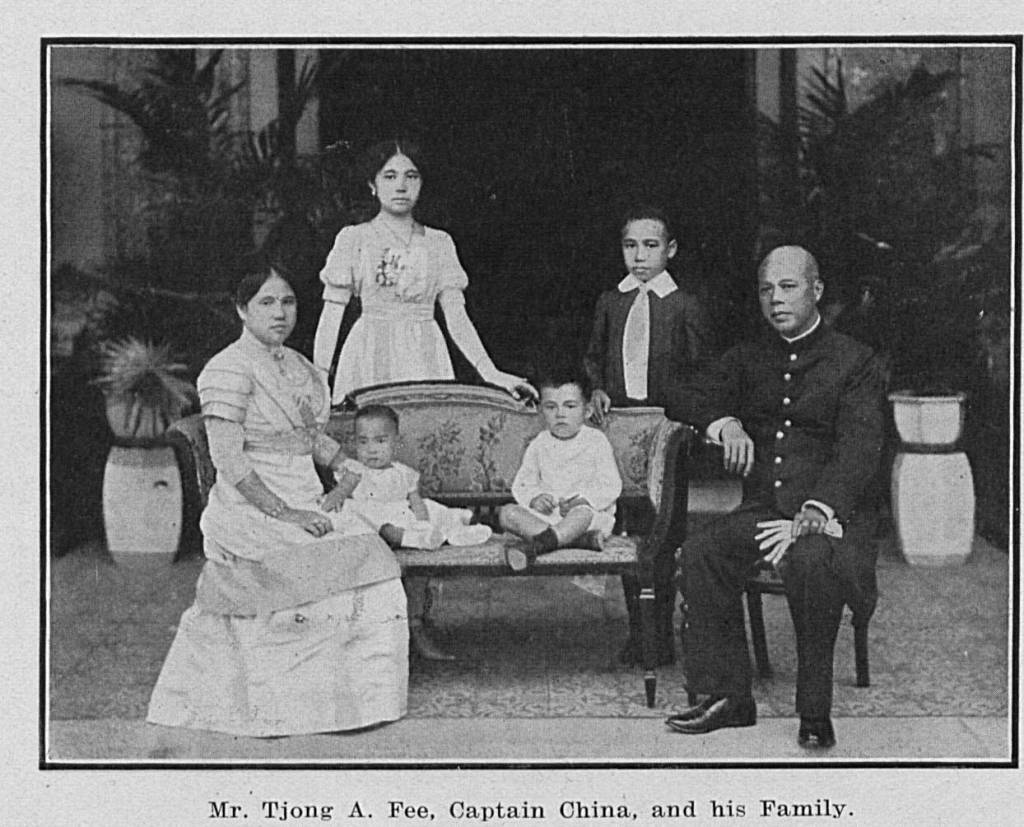
Chinese Major of Medan (Deli), Sumatra (east coast), was born at Moy Hian, Canton, and that name he chiefly uses in this country. In China, however, he is known as Tjong Jiauw Hian, whilst his name in Chinese Government circles is Tjong Foeng Nam. During his childhood he was very studious, but his parents were old, and they could hardly support him in his school-days. During this childhood, his father had a small trading business in China, and with his brother, the late Major Tjong Jong Hian, the boy began business life by assisting his aged parent, the business flourishing. But Tjong A Fie was not content; his desire was to go abroad, and, together with his brother, he sailed for Deli, Sumatra.
He left his village to join his brother to Deli via Penang. At Laboehan Deli, they established themselves, with a kedeh under the name Ban Yoen Tjong. Business went well, a lot of money was made. He lived in harmony with others, expecially trhe Europeans and Malays. He befriended Sultan of Deli, Maamoen Al Rasjid Perkasa Alam Sjah and Toenkoe Radja Moeda Deli. The Malay sultan had great confidence in him and had the greatest respect for him.
This country being often disturbed by workers from Dutch firms who were mostly vagabonds from Kouangtong and Foukien. The Dutch authorities suffered and were unable to face their quarrels which sometimes bloody brawls. Hearing about Hong-nan and Yu-nan, the Dutch authorities turned to them and attributed to them both the title of Lieutenant with the charge of all Chinese affairs of Labuhan and Medan.
On November 4, 1885, he was honoured with the Lieutenancy Titulair of the Chinese community of Laboehan. On June 7, 1886, the Government made him chief of the Chinese of Laboean Deli. He subdued many feuds between troublous Chinese sects.
In 1886, the Dutch make Medan a capital city and Tjong A Fie settled permanently in Medan, then still a small town. At that time, many riots took place in Medan itself as well as in the surrounding businesses. He then went there in the company of the Controller in order to restore peace. At that time. here was no Chinese temple in Medan, the Chinese residents were mostly superstitious and therefore duped evildoers. The slightest misunderstanding was enough to provoke a bloody quarrel. To prevent all these quarrels and brawls, Hong-nan and his brother established a temple in honor of Kouan-ti at Klingenstraat, in place of the evil gods who did wrong to the ignorant population. This initiative was for something to the improvement of manners and customs of the country. The brother built another temple at Poelau Brayan.
Whenever one had to carry out excavation and construction of the railway people often came across skeletons of a Chinese. It was Tjong A Fie who designated a place in Poeloe Brayan for this purpose. He founded an Association which aim was to maintain the cemetery there. He also built a hospital for the poor of Medan.
In his own country, Tjong A Fie did a lot of good, among others when China he donated money for floods. As a result of his philanthropy the Government of China in 19 of conferred on him the title of Chie Hoo, and later the higher title of Taw Thai.
During the Nanking Exhibition Tjong A Fie was a member of committee, and afterwards he bought the site to build a factory on it. The Government then conferred on him the title of Sie Pin Kin Tong of the Fourth Class, and subsequently that of the Third Class, Sam Pin in Tong. While he was on
a visit to Canton his brother, Major Tjong Jong Hian, died, and as during his if: he had held
office in the Chinese Ministry, the title now fell to Tjong A Fie.
In the second year of the Chinese Republic (1913), Tjong A Fie was made an adviser of the Board of Commerce and Industry. In 1916 he was presented with a medal “Kia Wo Chang 3rd class ”, in commemoration of his services to mankind. In one of the provinces he has had — three bridges built- at Kian Foeng, Oe Sen, and Jat Kong respectively., . In Hongkong he built a hospital, helping also with funds the hospital at Canton and the Red Cross Society of Soengkau. In Hainan he built a school.
To the Malays he has given a large masjid, and funds to build other places of worship; while to the
Arabs he presented land for a burial-ground, and has caused a house of worship to be built
on it. At Petissa (Medan) he built a masjid, and another at Sipirok.
He was fair and impartial for everyone, for the Cantonese as well as for the Foukiennese. In Deli, there was a Council made up of masters of Dutch firms and responsible for taking care of all matters of interest to Chinese workers. Thanks to his experience in this matter, Hong-nan was often consulted and gave, on occasion, many useful and beneficial advice to the entire Chinese population of the port. He repatriated, at his own expense, the workers who had been hijacked by their comrades and distributed, at the end of each year, money for the poor to enable them to obtain winter clothes.
On March 24, 1893, he was made Lieutenant over the Chinese. On the Planters Committee, he is adviser to the Chinese contract coolies. In 1898 was made Chinese Capitan Titulair of Medan. On 23 April 1905, he was made Kapitein der Chineezen te Medan, while his Brother Tjong Yong Hian was the Majoor der Chineezen.
He was the founder of the Deli Bank, Medan, the Rubber Company Si Boelan, and is the President of the Chinese Chamber of Commerce, Medan.
On August 22, 1904, the Dutch Government conferred on him the small Golden Star. In 1906 he became a member of committee of the Cultuur Raad, and in 1909 a member of the Gemente Raad.
On 22 Nov 1911, he was made Chinese Major of Medan. In 1912 he was knighted with the Order of Orange Nassau or Ridder in de Orde van Oranje-Nassau.
He has given the Gemente Raad a big clock. Gifts have also been made by him to the Leper Hospital at Poelau Sitjanang, Leger des Heils Kinderhuis (Salvation Army), and Frebel School, and he donated a piece of ground for a school. He was given the honorary title of LL.D. by Hongkong University.
 Stories from Deli
Leave a comment