Deli Courant, 1935
A low coast looms in the distance. “There is Belawan,” the pilot points out. Medan already appears in the distance. We are already floating above the city. see the slender minaret of the graceful sultan’s mosque and with an elegant flight the pilot lands our loyal Fokker in Medansche airport. We say goodbye, passengers and crew, who in such a flight of 7 days, got to know and appreciate each other and the waiting friends take us on a fast ride to Medan. That welcomes us with its broad streets and orderly explanation.
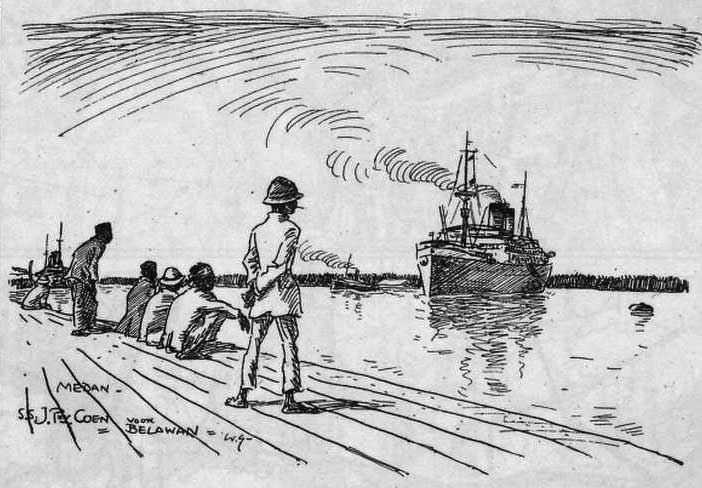
Or if you still prefer the old way of traveling, you approach Belawan with one of our modern mail ships from the Netherlands or Lloyd and we admire the labor that cleared a channel of 13 km long through the sand and mud banks of the Deli river. And who managed to create a modern ocean harbor from an unknown estuary, where ships can enter at all times to take their cargo of precious products. An express train of the Deli Railway or a fast car is already waiting for us and in half an hour we are in Medan.
This is the arrival at Deli, in the year nineteen hundred and thirty-five. Fifty years earlier. We are writing March 18, 1895. The new mail boat, the “Prins Alexander”, which, when it arrived in the East, attracted general admiration for its steam power, brought us to Riouw. There we switched to the ‘Siak’ of the Dutch Ind. Stoomboot Mpij. A small boat of 200 tons with a machine of 80 horsepower, which brought us to Laboean via Bengkalis, Siak and Asahan, almost only to get the post. Unless we came to Penang by English mail boat and made the crossing from there on the small coastal boat and sailed directly to Deli. The captain, who is an experienced sailor on these shores, waits in front of the bank at high tide , because even if our ship crosses too narrowly 5 feet, without the tide we cannot cross the coast bank. In the distance we only see the comfortless beach woods and rhizophores. Incidentally, not a single sign of life, not even kampongs, which are scanty as they are, situated higher up on the rivers to be protected from flooding. Then the coast narrows to the mouth of the river.
The Deli River and in that mouth lie a number of Malay canoes, which will take over the few passengers and the small amount of cargo and will take us further on to Laboean, the port of Deli. On the left is Belawan Island, which is home to only a few fishermen. For about an hour, the rowers toil up against the river current. Aided by the tide, which makes itself felt as far as here, and so we reach our destination. Laboean, the anchorage. This takes three hours for draining water. Deli’s port does not exactly make an uplifting impression. We see a road, it runs almost parallel to the river and some shabby Native houses, which stand with the back to the river. But we are already approaching “the new tree”, a bamboo office building of Customs covered with atap, which was erected the previous year and the construction of which was celebrated as a major event in this young country. There we step ashore, the only civil servant with a Native helper inspects the thrifty baggage, and has a particular eye for the boxes of Straits dollars which have come from Penang for the semi-monthly payments of the coolies.
Special attention is also paid to the goods of the Chinese passengers who have come from Penang, to inspect their branches in Laboean or to bring new goods, mainly consisting of the items required by the enterprises and the coolies. In the vicinity of the tree, we see the first Delian trading houses, Mr. Hüttenbach’s toko, housed in a teqcn of the insignificant atap houses, strongly contrasting stone kedeh, while Mr. Kehding already has a real office building there, even with a brick safe for books and money – because unregulated situations still exist here – with a real iron vault door, the ascent of which must have taken quite some effort.
Further on rises the old Palace of the Sultan of Deli. Tuangkoe Maarnun Alrashid Alam Shah, an atap house on stilts, set up behind a thick stone wall, while on the other side an insignificant missigit brings the believers together. The Palace is in disrepair because just at this time the sultan has decided to move his residence to kampong Kesawan, not far from kampong Medan, where the new tobacco company, the Deli Maatschappij, has established its office, in the midst of its tobacco field and the nutmeg gardens of the population. So maintenance is no longer done and the Palace shows ugly signs of decay.
Coolies have landed mail, goods and money consignments, and now we notice that the money boxes are all provided with a long rope, to which is tied a good piece of light wood, to serve as a buoy when by some unlucky person. by chance a sampan has been overturned and the money box has sunk into the mud of the river bed.
At the Post Office – the pride of Deli since 1870 when it was built – several planters and other Delians have gathered to receive their letters and other mail. They all assist the Native administrator in opening some of the mailbags which are thrown out on the floor, and he in picking out the letters intended for them from the great heap. And if they encounter letters for acquaintances while searching, they also take care of these documents, which they will forward to the addressees when they meet them or possibly by extra-looper. When these concerns have also been made, we take a walk through the camp, we see the few crooked houses of officials, the almost dilapidated “barracks” and observe that the main town of Deli is little more than a “nest of mud.” and mosquitoes ”.
Then we find shelter in the Deli-hotel, in the walk, called the Roode Aap and where the owner, Mr. Donzelaar has four rooms for the coming and going man, although on special boat days there are sometimes twice as many salvaged. The planters present have settled on the lawn in front of the hotel and enjoy beer, which costs a “ringgit”, a Straitsdollar, the bottle and which is practically the only drink which is sold here. When paying, we also see that various types of company coins are also used as small money in addition to the dollars. We also hear that Laboean is in the process of losing its significance because they recognize the advantage of moving to Medan, which has been on the rise since the Deli Company, which was founded on November 1, 1869 and has developed rapidly, established its office building and center.
We follow this stream of travelers and goods to Medan, after spending the night in warm Labuan. We have to get out early because it is a long journey and especially in this rainy season we can expect difficulties. Some planters have already climbed on their kitty mountain horses, which they bought from the Bataks or exchanged for salt and powder, and have preceded us. The goods are loaded in oxcarts, which are pulled through heavy and unwieldy buffalo, and on which also a few Javanese coolies for the companies find a place. Because it was precisely in the last year that the planters started to bring over Javanese coolies from distant Java as well as Chinese coolies van den Overwal as a test.
Finally the procession sets in motion, and soon we see with our own eyes that the stories about ox carts disappeared in mud and pits can hardly be exaggerated. Repeatedly the carters have to help each other to pull their wagons from the deep holes of the road, and many times fear creeps over us. That we will get stuck on the way. We now also understand that the ladies are transported in the rainy season in sedans, which are carried by about 12 coolies or punished persons, when the assistant resident or inspector has made them available for a high citizen. The trip lasts for hours. We pass some poor kampongs, where few people school together. The road or what continues before it runs for the most part through forest, where meranti and damar laoet alternate. In between lie here and there the scant ladangs on which the padi grows and pepper nutmeg gardens, separated by clappers and fruit trees.
The land looks fertile, but it is not much more than a wilderness. At Mertoeboeng, we see the first establishment of the tobacco planters and their barns, in which tobacco is now being prepared for the European market.
Then, after six hours, we reach Medan. At the confluence of the Deli and Babura rivers, Mr. Nienhuijs has chosen the new field’s location. Where the Deli River makes a great bend, Medan Poetri (Princess’ Square) can be located on the site of an old Maïe fort. It was surrounded by an earthen wall and which is being excavated to create an old watercourse through what will later become the driveway. The Administration’s wooden office building is covered with atap, while the floors consist of niboengg slats. When one enters, the whole office building shakes on its stone. Next to this is the administrator’s house and a small hospital, at the head of which a doctor, who also finds his home here. However, we will not enter this time, because we must try to find shelter.
For a few years now, Mr. Vink has opened a very modest Hotel-Medan (the later Grand Hotel Medan) which we soon find opposite a tobacco plantation of the company Medan, around which the new Medan is starting to build. On our way there, we passed another house of the Deli Maatschappij (where Hotel de Boer is currently being built) and next to it (where the Javasche Bank and City Hall are now located) the atap sheds, which represent the barracks, is the garrison of Deli.
On the way to the hotel, we pass the new shopping street, called the Kesawan, on our right and turn left on our way to our hotel. As much as that long row of wooden shop houses, kedehs and cap tax attract us, new as they look. And the first of these is the kedeh of Seng Hap, the largest and best supplied, where the European inhabitants of Medan stock up on their foodstuffs, their drinks, lamps, and other necessities. Several European affairs had already begun to follow this example. Full of hope for the future which will make Medan the capital, now that an associate resident and a controller had been placed there. It was even said that in the future, Medan will replace Siak and become the resident’s seat. It is true that these civil servants lived only in atap houses borrowed from the sultan. The pessimists still feared that no definitive settlement would be decided upon, but the optimists thought quite differently.
After all, the Deli Spoorweg Maatschappij had been founded and was busy with the construction of its first section, for which resident Michielsen had put the first spade in the ground on 1 October 1883. The construction was not easy, and it was said that for the construction to the coast as many workers as troublemakers were needed, but they had confidence in the private initiative and even if the Government could withdraw the Administration, the rail track – once constructed – would remain. . The planters would take care of that. So we look, with confidence, into the future of the country.
The Hotel-Medan, which is brand new. Until this establishment, visitors or newcomers depended on the hospitality of the administrator of the Deli Maatschappij and his wife, who gladly gave it. Young people applying for a position, the sick, inspecting officials who occasionally came over from Bengkalis and occasionally from Java, all found shelter in the spacious house. But lately, that visit had grown so much that it became a burden, and a hotel had become indescribably necessary. We hit it; our boat had brought fresh bread from Penang, and there was some fresh meat, for in the encampment, the soldiers had been slaughtered that day, and then civil Deli also enjoyed the feast, alternating with the chickens or on the hunt. shot pork and the variety of a tasty venison leg. For the gourmets, sate of bear meat was occasionally served at the rice table.
By the way, there was plenty of game, sometimes even too much. Many a resident of Medan had heard the elephants in the distance trumpets in his house at night, and tigers even made occasional visits in the streets of the young city. As newcomers at the rice table, we were told in colors and scents that one of the residents of the Camp, when he returned home from the club in the evening, always carried a goat along with his lantern. The lantern to keep the unlit roads and the goat to divert an attack from the tiger. When the soon-to-be founder of the Deli newspaper in this environment and this environment for the first time mentioned his firm intentions to found a printing company and a newspaper in this new place, the hilarity must have been general. Such a good joke had not been heard in a long time.
But the surroundings did not deter him, and from that small beginning could grow a great place, a center of a prosperous and industrious area. That is why he went ahead with his plans and after a few months arose on the dirt road, which is now Hüttenbachstraat. a wooden shed in which the machines and other necessities were set up and in which the first issue of the Deli Courant was born on Wednesday March 18, 1885. Using a second-hand printing press, in a number of 150 pieces. Not deterred by the sight that Deli and Medan gave him. That was 50 years ago.
 Stories from Deli
Leave a comment