HANDEL MAATSCHAPPIJ HUTTENBACH & CO.
The progressive colonization of Sumatra by the Dutch greatly expanded the markets for European goods handled. German firms found a niche in the Dutch East Indies trade.
The firm Handel Maatschapplj Huttenbach & Co. was established in 1875 in Labuhan Deli. It became the oldest European business organization on the Sumatran east coast.

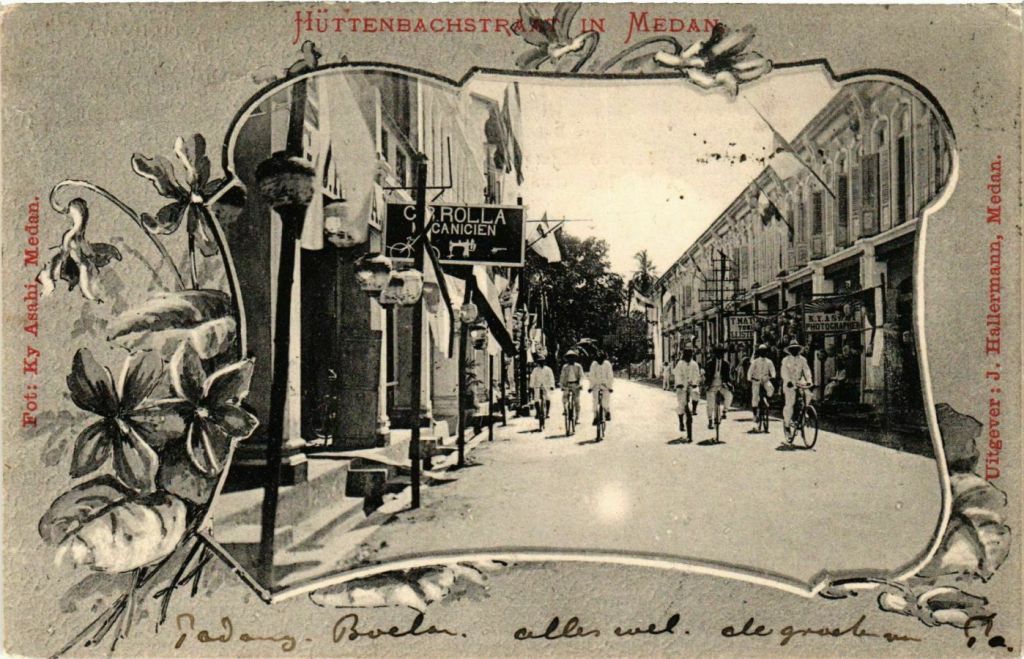
It had its headquarters in Medan. where one of the thoroughfares was named ‘Huttenbach Street’.
The Hüttenbach Brothers came from a well-known Jewish merchant family in Worm
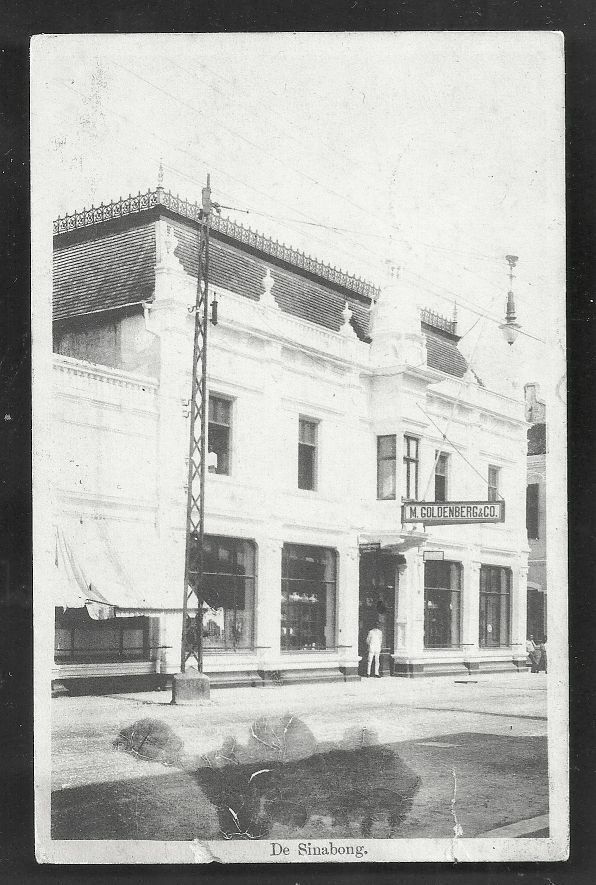
Jewish firm Goldenberg & Zeitlin started out In Medan in 1898 and then went into business In Penang in 1903 by acquiring shares in an existing Penang based import firm.
Huttenbach has its headquarters in Sumatra at Medan, and is represented at Amsterdam, Holland, at 88 Rokin, and in London by Huttenbach & Co., of 4 Fenchurch Avenue, E.C. The firm acts as general wholesale merchants, and was established in 1875, being the oldest European business organization on the east coast of the island. The chief director is Mr. H. Huttenbach, who are agents for in Amsterdam, while the manager at Medan is Mr. Ruurd J. de Jong.
The agencies which the company holds are as follows: Royal Insurance Company, Liverpool; Northern Assurance Company, London; van Heek & Co., Enschedé, the largest exporters of Holland; G. J. van Heek and Zonen, Enschede; Burgers E.N.R. Works, Deventer, bicycles; Netherlands Distilleries, Rotterdam; Heinekens Bierbrouwery Maatschappij, Rotterdam; N. W. van Os, Amsterdam, tobacco; Koler and Ankersmit, Deventer, provisions; Cadbury Bros., Bournville, cocoa, Geo. G. Sandeman Sons & Co., London, wines; Ford Motor Company, Ltd.; John Haig & Co., Ltd., Glasgow, whisky; Guinness’ stout, “Bear” brand; Gramophone Company, Ltd., London; the Continental Bodega Company, Ltd., wine; John Leckie & Co., Walsall, saddles; Ardath, Tobacco Company, Ltd., London; the Salonica Cigarette Company, Alexandria; Mesmaekers Frères, Turnhout, playing cards; Burroughs and Watts, London, billiard tables, etc.; Ch. Southwell & Co., London, provisions; A. Frederich, Arnheim; B. v.d. Tak & Co., Rotterdam, cigars; Konink- lijke Tabak and Sigarenfabriek N. O. Estoppeij & Co., Utrecht; Koninklijke Utrechtsche Sigarenfabriek H. G. and M. A. Hagen, Utrecht; Crown Perfumery Company, London and Paris; Empire Company, London, etc.
The Medan premises cover about 20,000 square feet.

From their foundation they have endeavoured to supply the general requirements of the Government, and of the planting and industrial communities, and as the country has been gradually developed their interests have been continually increasing. Now their premises in Medan form an imposing emporium containing merchandise of every conceivable description, where large transactions, both wholesale and retail, are effected. There are departments for general merchandise, machinery, tools, motors, elec trical goods, harness, saddlery, guns, and ammunition, mechanical watchmaking, and tailoring. The firm are also agents for some of the most prominent trading, insurance, and manufacturing concerns in Europe and the East, and have at various intervals established extensive tobacco plantations in Langkat and Serdang, to convert them after wards into flourishing companies. It will thus be seen that their enterprise is by no means confined to any one branch of com mercial activity. The managing director of the Company. Mr. Heinrich Huttcnhach, has had some thirty years’ experience of the East, and is well known as a planter and merchant both in Sumatra and the Straits Settlements. Mr. A. Pedersen, who holds the position of general manager to the Company, was formerly administrator of the Kwaloe Asahan Tobacco Company and the Paya Jambu Estates Company of Langkat. The firm have a high reputation, both with the general public and among their employes. Their continued prosperity is a sufficient testimony of the one, while the long records of service which many members of the staff can show are conclusive evidence of the other. The chief Chinese clerk has beeni-with the Company for over thirty years.
The business is managed as a distinct enterprise from the retail store, which operates under the title of Medan’s Warenhuis, t/v Handel Huttenbach & Co. The firm deals annually with imports worth F. 1,200,000, and its policy is to extend its influence all through Sumatra.
Medan’s Warenhuis tot voorzetting van den Detailhandel Hüttenbach & Co. was established in 1916 with I. Cornfield as director.
The new Warenhuis is being built in 1919.

Heinrich Hüttenbach was born in Worms in 1859. Not much is known about him except that he moved to the Netherlands East Indies as a planter around 1876. He returned to Worms for a short time in 1885 when the first edition of his teaching book was published. It saw another four editions, extensively revised and enlarged. At some time before 1906 he had established himself as a merchant in Deli, Sumatra. He became a naturalized Dutch citizen in 1908 and died in Medan in April 1922 shortly after his company went bankrupt in January 1922.
Hüttenbach’s second edition was very much enlarged and was not published in Germany,
but in Medan, 26 years after his first introduction of Malay was finished in 1883 (Hütten-
bach 1885, 1909). A third revised edition was published in 1921, again in Medan.
Hüttenbach, Heinrich (1885), Anleitung zur Erlernung des Malayischen zum Studium während der Reise nach Ost-Indien, Worms: H. Kräuter ‘sehe Buchhandlung.
Hüttenbach, Heinrich. Anleitung zur Erlernung der Malayischen Sprache, new and rev. edn, Medan-Deli: J. Hallermann [revised editions: 1917 and 1921].
Trade Company v. H. Huttenbach & Co.
The management of the aforementioned company has sent the following to chilling Dutch newspapers.
As a result of the information published by “Aneta” and provided to her by the management of the Nederlandsch-Indische Escompto Maatschappij, we are obliged to state that this information is not accurate. Our company has not itself filed for bankruptcy, but this was done by creditors who had sent their goods to our firm on consignment for more than 20 years and now could not obtain the proceeds belonging to them, as the Dutch East Indies Escompto Mij did not permit our representative in the Indies, this money to them. The bankruptcy of our company was inevitable as the Nederlandsch Indische Escompto Maatschappij did not allow our representative in the Dutch East Indies to send money to our Amsterdam office and it was impossible for the Amsterdam office to continue to make payments indefinitely without even part of the great sums of money already advanced for many months, was refunded. “If the Nederlandsch Indische E-compto Maatschappij had only allowed to transfer the funds received during a single month, our company would not have had to go bankrupt. And if our company had not been forced into bankruptcy and had only been allowed to do so for some time. to meet its obligations, no creditor or shareholder would have had to lose a single cent.
The Debacle of Trade Me. v./h. Huttenbach & Co. is largely due to the fact that our firm in India – like so many other Indian firms – had purchased large quantities of goods which had fallen well below the invoice value at the time of delivery, and to the fact that we were working with bank credits, which were withdrawn from us at the moment when we needed them. The editor of the “Telegraaf” turned to the Nederlandsch Indische Escompto Maatschappij, which stated the following: that the debacle at Handelmaatschappij v./h. Huttenbach & Co. must be regarded as the result of bad management, especially during the In recent years successive representatives in Medan, even outside the management in Amsterdam, placed improper large orders, so that not only large write-offs on stocks became necessary, but continued depreciation and proven unsaleability of the goods ultimately resulted in the claim der Nederlandsch Indische Escompto Maatschappij was insufficiently covered, so that the credit had to be canceled.
 Stories from Deli
Leave a comment