Rewritten from The Sydney Morning Herald 11 Jun 1938

Professor Pieter Vincent van Stein Callenfels, the eminent Dutch anthropologist and preeminent authority on the prehistory of Southeast Asia, was a figure as renowned for his scholarly contributions as for his larger-than-life persona. Known across the “Far East”—including the Netherlands Indies, Malaya, the Philippine Islands, Siam, French Indochina, and Hong Kong.
Standing at six feet four inches (1.9 m) tall and weighing over 20 stone (127 kg), Callenfels was instantly recognizable with his towering stature, bushy beard, and booming voice. His capacity for humor, irreverent wit, and a remarkable tolerance for whisky drinking were as well-known as his academic achievements. It is said that he could outdrink anyone in the region, adding to the many stories that surrounded him.
Professor Callenfels is widely believed to have inspired Sir Arthur Conan Doyle’s character, Professor Challenger, the protagonist of The Lost World. Doyle reportedly met Callenfels in Kuala Lumpur around thirty years ago and immortalized him as the brilliant yet eccentric scientist who discovers a hidden world deep in Central America. The fictional Professor Challenger’s imposing figure, indomitable spirit, and penchant for confrontation were all modeled on the real-life Callenfels, leaving little doubt as to the identity of the man behind the pen-and-ink figure.
A Scholar and a “Character”
As famous for his scientific achievements as he was for his humor, Callenfels’s wit was legendary across Southeast Asia. During a census in Java, when asked, “How many children do you have?” he replied, “Since I arrived in Java at the beginning of this century, the population has increased by 15 million.”
His early days in the Dutch colonial civil service were filled with such episodes. Tasked with overseeing government coffee plantations, he found himself struggling to protect the crops from marauding monkeys. After receiving a stern letter from his superior demanding to know how he was handling the problem, he responded: “Sir, I have the honor to report that since your visit, there have been no monkeys in the coffee plantations.”
In Bali, one of Callenfels’s most celebrated feats occurred when he sought access to ancient temples containing inscriptions in a previously unknown script. Determined to decode the inscriptions, he realized that traditional protocol would prevent him from gaining entry to these sacred sites. With characteristic audacity, he convinced a high priest to adopt him through a ceremonial mixing of blood, thus becoming an honorary member of the priest’s family. This unique status granted him access to the otherwise forbidden inner sanctums, where he was able to study and eventually decipher the inscriptions. His findings shed light on early Balinese land tenure systems, significantly contributing to the understanding of the island’s ancient history.
A Legacy of Discovery
Professor Callenfels’s contributions to Southeast Asian prehistory are unparalleled. Over a distinguished 35-year career, he served as Director of the Archaeological Department of the Netherlands Indies, conducting extensive excavations that revealed the region’s deep and complex past. One of his most significant discoveries was in the shell mounds on the border of Province Wellesley and the Kuala Muda district of Kedah, where he uncovered evidence of a Melanesoid civilization that thrived around 4000 BCE. He found bones, tools, and other artifacts embedded in the shell deposits, providing a window into the lives of the Melanesoid people who were the precursors of the present-day South Seas Melanesian race.
Despite his scholarly rigor, Callenfels was a man who could engage and inspire both the academic community and the general public. When he arrived in Malaya after retiring from the Netherlands Indies service, he found that many educated residents were unaware that their land even had a Stone Age past. Through his dynamic public lectures and personal charisma, he ignited a newfound interest in the region’s history. His lecture on the Java ape-man in Singapore was hailed as one of the most brilliant expositions of a complex scientific subject ever delivered in the region.
“Twenty-four Stone of Solid Science”
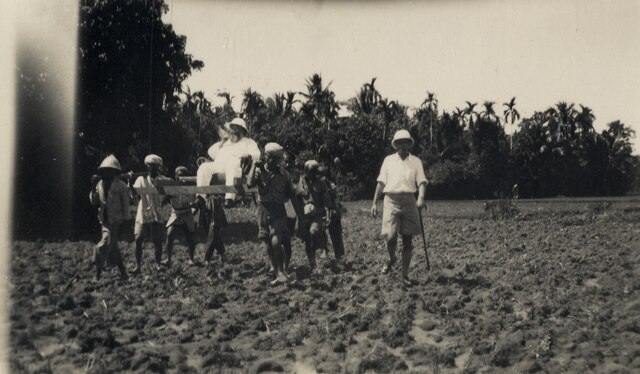
When Callenfels attended the Congress of Far East Prehistorians in Singapore, his ship’s bunk had to be specially widened and reinforced to accommodate his massive frame. A London newspaper once dubbed him “Twenty-four Stone of Solid Science”—a testament not only to his physical presence but also to his intellectual heft.
His success in the field stemmed not just from his academic prowess but from his ability to bridge cultural gaps. He could enlist the cooperation of local communities, earning their trust and navigating sensitive situations with tact and fairness. His motto, “Examine all things but hold fast to that which is true,” guided his work, as he often revised his interpretations when confronted with new evidence.
Professor Pieter van Stein Callenfels died in Colombo in 1938.
 Stories from Deli
Leave a comment