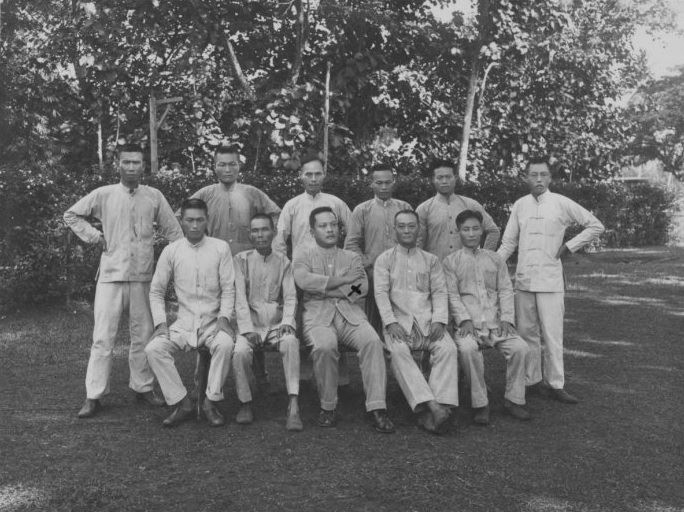
It seldom happened that the chief tandil, Lim Ang Kau, spoke of how, as a young man of about twenty, he had been picked up in a drunken stupor at Swatow, brought on board with a load of fellow sufferers, and taken to Deli. Not that he was ashamed that he too had started as a kongsikang, as one of the hundred thousand Chinese coolies who had since been brought from their land to the hot tobacco fields, where hard labor and meager wages awaited them. But it was not custom for a conversation with the Europeans to extend to the private affairs of any Eastern worker. These only had orders to receive and that was the end of it, and so there was always a great distance between ‘East and West’. But once in a while it happened,
In the first years of the rise of the Delian cultures, the recruitment of coolers was not so close. A steady stream of new labor was needed for the reclamations, which promised a rich harvest, and the native Malays from the beginning did not feel like going to work. In China there was an inexhaustible supply of human material, and so the only solution to the workers’ question was to get the necessary coolies from there in any way. In later years official recruiting offices were established and recruitment was under the supervision of the authorities, but in the past the recruiters ran deep into China and picked up every man whom they could might with beautiful promises, or with cunning, sometimes by force. turn into.
That is how Lim Ang Kau had fallen into a trap. He had enjoyed a decent education, could read and write well, but in the great port city of Swatow he had descended to the guild of harbor vultures, which made a living with a trade, a burglary and a false guess. One evening he had celebrated the success of a “transaction” in one of the many harbor bars and had become so drunk there that he had been unable to find his sleeping table and fell unconscious on a bench by the harbor. When, after who knows how many hours after his intoxication, he had slept off, he found himself on board a steamship in the high seas. They sat in the hold with several hundred fellow sufferers and there was no chance that they could come on deck. Where they went no one knew because the word ‘Deli’,
The rebellious tempers were noticeably calmed during the voyage by the good food on board, the generously supplied opium and the prospect of adventure in the foreign land that was the purpose of the voyage. The few dollars in advance, which had received Zig, had soon changed hands several times, for to dispel the boredom the tjentings, the keepers, had immediately set up a play-bench with the result that at the end of the journey the entire capital of ‘the cargo’ had ended up in the pockets of those bankers.
So Lim Ang Kau arrived in Belawan with no possessions other than the pants and jacket, which he wore on his bare body. They were registered as best as possible in a shed on the quay and then transported to the tobacco company. They had already reconciled themselves to their lot for the time being; the country where they had ended up did not look bad and they noticed that there were many race mates walking around, who apparently lacked nothing, so that they did not worry about the future … In their own country they generally spoke also had a bad time. After a short train journey and a long march in the tropical heat, they arrived at the company’s office and squatted in anticipation of things to come.
A heavy, well-fed fellow countryman in an immaculate white suit and with a beautiful hair tail, shouted to them in a loud voice that they had been recruited for field labor and that, after their names were called, they should come forward and put a cross on a piece of paper, after which they would receive another advance on their wages. They therefore committed themselves for three years and were given a free home, but what else was stated in that contract was not disclosed. In the office before the open window sat a taukeh, a European, holding the pen holder, and they had nothing to do but touch the top of that pen holder while taukeh put the cross after their names. On the table were also the piles of dollars from the advance, but when a contractor held up his hand to receive it, his fingers were slapped and he was shouted to understand, that the main toothil would first buy the necessary things they needed for that money, and that they would get the remainder later.
So they started their careers with a heavy debt and without any possessions. Lim Ang Kau had taken it easy for a moment and thought his own way. He himself was an expert in stealing their money from others, and he was by no means a stupid field worker like most of his fellow sufferers. So when his name was called to sign the collective contract, he protested excitedly with the vocabulary of the crafty harbor vulture that he was, but strong arms took hold of him, brought his hand to the fatal penholder and when he touched it for a moment , the taukeh quickly put the cross and Lim Ang Kau was also a contract coolie for three years. He grabbed the pile of dollars in his advance at lightning speed, but a treacherous punch in the stomach area from one of the chentings made him cringe in pain, and his dollars disappeared into the money pouch of the main toothil. He was roared with the necessary ‘Pfoe-nia-bob’s’ that for that money his mosquito net * and tikar ** and tools would be bought, as well as the food until the next payment of wages, but Lim Ang Kau was sufficiently informed of that ‘box’ to calculate that there was still a lot left, of which he would never see a cent. He understood that he was hot with it and was determined to get off it as soon as possible. He was not a farm laborer, and the work that awaited him was not only entirely strange to him, but also thought it very inferior.
At the end of the ceremony, the new contractors went to a shed, where they were given plenty to eat and where their sleeping tables were ready with new mosquito nets and tikars: at least that was all right. Lim Ang Kau once thoroughly explored his new environment and it was not disappointing. Tall palms lined a well-tended road, with a few Europeans’ houses here and there. Furthermore, many sheds for the workforce and a Chinese shop, where everything was available that a Chinese would want. There was heavy traffic on the road; Hundreds of race mates walked back and forth and countless Javanese, Klingaleese and other Easterners, including many women, so that Lim Ang Kau came to the conclusion that he had not ended up so badly and that he saw a good chance of a good life in this country. to create, if only he hadn’t been bound. But as long as he was a contract coolie, there seemed little chance of exercising his old practices.
The next morning, before sunrise, he sat with the other singkehs , all equipped with a parang, a machete, at the roll call and they left under the guidance of a tandil. To a complex young forest that had to be cut down. This tandil, Oei Tong Hok, was one of the old school, who at the slightest neglect of his coolies grabbed them by the hair tail and hammered it with his rattan stick; Lim Ang Kau soon became acquainted with this educational system. He had never seen, let alone cleared, young wood in Swatow, and after a few hours he felt himself collapsing. Merciless and ever more fierce, the tropical sun burned on his bare upper body, which, unaccustomed to this radiation, started to hurt him unbearably. ‘His mates, for the most part, accustomed to heavy field labor, did this work with ease and their distant bodies also tolerated the heat, but bar clerks far away Lim Ang Kau almost fell down and he became more and more convinced of it. , that it was necessary to end it. But in this strange land, where he knew no one and did not know the way, great risks were involved in flight.
In the afternoon, a Chinese hair shaver joined the singkehs plow to strip their heads around the hairtail of the stubble, and Ang Kau suddenly saw a possibility in connection with his escape plans. When it was his turn, he sat on the wooden tripod under the pajong, wiped the sweat from his face with his loincloth and while the hair-shaver wiped his head. wet, wet, and ran the short razor over his head, he began to ask indifferently what kind of a countryman he was. Also a Swatower, that was good, and after singing the praises of that good city together, he cautiously brought the conversation to the possibility of a flight to a city where he might lead an existence more in tune with his nature and gifts. If the shaving boss could help him in this, he would reward him generously as soon as he was able to do so. The latter listened to this and pointed out to him that that evening he had to come to a certain side road, where he would then meet a fellow countryman who would take him further to the city. Many Swatowers lived there, with whom he could hide if the tjentings, the henchmen of the main tandil, sought him. Both sides assured each other in the usual manner of duty that they would keep their promises, and relieved, Lim Ang Kau took his place among the forest cutters.
That hair-shearer, he remembered, had been a messenger to the good gods, and he resolved, out of gratitude, to burn the necessary incense sticks in their honor upon the house altar of his future host, as soon as he was in the city. Surely a guy like him was destined for something more than just working up a sweat day in, day out as an ordinary stupid coolie for a pay barely big enough not to starve. He became more and more convinced that this drunkenness in Swatov, and all that had resulted from it, was the work of his guardian spirit; a rich future awaited him in this country: a large house 67 with many servants, silk robes, and plenty of food and drink with little work! But then he had to get out of this hot hell and this stupid work to the big city as soon as possible, where he would soon find his victims. Exhausted, he stumbled back to the kocheloods that evening, poured copious amounts of cold water over his sun-glowing body, and stretched out on his sleeping table, unable to cook his rice pot for the moment, as his fellows were now doing.
The sharp smoke of burning wood beneath the rice pots mingled with the fumes of the sweaty bodies of the men, so that soon the shed was unbearable, and Ang Kau decided to go out exploring now that he had some story to tell. had come. Everyone was busy now, and no one would notice his departure. When he got to the conscious side road, he would hide there and then wait calmly for his liberator to show up. He had no luggage, so that nothing hindered his movements and they would not grab him by the collar. He knew those tricks! So he sauntered out the door of the coolie shed and walked as inconspicuously as possible in the direction indicated. Tropical night had already fallen, and he could barely distinguish the narrow strip of sky above the road from the tall trees on either side. Inaudible on his bare feet and invisible in the darkness, he walked cautiously on, each time startled by strange noises coming from the forest. The harbor vulture Lim Ang Kau was here in a completely unknown territory to him, and every time he stopped with a pounding heart when the tree branches creaked or mysterious snorts hit his ear. He became aware that anything could happen to him in this cursed forest where tigers or elephants would live and that was something he hadn’t counted on.
He almost died when some wild pigs rushed across the road just behind him and disappeared into the forest edge again with a loud clamor, and he was already considering breaking off this dangerous journey and returning to the safe coolie shed. But he could not go back: his guardian spirit had shown him this way to get to the place where his office was, and he also feared the revenge of his helpers if he did not keep his word. He had been on the road for an hour when the forest ended and gave way to open field, where it was slightly lighter, so that he could better distinguish the surroundings and, looking closely at the conscious side road, which could not be far now anyway, far he steps. Suddenly a figure emerged from the lalang along the road and asked him his name … expecting nothing but that this was the shaving boss’s helper, he replied: Lim Ang Kau, but before he could handle it
To add, he felt himself pounced from behind, while the man standing before him gave him a terrible stomach thrust, so that he collapsed defenseless. His hands were tied behind his back, and he was hardly aware that he was being set on his feet and forced to retreat under a deluge of curses and punches. His attackers asked him if he was crazy enough to think you could just walk away from here? The head-toothed had immediately noticed what kind of guy he was, because of the big mouth he had put on, when he had to sign the contract and Oei Tjong Hok had already reported that he was very reluctant in the work. So it was to be expected that he would attempt an escape, and it was a small trick to prevent him, as he had now noticed. He had now come off mercifully, but next time, they would break his ribs … With numerous bruises and a bloody nose, Lim Ang Kau arrived at the house of the main tandil, where he was locked up in a pen of the outbuildings. He was detained there for three days, during which time the head mandil took him over again, personally and assured him that another attempt to escape would kill him. In the silent darkness of his prison, Lim Ang Kau had plenty of time to see, that there was a great risk in trying to regain his freedom in this way. He considered that the three years for which he had committed himself were not eternity after all, and that after that he would still be completely free. There might also be an opportunity here at the company to practice his familiar trades and gambling, which would save him some money, and that could be very useful for the big business he wanted to do in the future. He could learn the hard work in the fields, and that was always better than being beaten to death, because he had now found that they dared to get involved here.
With the intention of complying with his fate, he reappeared in the coolie shed, where he was beaten again, now by his tandil Oei Tjong Hok, who thus took revenge for the fact that he had been fined five dollars because Lim Ang Kau had wanted to pass away. Surely Ang Kau would have to pay those five dollars, plus interest on interest! Thus the first week of his sojourn in that foreign land was for him a series of humiliations and debts, and there was nothing left but to bear his fate patiently. But he would withhold the incense sticks for his guardian spirit anyway until there was more cause for gratitude … In the course of time he learned to use the tools and soon he was no longer inferior in his work performance to his comrades, to which the rottan stick of Oei Tjong Hok had cooperated vigorously every now and then. His body became muscular and more and more resistant to the tiring work and since he also had the opportunity in the evening in the shed to give his friends some money at the game, the urge to escape became more and more in the background.
After two years, Lim Ang Kau was assigned his own tobacco field for cultivation and so he left the ranks of the inferior ‘Congicans’ and became ‘field coolie’. Because of his knowledge of Chinese writing and his great dexterity, he soon fell in favor of the tandil of his congsi, and when the three contract years were up, he even signed up without hesitation. In the years that followed he by no means became one of the best field coolies. Numerous times, the assistants had to crack down on him in order to punish offenses, as was customary at the time, and it was not because of his achievements in the fields that Lim Ang Kau had attracted the attention of his employers. But by his unparalleled dexterity and his “cheeky mouth” against his comrades, he had soon gained a certain preponderance over them, which stood out. With his decent schooling and early life in Swatow, he felt far above the other coolies, who knew and knew nothing but the hard day-to-day work in the fields, which he still considered inferior. He knew from experience that there were other and easier ways to earn a living, but he stayed where he was, because in this environment, he saw an opportunity to work his way up higher. He did not miss an opportunity to come to the fore.
In dry barn fires, it was Lim Ang Kau, who first sat on top of the burning roof and fired up the other coolies to help extinguish or bring the precious product from the drying barn to safety. When the river that flowed through the enterprise bandaged and heavy logs were carried with the enormous bodies of water and accumulated against the pillars of the wooden bridge, so that it was in danger of collapsing at any moment, Lim Ang Kau was among the first to reach axes and saws kept an opening for the wild current to flow away. Then he toiled, sometimes up to his neck in the water, considering no danger, until the impending disaster was over and hundreds of coolies followed suit. In the fermentation shed, where the whole enterprise’s crop had been stacked in bundles of dry tobacco leaves to ferment, and then sorted, he sat first in the rows of the bundlers, but soon made it to sorter. In fact, he became so good a sorter that, after a few campaigns, he ended up in the ‘reception room’, where the sorted tobacco was brought from each sorter to be checked, and ‘received’ or rejected. Then when he was given a batch of less well-sorted bundles to judge, he could express his disapproving opinion to the sorter squatting in front of him in a way that often compelled the “receiving assistant” to admonish him to shut up
When after many years a place became available as a tandil, as a superintendent, the company administrator did not hesitate to appoint Lim Ang Kau for it. That was a very big leap to the intended goal! Now the heavy fieldwork was over; he had to make it work now and he could! He always used his rattan-stick or his mind at the right time, and related the reprimands he still got from the touans in his way to those who caused them. Until another company of the same partnership required a head tandil and Lim Ang Kau was summoned to the head office to be put to the test as one of the candidates. In his best outfit, black silk wide trousers and a snow-white jacket, the head adorned with a real planter’s hat, including the long, shiny hairtail came out extra carefully braided, he set off. Now there was a chance that his childhood dream would come true; a large house with many servants, silk robes, much money, much food and drink; a private buggy with a fiery Batakker go and come as he wanted. He knew that he was full-ahead, and made all the demands that could be made of a head-tooth; he was knowledgeable in all the intricacies of the culture and tobacco processing. He had an established predominance over his race mates and spoke many dialects of their great homeland.
Most of all, he was fully aware of all the coolies’ secret tricks and nastiness, so that they might deceive him of no sense. And he also knew the ways, that a head tandil walked in order to obtain much money, that lp was needed to keep his state up. But he wouldn’t talk about that to headquarters! After a long and rigorous interrogation, during which he heard many exhortations and wise words, he was indeed heard and thus the ex-harbor vulture of Swatow, who had literally been taken from the quay and kidnapped, involved the great head as the powerful intermediary between the European dental house, leadership and the thousand Chinese coolies of the company. He set up a precious house altar for his tutelary deity, and there were never missing the smoking incense sticks in honor of that god who had led him to the place where he was now esteemed. He was indeed produced, and so Swatow’s ex-harbor vulture, literally snatched from the quay and kidnapped, involved the great chief as the mighty intermediary between the European dental house, management and the thousand Chinese coolies of the enterprise. He set up a precious house altar for his tutelary deity, and the smoking incense sticks in honor of that god who had led him to the place where he was now esteemed were never missing. He was indeed produced, and so Swatow’s ex-harbor vulture, literally snatched from the quay and kidnapped, involved the great chief as the mighty intermediary between the European dental house, management and the thousand Chinese coolies of the enterprise. He set up a precious house altar for his tutelary deity, and there were never missing the smoking incense sticks in honor of that god who had led him to the place where he was now esteemed.
From H. Gorter. Tabakkers


Leave a comment